Smelting, process by which a metal is obtained, either as the element or as a simple compound, from its ore by heating beyond the melting point, ordinarily in the presence of oxidizing agents, such as air, or reducing agents, such as coke. The first metal to be smelted in the ancient Middle East was probably copper (by 5000 BCE), followed by tin, lead, and silver. To achieve the high temperatures required for smelting, furnaces with forced-air draft were developed; for iron, temperatures even higher were required. Smelting thus represented a major technological achievement. Charcoal was the universal fuel until coke was introduced in 18th-century England. Meanwhile, the blast furnace had achieved a high state of development.
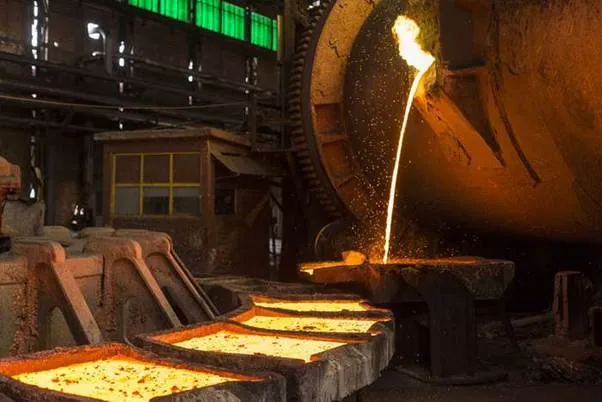
molten copperMolten copper being made into plates.
In modern ore treatment, various preliminary steps are usually carried out before smelting in order to concentrate the metal ore as much as possible. In the smelting process a metal that is combined with oxygen—for example, iron oxide—is heated to a high temperature, and the oxide is caused to combine with the carbon in the fuel, escaping as carbon monoxide or carbon dioxide. Other impurities, collectively called gangue, are removed by adding a flux with which they combine to form a slag.
In modern copper smelting, a reverberatory furnace is used. Concentrated ore and a flux, commonly limestone, are charged into the top, and molten matte—a compound of copper, iron, and sulfur—and slag are drawn out at the bottom. A second heat treatment, in another (converter) furnace, is necessary to remove the iron from the matte.