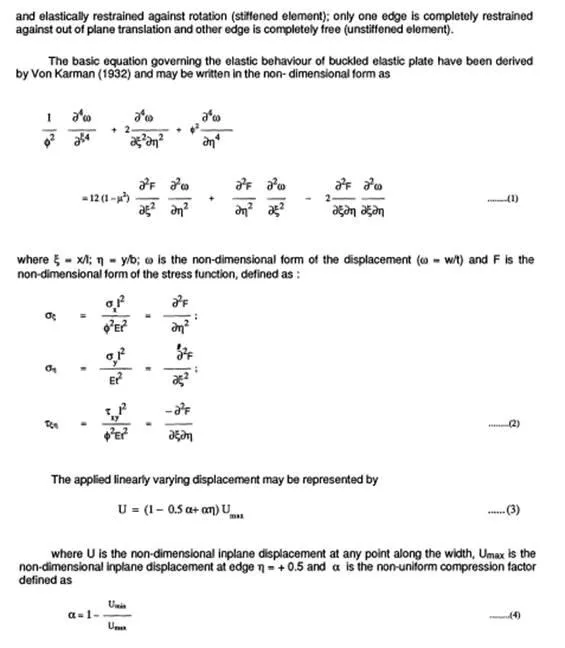
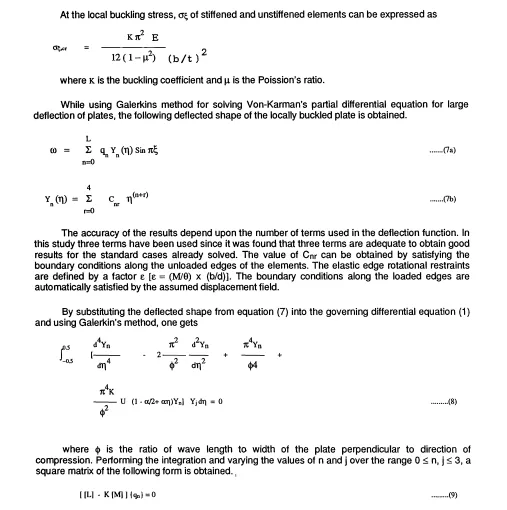
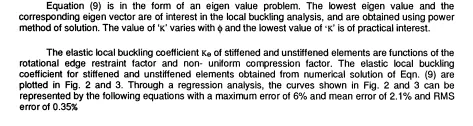
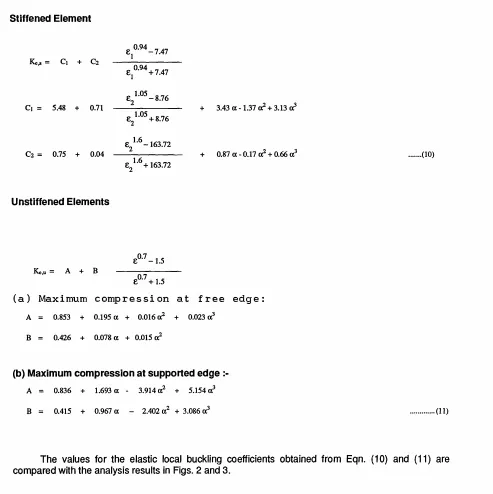
Thin walled members are composed of plate elements which are supported along both edges parallel to the direction of compression (referred to as stiffened elements) and supported along only one edge parallel to the direction of compression with the other completely free (referred to as unstiffened elements). These t~lin plate elements may experience elastic local buckling and stable postbuckling behaviour when subject to inplane compressive, bending or shear stress. Due to initial imperfections, the bifurcation type of local buckling indicated by small deflection theory is not usually experienced by elements of commercially manufactured thin walled members. However, the postbuckling behaviour expressed in the form of effective width equations is a function of the elastic local buckling stress and hence the theoretical calculation of elastic local buckling stress of thin walled elements is of practical interest. Furthermore, the out of plane deflection of imperfect plates increases drastically at local buckling stress and hence is of interest to deSigners. Stowell (1939). Timoshenko (1961), Winter (1959), and Kalyanaraman (1979), have presented methods for evaluating local buckling strength of thin plate elements and members subjected to uniform in plane compression. Rhodes and Harvey (1971) and Walker (1967), have presented analytical procedures for evaluating the local and postbuckling behaviour of t~lin walled stiffened and unstiffened elements subjected to linearly varying in plane compression. Ramakrishna and Kalyanaraman (1984) have presented closed form equations for local and post buckling strength of thin walled stiffened elements subjected to linearly varying inplane compression based on regression of analytical results. In this paper Galerkin’s procedure has been used to solve the governing differential equation for calculating the Iqcal buckling stress of non-uniformly compressed stiffened and unstiffened elements having elastically rotationally restrained longitudinal edges. Through regression, equations developed [Jayabalan (1989)] for the local buckling coefficient are presented as a function of the edge rotational restraint factor, and the non-uniform compression factor. The results of the proposed equations are compared with experimental results.
ANALYTICAL STUDY
Governing Equations
A thin flat rectangular plate compressed by linearly varying displacements in the longitudinal direction asshown in Fig. 1 is considered, where the unloaded longitudinal edges may have one of the following boundary conditions. Both edges are completely restrained against out of plane translation