
Skip to content
Saturday, November 28, 2026Ideas worth exploring. Knowledge worth sharing.
S. SenseCentralDISCOVER EVERY DAY
Bioorganic Chemistry

Ester Enolates

we introduced the enolates of aldehydes and ketones (review) and looked at their reactions as C nucleophiles (review).  These enolates were formed by treating the aldehyde or ketone with a suitable base :
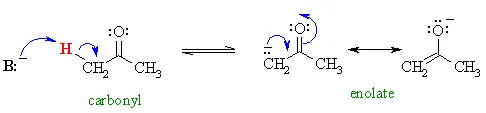
Now we will investigate another group of carbonyl containing compounds, the esters, which behave in a very similar fashion…..
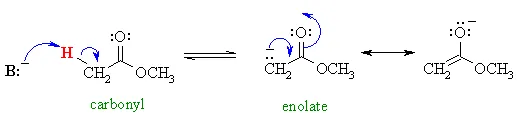
When preparing ester enolates, the base is normally chosen to match the alcohol portion of the ester…
So if you have:
a methyl ester, RCOOCH3 you use methoxide, –OCH3, or,
an ethyl ester, RCOOCH2CH3 you use ethoxide, –OCH2CH3

This avoids problems caused by transesterification (conversion of one ester into another)……

or hydrolysis……

Note that in both cases the problem arises because the base reacts as a “nucleophile“

Author

  • Rajil TL

    Rajil TL is a SenseCentral contributor focused on tech, apps, tools, and product-building insights. He writes practical content for creators, founders, and learners—covering workflows, software strategies, and real-world implementation tips. His style is direct, structured, and action-oriented, often turning complex ideas into step-by-step guidance. He’s passionate about building useful digital products and sharing what works.

WRITTEN BY

Rajil TL

<p data-start="2434" data-end="2888">Rajil TL is a SenseCentral contributor focused on tech, apps, tools, and product-building insights. He writes practical content for creators, founders, and learners—covering workflows, software strategies, and real-world implementation tips. His style is direct, structured, and action-oriented, often turning complex ideas into step-by-step guidance. He’s passionate about building useful digital products and sharing what works.</p>

More from this author ↗

Leave a Reply

Your email address will not be published. Required fields are marked *