A great pitch deck tells a compelling story in 10-12 slides. Here is exactly what each slide should contain.
The 12-Slide Structure
Slide 1: Cover
- Company name and logo
- One-line tagline (what you do in 10 words or less)
- Your name and contact information
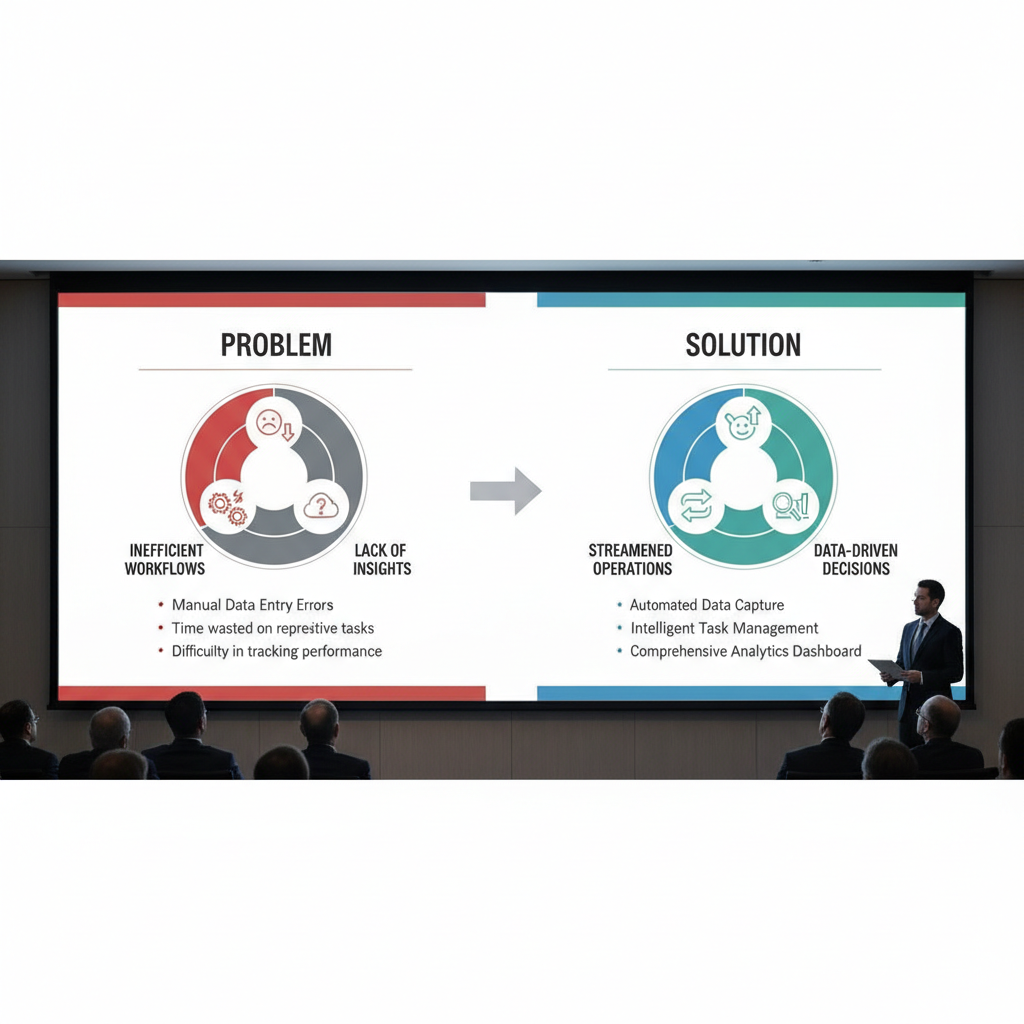
Slide 2: Problem
This is the most important slide. Make the problem visceral and specific.
- Who has this problem?
- How painful is it? (quantify if possible)
- Why has it not been solved?
Common mistake: Being too abstract. "Businesses waste money" is not a problem. "Indian SMEs spend ₹2,000 crore/year on manual GST compliance" is a problem.
Slide 3: Solution
Show your product, not describe it. Screenshots are better than words.
- What is your product?
- How does it solve the problem?
- What makes it different?
Slide 4: Market Size
Investors want to know the opportunity is big enough to justify their investment.
- TAM (Total Addressable Market): The entire market
- SAM (Serviceable Addressable Market): The part you can reach
- SOM (Serviceable Obtainable Market): What you can realistically capture
Tip: Build your market size from the bottom up, not the top down.
Slide 5: Product
Deep dive into your product with screenshots or a demo video.
- Key features and how they work
- User journey
- What makes it delightful to use
Slide 6: Traction
This is where you prove the dog eats the food.
- Revenue (if any)
- User growth
- Retention metrics
- Key customer logos
- Notable partnerships or pilots
Slide 7: Business Model
How do you make money?
- Pricing model (subscription, transaction, freemium)
- Unit economics (CAC, LTV, payback period)
- Revenue projections
Slide 8: Go-to-Market
How will you acquire customers?
- Primary acquisition channels
- Sales motion (self-serve, inside sales, enterprise)
- Marketing strategy
Slide 9: Competition
Show you understand the competitive landscape.
- Direct and indirect competitors
- Your differentiation (2x2 matrix works well)
- Why you will win
Slide 10: Team
Investors bet on people as much as ideas.
- Founders' relevant experience
- Why this team for this problem
- Key hires you have made or plan to make
Slide 11: Financials
- Last 12 months of revenue (if applicable)
- 18-month projection
- Key assumptions
- Current burn rate and runway
Slide 12: The Ask
- How much you are raising
- What you will use it for (specific milestones)
- What you will achieve with this capital