Skip to content
Thursday, November 26, 2026Ideas worth exploring. Knowledge worth sharing.
S. SenseCentralDISCOVER EVERY DAY
petroleum secondary processing

Desirable Chemical Reactions

Figure 8.2 illustrates more specifically the desirable chemical reactions of catalytic reforming including:

·         dehydrogenation of naphthenes to aromatics,

·         dehydroisomerization of alkyl-C5-naphthenes,

·         dehydrocyclization of n-paraffins to aromatics, and

·         isomerization of n-alkanes to i-alkanes.

All of these reactions significantly increase the octane number (research octane number [RON] from 75 to 110 in Reaction 1, from 91 through 83 [cyclohexane] to 100 in Reaction 2, from 0 to 110 in Reaction 3, and from –19 to 90 in Reaction 4).
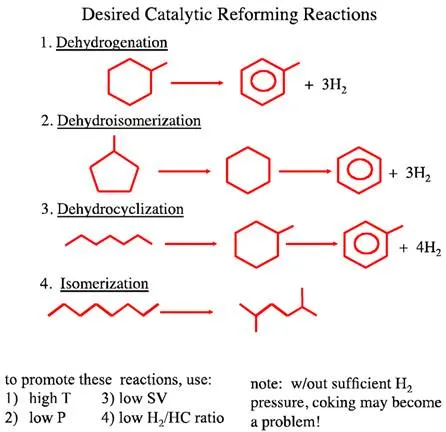
Figure 8.2: Desirable chemical reactions in of catalytic reforming reactions.

Reaction conditions that promote the desirable reactions are also listed in Figure 8.2. As can be seen in Figure 8.2, aromatic compounds and large quantities of by-product H2 are produced in the highly endothermic Reactions 1–3. High temperatures, low hydrogen pressures, low space velocity (SV), and low H2/HC ratio strongly promote the conversion in Reaction 1-3. Although maintaining a low hydrogen pressure is needed for promoting equilibrium conversion in Reactions 1-3, it is, however, necessary to maintain a sufficiently high hydrogen pressure in the reactors to inhibit coke deposition on the catalyst surfaces.

Author

  • Rajil TL

    Rajil TL is a SenseCentral contributor focused on tech, apps, tools, and product-building insights. He writes practical content for creators, founders, and learners—covering workflows, software strategies, and real-world implementation tips. His style is direct, structured, and action-oriented, often turning complex ideas into step-by-step guidance. He’s passionate about building useful digital products and sharing what works.

WRITTEN BY

Rajil TL

<p data-start="2434" data-end="2888">Rajil TL is a SenseCentral contributor focused on tech, apps, tools, and product-building insights. He writes practical content for creators, founders, and learners—covering workflows, software strategies, and real-world implementation tips. His style is direct, structured, and action-oriented, often turning complex ideas into step-by-step guidance. He’s passionate about building useful digital products and sharing what works.</p>

More from this author ↗

Leave a Reply

Your email address will not be published. Required fields are marked *