


Generalized Laws of Viscosity
We have derived a law for the behaviour of fluids – that of Newtonian fluids. However, experiments show that there are non-Newtonian fluids that follow a generalized law of viscosity:
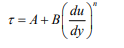
Where A, B and n are constants found experimentally. When plotted these fluids show much different behaviour to a Newtonian fluid:
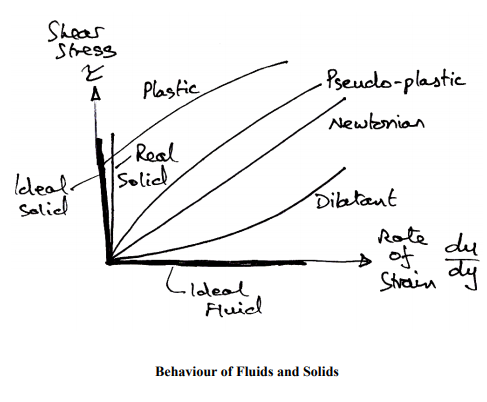
In this graph the Newtonian fluid is represent by a straight line, the slope of which is µ . Some of the other fluids are:
· Plastic: Shear stress must reach a certain minimum before flow commences.
· Pseudo-plastic: No minimum shear stress necessary and the viscosity decreases with rate of shear, e.g. substances like clay, milk and cement.
· Dilatant substances; Viscosity increases with rate of shear, e.g. quicksand.
· Viscoelastic materials: Similar to Newtonian but if there is a sudden large change in shear they behave like plastic.
· Solids: Real solids do have a slight change of shear strain with time, whereas ideal solids (those we idealise for our theories) do not.
Lastly, we also consider the ideal fluid. This is a fluid which is assumed to have no viscosity and is very useful for developing theoretical solutions. It helps achieve some practically useful solutions.