The real behaviour of fluids flowing is well described by an experiment carried out by Reynolds in 1883. He set up the following apparatus:
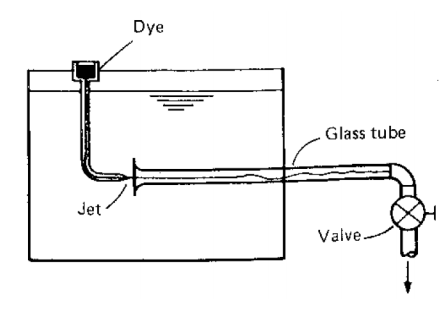
The discharge is controlled by the valve and the small ‘filament’ of dye (practically a streamline) indicates the behaviour of the flow. By changing the flow Reynolds noticed:
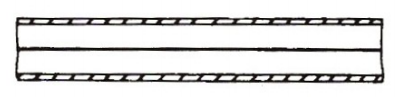
· At low flows/velocities the filament remained intact and almost straight. This type of flow is known as laminar flow, and the experiment looks like this:
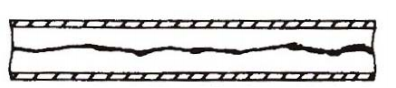
· At higher flows the filament began to oscillate. This is called transitional flow and the experiment looks like:
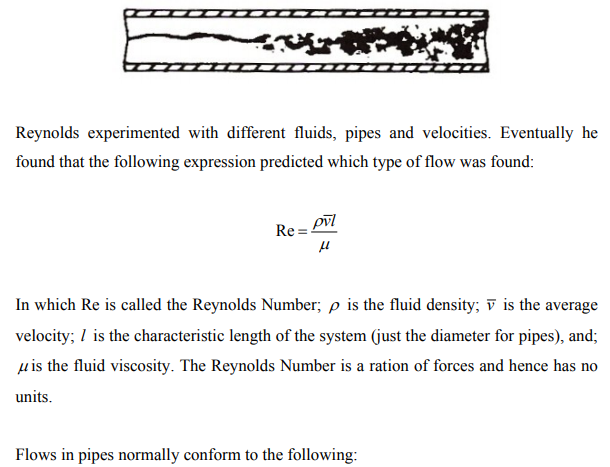
· Lastly, for even higher flows again, the filament is found to break up completely and gets diffused over the full cross-section. This is known as turbulent flow:
· Re 2000 < : gives laminar flow;
· 2000 Re 4000 < < : transitional flow;
· Re 4000 > : turbulent flow.
These values are only a rough guide however. Laminar flows have been found at Reynolds Numbers far beyond even 4000.
For example, if we consider a garden hose of 15 mm diameter then the limiting average velocity for laminar flow is:
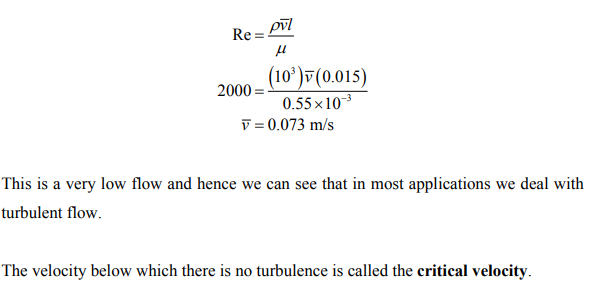
Characteristics of Flow Types
For laminar flow:
· Re < 2000;
· ‘low’ velocity;
· Dye does not mix with water;
· Fluid particles move in straight lines;
· Simple mathematical analysis possible;
· Rare in practical water systems.
Transitional flow
· 2000 < Re < 4000
· ‘medium’ velocity
· Filament oscillates and mixes slightly.
Turbulent flow
· Re > 4000;
· ‘high’ velocity;
· Dye mixes rapidly and completely;
· Particle paths completely irregular;
· Average motion is in the direction of the flow;
· Mathematical analysis very difficult – experimental measures are used;
· Most common type of flow.