- Table of Contents
- Key Takeaways
- Why Look Beyond HubSpot in 2026?
- 1) Total cost can rise quickly
- 2) You may want a “best-of-breed” stack
- 3) Your workflow may not be “inbound-first”
- 4) You need deeper customization or enterprise controls
- How We Reviewed HubSpot Competitors
- Quick Comparison Table
- The 11 Best HubSpot Alternatives (Detailed Reviews)
- 1) Salesforce Sales Cloud
- 2) Zoho CRM
- 3) Pipedrive
- 4) Freshsales (Freshworks CRM)
- 5) monday sales CRM
- 6) ActiveCampaign
- 7) Keap
- 8) Copper
- 9) Zendesk Sell
- 10) Bitrix24
- 11) Apptivo
- How to Choose the Right HubSpot Alternative
- Step 1: Decide your priority (pick one)
- Step 2: List your “must-haves” (non-negotiables)
- Step 3: Evaluate onboarding and adoption
- Step 4: Run a 7-day pilot with real data
- Migration Tips: Moving From HubSpot Without Losing Data
- 1) Export your data (contacts, companies, deals)
- 2) Map objects and fields in the new CRM
- 3) Recreate automations carefully
- 4) Verify compliance for email and privacy
- 5) Run parallel for 2–4 weeks
- FAQs
- What is the best free HubSpot alternative in 2026?
- What’s the best HubSpot alternative for small businesses?
- Which HubSpot competitor is best for marketing automation?
- Is Salesforce better than HubSpot?
- Can I migrate from HubSpot without losing emails and activities?
- What should I check before canceling HubSpot?
- References & Helpful Resources
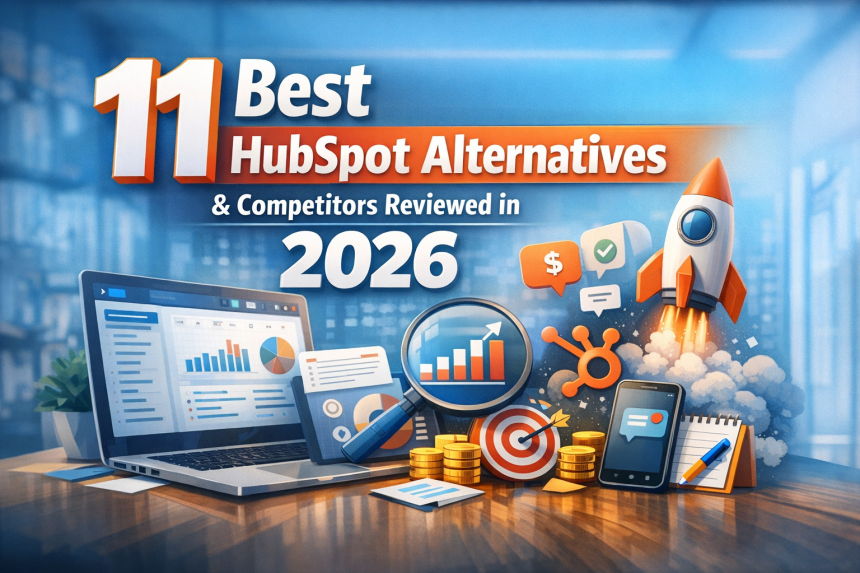
If you love HubSpot’s “all-in-one” promise but feel the pricing, packaging, or scaling limits don’t match your business in 2026, you’re not alone. HubSpot is a strong platform—especially for inbound marketing and clean UX—but it’s rarely the only CRM worth considering. Depending on your team size, sales motion, support needs, and marketing maturity, a different CRM can deliver a better fit (and sometimes a better total cost).
This guide reviews 11 HubSpot alternatives that compete seriously across sales CRM, marketing automation, customer service, and workflow automation. You’ll get a quick comparison, who each tool is best for, real-world pros/cons, and a practical “choose this if…” decision flow—so you can pick with confidence.
Disclosure: Pricing and plan packaging change often. Where we reference prices, treat them as “as of early 2026” and verify on the vendor’s pricing page before purchasing.
Table of Contents
- Key Takeaways
- Why Look Beyond HubSpot in 2026?
- How We Reviewed HubSpot Competitors
- Quick Comparison Table
- The 11 Best HubSpot Alternatives (Detailed Reviews)
- How to Choose the Right HubSpot Alternative
- Migration Tips: Moving From HubSpot Without Losing Data
- FAQs
- References & Helpful Resources
Key Takeaways
- HubSpot isn’t always the best value at scale. As teams grow, “must-have” features may sit in higher tiers or separate Hubs, increasing total cost.
- Pick by workflow, not hype. The best CRM is the one your team actually uses daily—pipeline clarity, automation, and reporting matter more than feature checklists.
- Sales-led teams often prefer simpler CRMs. Tools like Pipedrive, Freshsales, and Zendesk Sell can be faster to adopt for deal-focused sales teams.
- Marketing automation-heavy teams may lean toward ActiveCampaign or Keap. If nurturing and segmentation drive revenue, these can be strong fits.
- Google Workspace-centric teams love Copper. If Gmail/Calendar/Sheets are your “operating system,” Copper’s native approach can feel frictionless.
- All-in-one suites exist beyond HubSpot. Salesforce and Bitrix24 offer broad ecosystems—great for complex operations, but expect configuration work.
Why Look Beyond HubSpot in 2026?
HubSpot has earned its reputation by making CRM + marketing + sales + service approachable. But as the CRM market matures (and AI features become commonplace), many teams revisit their stack for a few common reasons:
1) Total cost can rise quickly
HubSpot’s free tools are useful to start. But scaling a sales org, adding advanced reporting, automation, or multiple pipelines can push you into higher tiers or separate Hubs. For small teams, that jump can feel steep.
2) You may want a “best-of-breed” stack
Some businesses prefer a specialized sales CRM + a dedicated marketing automation platform + a separate support tool. This approach can reduce costs and improve depth in each area—especially if your team already has strong processes.
3) Your workflow may not be “inbound-first”
HubSpot shines for inbound marketing and content-driven funnels. But if you’re outbound-heavy, deal-cycle obsessed, or service-led, other CRMs may match your day-to-day reality better.
4) You need deeper customization or enterprise controls
For complex org structures, strict permissions, or highly customized objects and processes, enterprise CRMs (like Salesforce) or modular suites may offer more flexibility—at the cost of setup effort.
How We Reviewed HubSpot Competitors
To keep this review practical (not theoretical), we compared tools using criteria most teams feel immediately:
- Core CRM usability: Contacts, companies, deals, pipeline views, tasks, and day-to-day speed.
- Automation: Workflow builders, triggers, sequences, lead scoring, and assignment rules.
- Reporting: Dashboards, forecasting, attribution (where relevant), and custom reports.
- Marketing capabilities: Email marketing, segmentation, landing pages, forms, and multi-channel options.
- Service tools: Tickets, shared inbox, knowledge base, and customer comms (if you need it).
- Integrations: Email/calendar, telephony, e-sign, accounting, ecommerce, and API ecosystem.
- Pricing clarity: How easy it is to understand what you pay for as you scale.
Tip: Before switching CRMs, document your existing workflow in plain language: “Lead comes from X → assigned to Y → follow-up sequence Z → deal stages A/B/C → won/lost reasons.” Then choose the tool that supports this flow with the least friction.
Quick Comparison Table
This table is a fast “map.” Click through to the detailed reviews for context and trade-offs.
| Tool | Best for | Why it’s a strong HubSpot alternative | Pricing signal (verify on vendor site) |
|---|---|---|---|
| Salesforce Sales Cloud | Growing teams & enterprise workflows | Deep customization, ecosystem, and advanced sales processes | Starter tiers available; enterprise options scale upward |
| Zoho CRM | Value + customization for SMB | Strong features-per-dollar and broad Zoho suite integrations | Free edition + paid tiers (regional pricing) |
| Pipedrive | Sales teams that live in pipelines | Fast adoption, clean deal views, strong sales focus | Per-user pricing, multiple tiers |
| Freshsales (Freshworks) | SMB sales + lightweight automation | Sales CRM with practical AI help and fast setup | Free plan + paid tiers |
| monday sales CRM | Teams blending CRM + projects | Highly visual workflows, great for cross-team collaboration | Seat-based tiers; minimum seats may apply |
| ActiveCampaign | Marketing automation + CRM alignment | Advanced automations, segmentation, and nurture sequences | Contact-based pricing; tiered plans |
| Keap | Small businesses needing automation | Strong automation + CRM + payments-oriented workflows | Bundle-style pricing (verify current packages) |
| Copper | Google Workspace teams | Native Gmail/Calendar integration feels “built-in” | Per-seat tiers |
| Zendesk Sell | Sales + support organizations | Great pairing with Zendesk support workflows | Per-user tiers |
| Bitrix24 | All-in-one business suite | CRM + tasks + comms in one platform, often fixed-price bundles | Free tier + bundles; org-level plans available |
| Apptivo | Teams wanting modular apps | “Pick the apps you need” approach keeps stacks flexible | Per-user tiers |
The 11 Best HubSpot Alternatives (Detailed Reviews)
Before you pick: identify your CRM “center of gravity”
Most teams fall into one of these patterns:
- Sales-led: Pipeline, activities, forecasting, and speed matter most.
- Marketing-led: Segmentation, automation, landing pages, and lifecycle nurturing matter most.
- Service-led: Tickets, omnichannel inbox, and customer context matter most.
- Ops-led: Custom objects, permissions, auditability, and integration depth matter most.
Keep this in mind as you read the reviews below.
1) Salesforce Sales Cloud
Best for: teams that need deep customization, enterprise-grade permissions, and a CRM that can grow into a “system of record.”
Why it competes with HubSpot
Salesforce is the heavyweight. If HubSpot feels limiting in complex workflows—multi-team pipelines, advanced forecasting, granular permissions, and custom objects—Salesforce is built for that world. It’s also backed by a massive ecosystem of extensions and consultants.
Standout strengths
- Highly customizable objects, fields, workflows, and reporting
- Strong sales enablement and forecasting options
- Large integration marketplace and enterprise security options
Watch-outs
- Setup can be complex—many teams need implementation support
- Total cost can rise with add-ons and higher tiers
Pricing: See official pricing here: Sales Cloud pricing
Try if: you’re building a multi-team sales org with sophisticated processes.
2) Zoho CRM
Best for: small-to-mid businesses that want strong CRM features without enterprise-level costs.
Why it competes with HubSpot
Zoho CRM is one of the best “value” alternatives. It covers core CRM needs (leads, deals, automation, analytics) and integrates tightly with the wider Zoho ecosystem (projects, desk, campaigns, analytics). If you like the idea of a suite but want pricing flexibility, Zoho is worth a serious look.
Standout strengths
- Strong customization and workflow automation for the price
- Broad suite (Zoho One / CRM Plus can cover many business functions)
- Good fit for global teams with multi-currency needs
Watch-outs
- UI depth can feel “feature-dense” for very small teams
- Advanced features may require higher editions
Pricing: Zoho CRM pricing
Try if: you want a capable CRM + suite ecosystem without paying HubSpot-style bundle premiums.
3) Pipedrive
Best for: deal-driven sales teams that want a clean pipeline, fast adoption, and minimal overhead.
Why it competes with HubSpot
Pipedrive is loved because it stays focused. If HubSpot feels like “a whole platform” when you just want to manage deals, activities, and pipeline health, Pipedrive can be a better daily driver.
Standout strengths
- Excellent pipeline visualization and deal management
- Strong activity tracking that keeps reps accountable
- Easy to onboard and maintain (low admin burden)
Watch-outs
- Marketing tools are lighter than HubSpot’s Marketing Hub
- For advanced service workflows, you may need integrations
Pricing: Pipedrive pricing
Try if: you want the simplest “sales-first” alternative to HubSpot.
4) Freshsales (Freshworks CRM)
Best for: SMB teams who want a modern sales CRM, quick setup, and practical AI-assisted selling.
Why it competes with HubSpot
Freshsales offers a clean sales CRM experience with solid automation and Freshworks’ broader customer engagement ecosystem. If you need something lighter than HubSpot but more modern than many “legacy SMB CRMs,” it’s a strong contender.
Standout strengths
- Fast onboarding with a UI that’s friendly to non-technical teams
- AI assistance (Freddy AI) for sales insights and productivity (availability varies by plan)
- Pairs well with Freshworks support tools if you want sales + service alignment
Watch-outs
- Deep marketing automation is typically less extensive than HubSpot’s
- Some advanced capabilities can be plan-dependent
Pricing: Freshsales pricing
Try if: you want a capable CRM with modern UX and “just enough” automation.
5) monday sales CRM
Best for: teams that want CRM + project-style collaboration, customizable boards, and visual workflows.
Why it competes with HubSpot
monday sales CRM is a great pick when sales doesn’t live in isolation. If your team needs to coordinate with marketing, ops, onboarding, or delivery—and you want CRM processes that look like flexible workflows—monday can feel more natural than traditional CRMs.
Standout strengths
- Highly customizable workflows (boards, automations, templates)
- Great visibility for cross-team handoffs (sales → onboarding → delivery)
- Useful when “project management + CRM” needs to live together
Watch-outs
- Not always as “sales-purist” as Pipedrive in pipeline simplicity
- Seat minimums can apply depending on plan and billing cycle
Pricing: monday CRM pricing
Try if: your sales workflow resembles a project workflow and you need collaboration visibility.
6) ActiveCampaign
Best for: teams where nurturing and lifecycle automation drive most revenue.
Why it competes with HubSpot
ActiveCampaign is widely chosen for automation depth—especially when email/SMS sequencing, segmentation, and behavior-based journeys are mission-critical. If your main “HubSpot pain” is paying for marketing automation features, ActiveCampaign can be a serious alternative (often paired with a lighter CRM workflow).
Standout strengths
- Powerful automation builder for behavior-based journeys
- Strong segmentation and personalization for email marketing
- Great fit for creators, ecommerce, and SMB lifecycle marketing
Watch-outs
- If you need a heavyweight sales CRM, you may want a dedicated sales-first tool
- Pricing often scales with contact counts
Pricing: ActiveCampaign pricing
Try if: marketing automation is the center of gravity, and CRM is mainly for sales context.
7) Keap
Best for: small businesses that want CRM + automation + client follow-up + payments in one workflow.
Why it competes with HubSpot
Keap is popular with service businesses, agencies, coaches, and SMBs that need “follow-up without forgetting.” If you want automation that feels built for small business execution (not a marketing department), Keap can be compelling.
Standout strengths
- Automation designed for SMB follow-up and client lifecycle
- Strong fit for appointment-based and service-based businesses
- Useful if you prefer bundled tools rather than stitching multiple apps
Watch-outs
- Pricing may feel high for very early-stage teams
- Customization depth is often less than enterprise CRMs
Pricing: Keap pricing
Try if: you’re a small business that values automation + execution more than complex CRM customization.
8) Copper
Best for: teams that run their business inside Google Workspace and want CRM to feel “native.”
Why it competes with HubSpot
Copper is designed for Gmail-first workflows. If your sales team lives in Gmail, Calendar, and Sheets, Copper can reduce the friction of logging activities and managing relationships. For many, the biggest win is adoption—because it fits existing habits.
Standout strengths
- Deep Google Workspace integration (Gmail, Calendar, etc.)
- Simple relationship management, tasks, and pipelines
- Easy adoption for teams that avoid heavy CRMs
Watch-outs
- If you need advanced marketing features, you’ll rely on integrations
- Some advanced reporting and automation live in higher tiers
Pricing: Copper pricing
Try if: Gmail is your command center and you want CRM to stay out of the way.
9) Zendesk Sell
Best for: organizations where sales and support need shared visibility, especially if you already use Zendesk for service.
Why it competes with HubSpot
If your world includes both sales and customer support workflows, Zendesk Sell can be a better “unifier” than HubSpot—particularly when your support team already lives in Zendesk. The advantage is shared context: sales sees support history, and support sees customer value and status.
Standout strengths
- Strong fit for teams combining sales CRM + helpdesk context
- Mobile-friendly CRM workflows
- Pairs naturally with Zendesk’s support and CX tools
Watch-outs
- If you want a marketing suite comparable to HubSpot, you’ll add external tools
- Best value often appears when you’re already in the Zendesk ecosystem
Pricing: Zendesk Sell pricing
Try if: support + sales collaboration is a priority and Zendesk is already in your stack.
10) Bitrix24
Best for: teams that want an all-in-one collaboration suite (CRM + tasks + chat + docs) under one roof.
Why it competes with HubSpot
Bitrix24 isn’t just a CRM—it’s a workplace suite. If HubSpot feels marketing-first but you want CRM plus internal collaboration tools (tasks, messaging, shared workspaces), Bitrix24’s positioning can make sense. Many teams choose it because they want “CRM + ops” in one subscription.
Standout strengths
- CRM + task management + collaboration tools in one place
- Often attractive pricing for larger headcounts (depending on plan structure)
- Good for organizations that want a single hub for many departments
Watch-outs
- Feature breadth can feel overwhelming without clear process ownership
- Best results come from configuring roles and workflows thoughtfully
Pricing: Bitrix24 pricing
Try if: you want CRM + collaboration suite in one place and can invest time in setup.
11) Apptivo
Best for: teams that like modular systems and want CRM capabilities without paying for features they won’t use.
Why it competes with HubSpot
Apptivo’s “apps” approach is attractive: you start with core CRM features and add modules as you grow. If HubSpot feels like you’re buying a full platform when you only need parts, Apptivo can be a cost-efficient alternative—especially for businesses with evolving needs.
Standout strengths
- Modular app ecosystem (add what you need over time)
- Good fit for SMBs that want flexibility
- Workflow and field customization for many common use cases
Watch-outs
- Some teams prefer a single, opinionated UI rather than modular screens
- Advanced marketing may require integrations depending on your needs
Pricing: Apptivo pricing
Try if: you want a flexible, modular CRM alternative with room to grow.
How to Choose the Right HubSpot Alternative
Step 1: Decide your priority (pick one)
- Sales pipeline simplicity: start with Pipedrive or Freshsales.
- Marketing automation depth: start with ActiveCampaign or Keap.
- Cross-team workflow + projects: start with monday sales CRM or Bitrix24.
- Enterprise customization: start with Salesforce.
- Google Workspace-first: start with Copper.
Step 2: List your “must-haves” (non-negotiables)
- Multiple pipelines?
- Sequences / outbound automation?
- Lead scoring?
- Custom objects?
- Two-way email + calendar sync?
- Shared inbox / ticketing?
- Role-based permissions?
Step 3: Evaluate onboarding and adoption
A CRM “fails” when reps stop using it. During trials, ask: Can a new rep understand the pipeline in 15 minutes? Can managers forecast reliably? Can marketing see lifecycle stages without spreadsheets?
Step 4: Run a 7-day pilot with real data
Import 100–200 real leads and a handful of deals. Build the pipeline stages. Create 2–3 automations (lead assignment, follow-up reminder, deal stage change). Then measure: do people actually use it daily?
Migration Tips: Moving From HubSpot Without Losing Data
Switching CRMs feels scary only when you don’t have a clean plan. Here’s a safe, repeatable migration approach:
1) Export your data (contacts, companies, deals)
- Export records from HubSpot: HubSpot export guide
- Document your properties: which fields are required, which are optional, which are used in automations.
2) Map objects and fields in the new CRM
Every CRM uses slightly different terminology. Map HubSpot properties → new CRM fields. Decide how you’ll recreate:
- Lifecycle stages
- Deal stages
- Owner assignments
- Lead sources
- Marketing opt-in status
3) Recreate automations carefully
Don’t rebuild every workflow on Day 1. Start with 3–5 automations that drive immediate value:
- Lead assignment rules
- Follow-up reminders
- Deal stage notifications
- Task creation on inbound leads
- Email sequence enrollment rules (if used)
4) Verify compliance for email and privacy
If you send marketing emails, ensure you maintain opt-out handling and compliance processes:
- FTC’s CAN-SPAM compliance guide: CAN-SPAM (FTC)
- EU/UK GDPR basics for SMEs: EDPB SME guide
5) Run parallel for 2–4 weeks
Keep HubSpot read-only during the transition so nothing is lost. Assign one person to reconcile data issues (duplicates, missing fields, mismatched pipelines).
FAQs
What is the best free HubSpot alternative in 2026?
If you want a free starting point, Zoho CRM offers a free edition (with limitations), and Bitrix24 also has a free tier. Always compare what “free” includes (users, records, automation, reporting) and what you’ll need six months from now.
What’s the best HubSpot alternative for small businesses?
For many small businesses, Zoho CRM, Pipedrive, Freshsales, Keap, or Apptivo can be strong choices—depending on whether you’re sales-led or marketing-led. If you want the simplest deal pipeline, Pipedrive is a common favorite.
Which HubSpot competitor is best for marketing automation?
ActiveCampaign is a strong choice when automation and segmentation are primary. Keap can also be excellent for service businesses that want automation tied to day-to-day execution.
Is Salesforce better than HubSpot?
Not universally. Salesforce is often better for highly complex sales organizations that need deep customization and governance. HubSpot can be better for teams that want speed, a smoother UX, and inbound marketing alignment.
Can I migrate from HubSpot without losing emails and activities?
Contact records and core CRM objects can be exported and migrated. Email history and activities vary by tool and integration method. Run a pilot migration with a small dataset and confirm what transfers cleanly before moving everything.
What should I check before canceling HubSpot?
Confirm data exports, automation replacements, integration parity (forms, calendars, ads, support inbox), and compliance processes. Keep HubSpot accessible (read-only) for a short buffer period for safety.
References & Helpful Resources
- HubSpot CRM pricing: https://www.hubspot.in/pricing/crm
- Salesforce Sales Cloud pricing: https://www.salesforce.com/in/small-business/pricing/
- Zoho CRM pricing: https://www.zoho.com/crm/zohocrm-pricing.html
- Pipedrive pricing: https://www.pipedrive.com/en/pricing
- Freshsales pricing: https://www.freshworks.com/crm/pricing/
- monday CRM pricing: https://monday.com/crm/pricing
- ActiveCampaign pricing: https://www.activecampaign.com/pricing
- Keap pricing: https://keap.com/pricing
- Copper pricing: https://www.copper.com/pricing
- Zendesk Sell pricing: https://www.zendesk.com/in/sell/
- Bitrix24 pricing: https://www.bitrix24.com/prices/
- Apptivo pricing: https://www.apptivo.com/app-pricing/
- HubSpot export records guide: https://knowledge.hubspot.com/import-and-export/export-records
- FTC CAN-SPAM guide: https://www.ftc.gov/business-guidance/resources/can-spam-act-compliance-guide-business
- EDPB SME GDPR guide: https://www.edpb.europa.eu/sme-data-protection-guide/home_en