Conditional statements help you to make a decision based on certain conditions. These conditions are specified by a set of conditional statements having boolean expressions which are evaluated to a boolean value true or false. There are following types of conditional statements in C.
1. If statement
2. If-Else statement
3. Nested If-else statement
4. If-Else If ladder
5. Switch statement
If statement
The single if statement in C language is used to execute the code if a condition is true. It is also called one-way selection statement.
Syntax
if(expression)
{//code to be executed
}
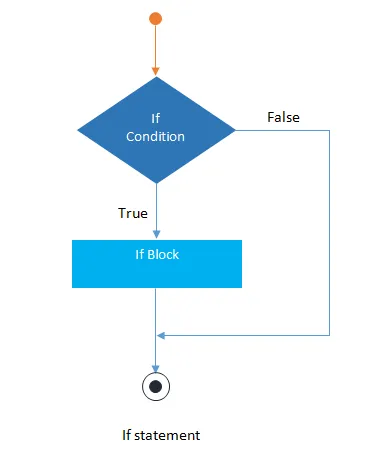
How “if” statement works..
· If the expression is evaluated to nonzero (true) then if block statement(s) are executed.
· If the expression is evaluated to zero (false) then Control passes to the next statement following it.
Note
“Expression must be scalar type” i.e evaluated to a single value.
if Statement Example
#include<stdio.h>
#include<conio.h>
void main()
{int num=0;
printf("enter the number");scanf("%d",&num);if(n%2==0)
{printf("%d number in even",num);}
getch();
}
If-else statement
The if-else statement in C language is used to execute the code if condition is true or false. It is also called two-way selection statement.
Syntax
if(expression)
{//Statements
}
else
{//Statements
}
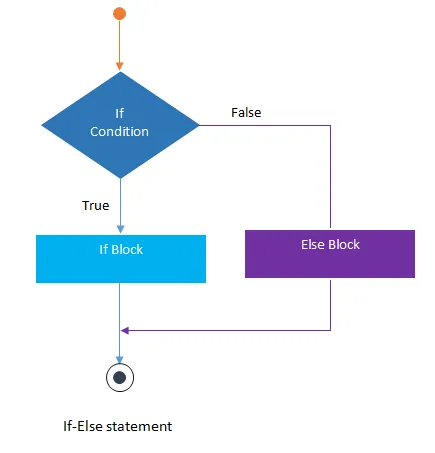
How “if..else” statement works..
· If the expression is evaluated to nonzero (true) then if block statement(s) are executed.
· If the expression is evaluated to zero (false) then else block statement(s) are executed.
if..else Statement Example
#include<stdio.h>
#include<conio.h>
void main()
{int num=0;
printf("enter the number");scanf("%d",&num);if(n%2==0)
{printf("%d number in even", num);}
else
{printf("%d number in odd",num);}
getch();
}
Nested If-else statement
The nested if…else statement is used when a program requires more than one test expression. It is also called a multi-way selection statement. When a series of the decision are involved in a statement, we use if else statement in nested form.
Syntax
if( expression )
{ if( expression1 )
{statement-block1;
}
else
{statement-block 2;
}
}
else
{statement-block 3;
}
Example
#include<stdio.h>
#include<conio.h>
void main( )
{ int a,b,c;
clrscr();
printf("Please Enter 3 number"); scanf("%d%d%d",&a,&b,&c);if(a>b)
{if(a>c)
{ printf("a is greatest");}
else
{ printf("c is greatest");}
}
else
{if(b>c)
{ printf("b is greatest");}
else
{ printf("c is greatest");}
}
getch();
}
If..else If ladder
The if-else-if statement is used to execute one code from multiple conditions. It is also called multipath decision statement. It is a chain of if..else statements in which each if statement is associated with else if statement and last would be an else statement.
Syntax
if(condition1)
{//statements
}
else if(condition2)
{//statements
}
else if(condition3)
{//statements
}
else
{//statements
}
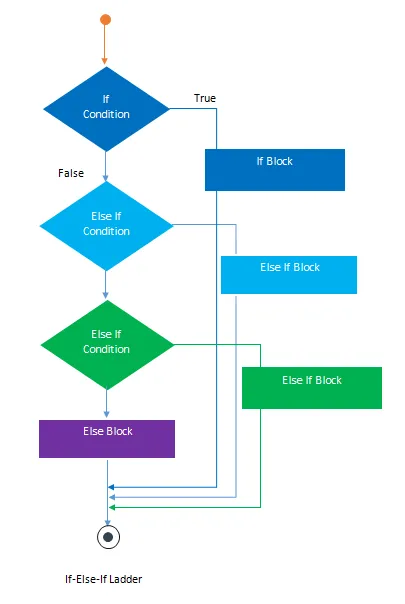
If..else If ladder Example
#include<stdio.h>
#include<conio.h>
void main( )
{int a;
printf("enter a number"); scanf("%d",&a);if( a%5==0 && a%8==0)
{ printf("divisible by both 5 and 8");}
else if( a%8==0 )
{ printf("divisible by 8");}
else if(a%5==0)
{ printf("divisible by 5");}
else
{ printf("divisible by none");}
getch();
}
Switch Statement
switch statement acts as a substitute for a long if-else-if ladder that is used to test a list of cases. A switch statement contains one or more case labels which are tested against the switch expression. When the expression match to a case then the associated statements with that case would be executed.
Syntax
Switch (expression)
{case value1:
//Statements
break;
case value 2:
//Statements
break;
case value 3:
//Statements
case value n:
//Statements
break;
Default:
//Statements
}
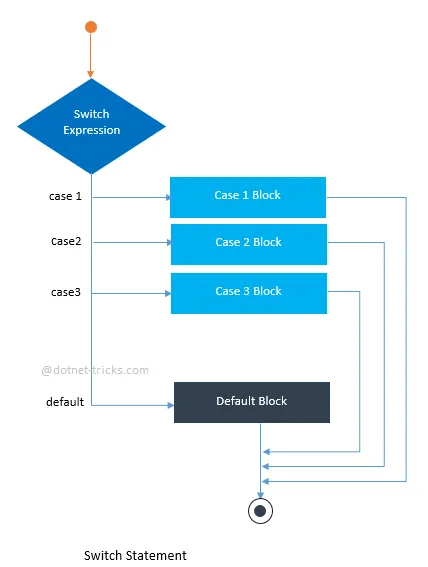
switch statement Example
#include<stdio.h>
#include<conio.h>
void main( )
{char grade = 'B';
if (grade == 'A')
{ printf("Excellent!");}
else if (grade == 'B')
{ printf("Well done");}
else if (grade == 'D')
{ printf("You passed");}
else if (grade == 'F')
{ printf("Better try again");}
else
{ printf("You Failed!");}
}
getch();
}
Read More Articles Related to C Programming Language
Note
· The switch statement must be an integral type.
· Case labels must be constants.
· Case labels must be unique.
· Case labels must end with a colon.
· The break statement transfers the control out of switch statement.
· The break statement is optional.