Requirements traceability is a way to organize, document and keep track of all your requirements from initial idea generation through to the testing phase.
The requirements trace ability matrix (RTM) provides a method for tracking the functional requirements and their implementation through the development process. Each requirement is included in the matrix along with its associated section number.
As the project progresses, the RIM is updated to reflect each requirement’s status. When the product is ready for system testing, the matrix lists each requirement, what product component addresses it, and what test verifies that it is correctly implemented
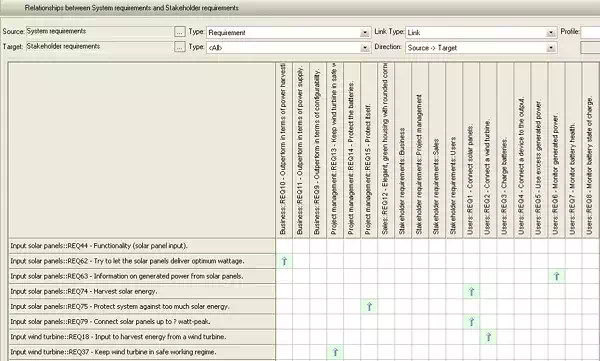
Include columns for each of the following in the RTM −
● Requirement description
● Requirement reference in FRD
● Verification Method
● Requirement reference in Test Plan
Example − Connecting the dots to identify the relationships between items within your project. It is a connector of common downstream flow.