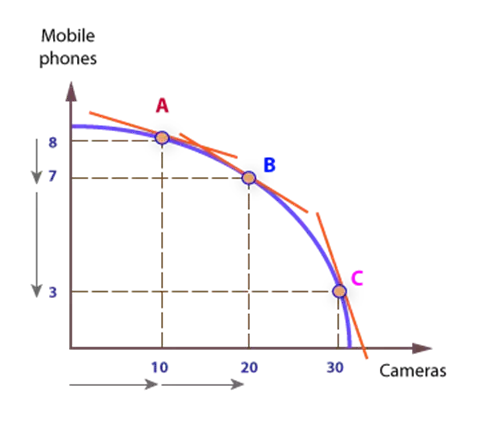
Opportunity cost can be thought of in terms of how decisions to increase the production of an extra, marginal, unit of one good leads to a decrease in the production of another good.
According to economic theory, successive increases in the production of one good will lead to an increasing sacrifice in terms of a reduction in the other good. For example, as an economy tries to increase the production of good X , such as cameras, it must sacrifice more of the other good, Y, such as mobile phones.
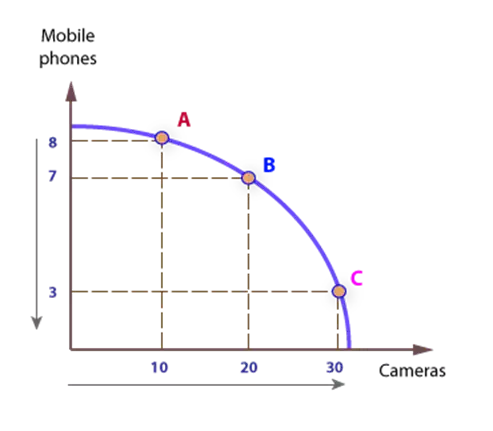
This explains why the PPF is concave to the origin, meaning its is bowed outwards. For example, if an economy initially produces at A, with 8m phones and 10m cameras (to 20m), and then increases output of cameras by 10m, it must sacrifice 1m phones, and it moves to point B.
If it now wishes to increase output of cameras by a further 10m (to 30m) it must sacrifice 2m phones, rather than 1m, and it moves to point C; hence, opportunity cost increases the more a good is produced.
The gradient of the PPF gets steeper as more cameras are produced, indicating a greater sacrifice in terms of mobile phones foregone.