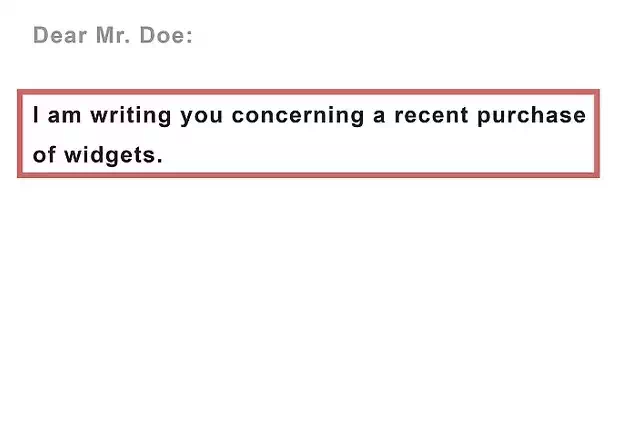
Strike the right tone. Time is money, as the saying goes, and most business people hate to waste time. The tone of your letter, therefore, should be brief and professional. Make your letter a quick read by diving straight into the matter and keeping your comments brief in the first paragraph. For instance, you can always start with “I am writing you regarding…” and go from there.
· Don’t concern yourself with flowery transitions, big words, or lengthy, meandering sentences – your intent should be to communicate what needs to be said as quickly and cleanly as possible.
· Be persuasive in your letter. Most likely the purpose of your letter is to persuade your reader to do something: change their mind, correct a problem, send money or take action. Make your case.
Use personal pronouns. It is perfectly fine to use “I,” “we,” and “you” in your business letter. Refer to yourself as “I” and your reader as “you.”
· Be aware if you’re writing the letter on an organization’s behalf. If you are stating the company’s perspective, you should use “we” so that the reader knows that the company stands behind your statement. If you are writing your own opinion, stick with “I.
Write clearly and concisely. Let your reader know exactly what you are trying to say. Your reader will only respond quickly if your meaning is crystal clear. In particular, if there is some result or action you want taken because of your letter, state what it is. Explain your position in as few words as possible.
Use the active voice. When describing a situation or making a request, make sure to choose the active voice, rather than the passive voice. The passive voice can make your writing ambiguous or impersonal. In addition, the active voice is more streamlined and straight to the point.[7] For example:
· Passive: The sunglasses are not designed or manufactured with attention to their durability.
· Active: Your company designs and manufactures sunglasses without attention to their durability.
Be conversational when appropriate. Letters are written by people to people. Avoid form letters if possible. You cannot build a relationship with canned impersonal letters. However, stay away from colloquial language or slang such as “you know,” “I mean,” or “wanna.” Keep the tone businesslike, but be friendly and helpful.
· If you know the recipient well, it’s fine to include a friendly line sending good wishes.
· Use your judgement when determining how much personality to reveal. Sometimes adding a little humor is actually helpful in a business setting, but err on the side of caution before making a joke.