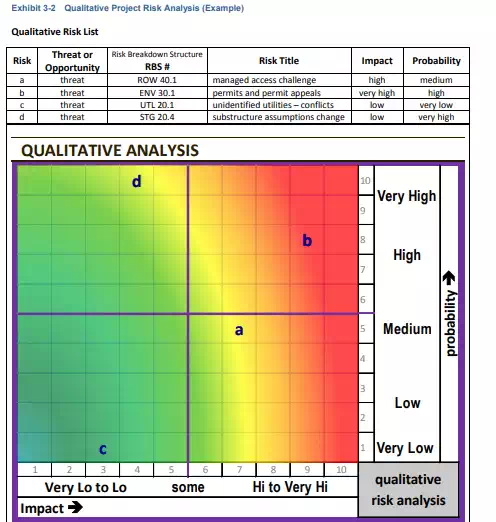
Once a risk is identified, including a thorough description of the risk and risk triggers, it can be characterized in terms of probability of occurrence and the consequence if it does occur.
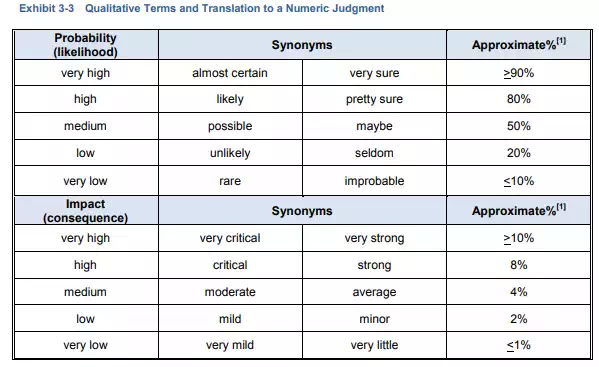
1. Gather the project team and appropriate persons to discuss project risk. Establish which of the qualitative risk matrices you intend to use, and define the terms you plan to use (Very High, High, Medium, Low, etc.).
2. Review the risk information from the risk identification step.
3. Discuss the risk with the group.
4. Evaluate the likelihood of the risk occurring by asking the group, “How likely is it that this risk will occur?” Record the result that the group agrees on.
5. Evaluate the consequences if the risk does occur by asking the group, “What will be the impacts if this risk does occur?” Record the result that the group agrees on.
6. Prioritize the risks based on the results of the qualitative analysis. If it is desirable, the risks can also be grouped by category (e.g., Environmental, Structures/ Geotech) and ranked within each category.
Helpful Hints for Qualitative Risk Analysis
· Invite appropriate participants (not too many, not too few).
· Define terms.
· Stay focused—put a time limit on discussion if necessary.
· Record the results.
· Prioritize the risks based on the results.
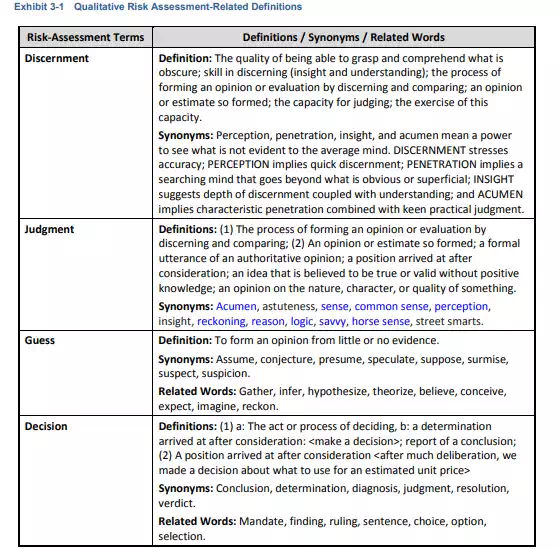
People who are relatively new to risk analysis sometimes claim that it is nothing more than guessing. However, this does not represent the actuality that assigning values for probability and impact relies on the expertise and professional judgment of experienced participants.
The determination of a value for the probability of occurrence and its consequence to project objectives, if it occurs, is for many a new activity and can seem strange at first. In any field, with experience, professionals develop intuition and an ability to understand projects to a greater degree than those not involved with project development and delivery. This experience and intuition is extremely valuable; in a risk workshop forum, we surround ourselves with “wise counsel” to seriously and thoroughly discuss the project. It might be helpful to examine the word “guess” and compare it to other words, such as “discernment” and ”judgment,” that more appropriately describe risk assessment. The definitions in Exhibit 3-1 come from the Merriam-Webster Online Dictionary/Thesaurus (with edits).