SenseCentral ETF Guide
How to Use ETFs for Long-Term Investing
ETFs can be useful for long-term investing because they offer diversification, transparency, and generally low-cost market exposure when used with discipline.

Editorial note: This article is for educational purposes only and is not financial advice. ETF selection should be based on your goals, risk tolerance, time horizon, costs, tax situation, and current market data. When needed, consult a SEBI-registered investment adviser or qualified financial professional.
Table of Contents
Quick Answer
ETFs can be useful for long-term investing because they offer diversification, transparency, and generally low-cost market exposure when used with discipline.
For beginners, the main idea is to avoid treating ETFs as “set-and-forget magic products.” ETFs can be excellent tools, but they still require basic due diligence. A good ETF choice usually has a clear benchmark, reasonable expense ratio, acceptable liquidity, transparent holdings, manageable tracking difference, and a role inside your total portfolio. If any of these points are unclear, pause before investing.
Why How to Use ETFs for Long-Term Investing Matters
How to Use ETFs for Long-Term Investing is a useful topic for any beginner who wants to use ETFs with more confidence. ETFs look simple because they trade on the stock exchange like shares, but a good ETF decision still requires attention to cost, liquidity, tracking quality, risk level, and the investor’s own goal. Many beginners focus only on recent returns. A stronger approach is to understand what the ETF owns, how it trades, how it tracks its benchmark, and how it fits into the rest of the portfolio.
In simple terms, ETFs can be useful for long-term investing because they offer diversification, transparency, and generally low-cost market exposure when used with discipline. This does not mean beginners need to become professional traders or fund analysts. It means they should know the basic checks that protect them from avoidable mistakes. A low-cost ETF can still be a poor choice if it is too narrow, poorly traded, heavily overlapping with other holdings, or unsuitable for the time horizon.
Goal-based ETF investing begins with the investor, not with the product. A retirement portfolio, a five-year house down-payment goal, and a long-term wealth creation plan should not all use the same allocation. ETFs are tools. The same equity ETF that is sensible for a 15-year goal may be unsuitable for money needed next year.
Risk profile also matters. Conservative investors may prefer a smaller equity allocation and more stable instruments, while aggressive investors may accept larger short-term declines. Moderate investors usually need a balance. The key is to create a plan that can survive real market conditions, not only a spreadsheet projection.
ETF investing becomes easier when you separate three decisions: product selection, portfolio allocation, and investor behavior. Product selection answers, “Is this ETF good enough?” Portfolio allocation answers, “How much should I invest here?” Investor behavior answers, “Will I continue this plan when markets become uncomfortable?” All three matter. A strong ETF can still disappoint if it is bought for the wrong reason or sold at the wrong time.
Step-by-Step Guide
Use the following practical process whenever you evaluate this topic. You can adapt it for Indian ETFs, international ETFs, gold ETFs, factor ETFs, and broad index ETFs.
- Write the investment goal, amount needed, and time horizon.
- Choose an ETF mix that matches your risk capacity, not just your return expectation.
- For goals under three years, be careful with equity-heavy ETFs because short-term market falls can hurt.
- For long-term goals, focus on low-cost diversified ETFs and consistency.
- Set a review date and rebalancing rule before emotions appear.
- Increase stability as the goal date comes closer by reducing dependence on volatile assets.
A beginner does not need a complicated dashboard. A simple spreadsheet or note can track the ETF name, benchmark, category, expense ratio, tracking error, average volume, spread, reason for buying, target allocation, and review date. This small habit makes investing more intentional and reduces random decisions.
Helpful Comparison Table
The table below summarizes the most useful checks related to How to Use ETFs for Long-Term Investing.
| Investor profile | ETF focus | Important caution |
|---|---|---|
| Short-term goal | Lower-risk assets and liquidity | Avoid heavy equity exposure for money needed soon |
| Long-term goal | Diversified equity ETFs plus rebalancing | Do not stop investing only because markets fall |
| Retirement planning | Gradual shift from growth to stability | Do not ignore sequence-of-return risk near retirement |
| Wealth creation | Low-cost broad market exposure | Avoid return chasing and over-trading |
| Emergency needs | Cash or liquid products before ETFs | ETFs are not a substitute for emergency savings |
Practical Example
Imagine a beginner investor named Aarav who wants to use ETFs instead of selecting individual stocks. He sees several ETFs with attractive past returns. One ETF tracks a broad large-cap index, another tracks a banking sector index, another focuses on momentum, and another has very low trading volume. At first, the highest recent return looks most attractive. But after applying a checklist, Aarav realizes that each ETF plays a different role.
The broad index ETF can work as a core holding. The sector ETF may be useful only if he is comfortable with banking-sector concentration. The momentum ETF may behave differently from a plain index and may fall sharply if market leadership changes. The low-volume ETF may look cheap but could be expensive to trade because of spreads. By checking these points before investing, Aarav avoids building a portfolio that looks diversified but is actually concentrated and difficult to manage.
This example shows why ETF education is important. The best ETF is not the one with the most exciting chart. The best ETF for you is the one that fits your goal, has acceptable costs and liquidity, and can be held with discipline through changing market conditions.
Common Mistakes to Avoid
1. Looking only at past returns
Past returns can show what happened, but they do not guarantee future performance. Many ETFs perform well because their underlying sector, factor, or market style had a strong period. Before buying, ask whether the return came from broad diversification or from a narrow bet.
2. Ignoring liquidity and spreads
Some investors compare expense ratios carefully but ignore the trading cost created by a wide bid-ask spread. This is especially important for low-volume ETFs, niche ETFs, and volatile market sessions.
3. Over-diversifying with overlapping ETFs
Owning many ETFs does not automatically mean better diversification. If several ETFs hold the same top companies, the portfolio may still depend heavily on the same stocks. Check overlap before adding another ETF.
4. Using sector ETFs as core holdings
Sector ETFs can be useful, but they are concentrated by design. Beginners should be careful about making a single sector the center of their portfolio unless they understand the risk and have a clear allocation limit.
5. Trading emotionally
ETFs trade throughout the day, which is convenient but can also tempt investors to react to every market move. Long-term investors should use ETFs as planned building blocks, not as emotional trading buttons.
Useful Resources for Creators, Website Owners, and Digital Product Sellers
Affiliate disclosure: Some links in this section may be affiliate or promotional links. If you purchase through them, SenseCentral may earn a commission at no extra cost to you. These resources are included because many SenseCentral readers are website creators, digital entrepreneurs, bloggers, designers, developers, and online business builders.
Explore Our Powerful Digital Products
Browse high-value bundles for website creators, developers, designers, startups, content creators, and digital product sellers.
Zee Sharp – Free Productivity Tools Hub
A growing suite of free online tools for productivity, development, and creativity. No sign-up. No watermarks. Just tools.
Creator Monetization Resource: Teachable
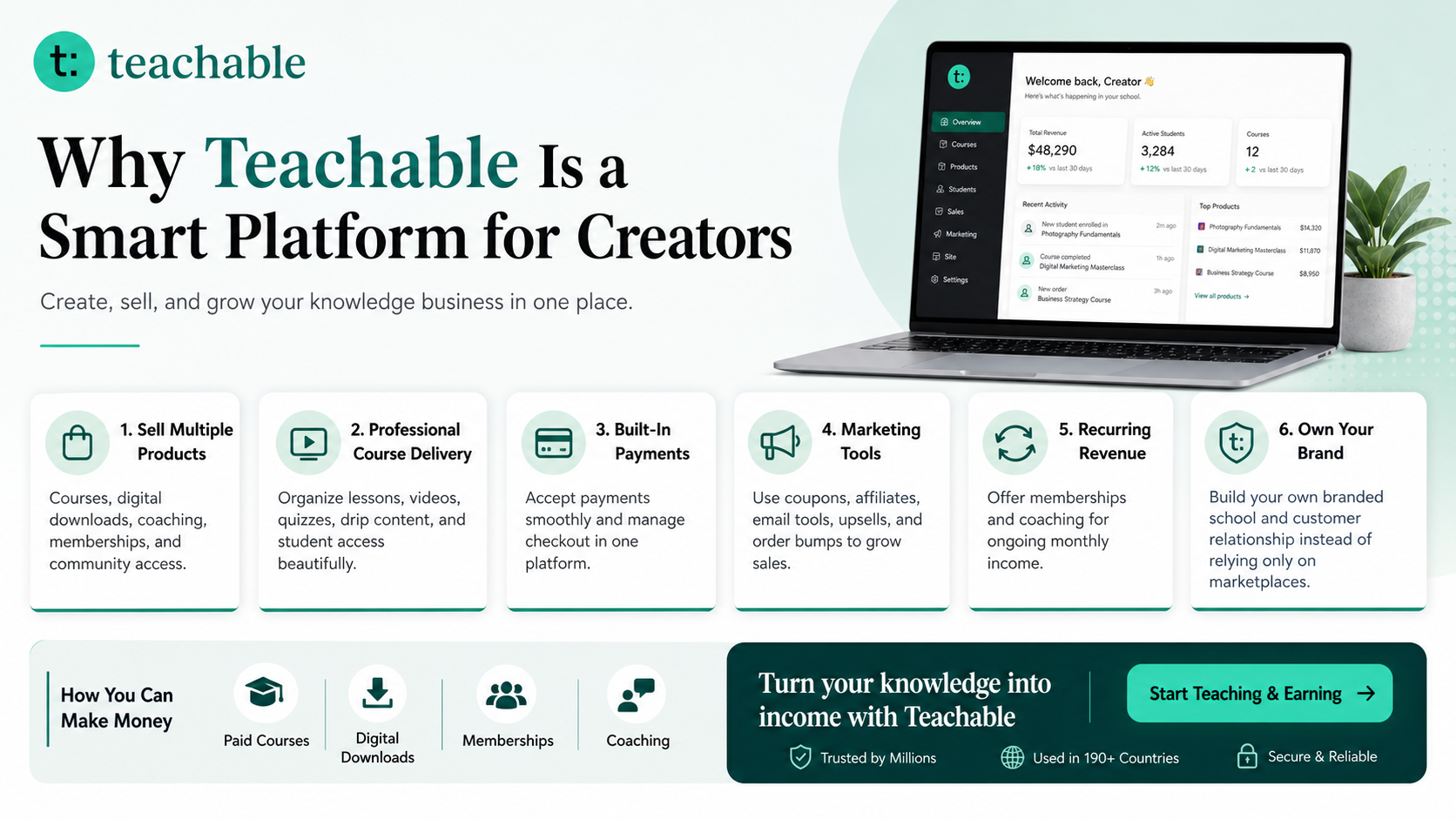
Teachable is an online platform that lets creators build, market, and sell courses, digital downloads, coaching, and memberships. It helps educators and entrepreneurs turn their knowledge into a branded digital business without needing complex coding.
Learn more: How to Make Money with Teachable: A Complete Creator’s Guide
Key Takeaways
- ETFs can be useful for long-term investing because they offer diversification, transparency, and generally low-cost market exposure when used with discipline.
- Use ETFs as portfolio tools, not as shortcuts to guaranteed returns.
- Check expense ratio, liquidity, spread, AUM, tracking error, tracking difference, and benchmark quality.
- Prefer broad, transparent ETFs as the core before adding sector, factor, gold, or international exposure.
- Use limit orders and avoid emotional decisions during volatile markets.
- Review your ETF portfolio periodically, but do not over-monitor it every day.
Internal Links and Further Reading on SenseCentral
- What Are ETFs? Beginner Guide
- How ETFs Work
- ETFs vs Mutual Funds Explained
- How to Buy ETFs
- What Is Tracking Error in ETFs?
- How to Make Money with Teachable: A Complete Creator’s Guide
FAQs
Is how to use etfs for long-term investing important for beginners?
Yes. ETFs can be useful for long-term investing because they offer diversification, transparency, and generally low-cost market exposure when used with discipline. Even if you invest small amounts, understanding this topic can help you choose ETFs more carefully and avoid mistakes that reduce long-term returns.
Are ETFs risk-free?
No. ETFs can reduce single-stock risk by holding a basket of securities, but they still carry market risk, liquidity risk, tracking risk, and sometimes concentration risk. The risk depends on the ETF’s underlying assets and how you use it.
Should I choose the ETF with the lowest expense ratio?
Expense ratio matters, but it should not be the only filter. Also check tracking error, tracking difference, liquidity, bid-ask spread, AUM, index quality, and whether the ETF fits your goal.
Do I need a demat account to buy ETFs in India?
In most cases, exchange-traded ETFs are bought and sold through a demat and trading account because they trade on the stock exchange. Some fund houses may offer fund-of-fund alternatives for investors who do not want direct exchange trading.
How often should I review my ETF portfolio?
For most beginners, reviewing once or twice a year is enough unless there is a major goal change. Frequent checking can encourage emotional decisions and unnecessary trading.
Can I lose money in ETFs?
Yes. ETF prices can fall when the underlying index, sector, commodity, or market falls. Long-term investors should match ETF selection with time horizon and risk tolerance.
References
The following external resources are useful for learning more about ETFs, passive funds, tracking error, and ETF market structure:
- SEBI Investor Education – Understanding Exchange Traded Funds
- SEBI Investor Education – Understanding Tracking Error
- NSE India – Exchange Traded Funds
- NSE India – Tracking Error
- AMFI – Types of Mutual Fund Schemes and Passive Funds
- HDFC Mutual Fund Learner’s Corner – ETFs
- Investopedia – Exchange-Traded Fund
- Investopedia – Authorized Participant
Final thought: ETFs are simple in design but powerful in use. The more clearly you understand the product, the easier it becomes to avoid noise, control costs, diversify sensibly, and stay committed to your long-term plan.