SenseCentral Digital Product Guide
Digital Products vs Physical Products: Which Is Better?
Digital products are intangible resources delivered electronically, such as templates, ebooks, printables, graphics, software, audio, courses, and memberships. This guide explains digital products vs physical products: which is better in plain language. It covers how the model works, why buyers pay, what sellers must provide, how licensing affects use, and which practical steps help newcomers make informed decisions.
Key Takeaways
- Digital products are delivered electronically and can often be sold repeatedly without physical inventory.
- Common formats include templates, ebooks, printables, graphics, software, courses, audio, and memberships.
- Low delivery costs do not mean zero work; marketing, support, licensing, and updates still matter.
- Buyers value clear outcomes, compatibility, ease of use, trustworthy previews, and accurate instructions.
- Beginners should start narrow, test demand, and improve one useful product before scaling.
Understand the Basics: Digital Products vs Physical Products: Which Is Better
Focus on the exchange of value. The seller packages knowledge, design, functionality, access, or convenience into a digital form. The buyer receives that value through a download, account, email link, app, or online portal. No parcel needs to be manufactured and shipped for every order, but the business still requires research, creation, presentation, delivery systems, customer support, and responsible licensing.
Apply the principle by creating a three-column decision note: desired outcome, evidence that confirms the need, and obstacles that could prevent success. This turns a broad topic into an operational plan. It can reveal whether you need a simpler product, clearer instructions, a different format, or more validation before moving forward.
See How the Digital Product Model Works
The category is broad. A digital product can be a small printable checklist, complex software, a stock-graphics collection, an online course, a subscription library, or an editable business template. The best format is the one that makes the intended result easiest for the customer. Beginners should resist copying a format merely because it is popular. Start with the problem, then select the most practical delivery method.
Imagine the first ten minutes after access. The user should know what to open, where to begin, which software is required, and what a successful result looks like. Reduce friction with a README file, descriptive folders, visible version numbers, sample outputs, and concise steps. These details influence perceived quality, support volume, reviews, and actual usage.
Questions and Checks to Complete
- Identify who creates the resource and who benefits.
- Confirm delivery and software requirements.
- Separate file ownership from permission to use content.
- Remember automated delivery still needs maintenance.
- Begin with a small project to learn safely.
Build Faster With Ready-to-Use Resources
Explore Our Powerful Digital Products Bundle
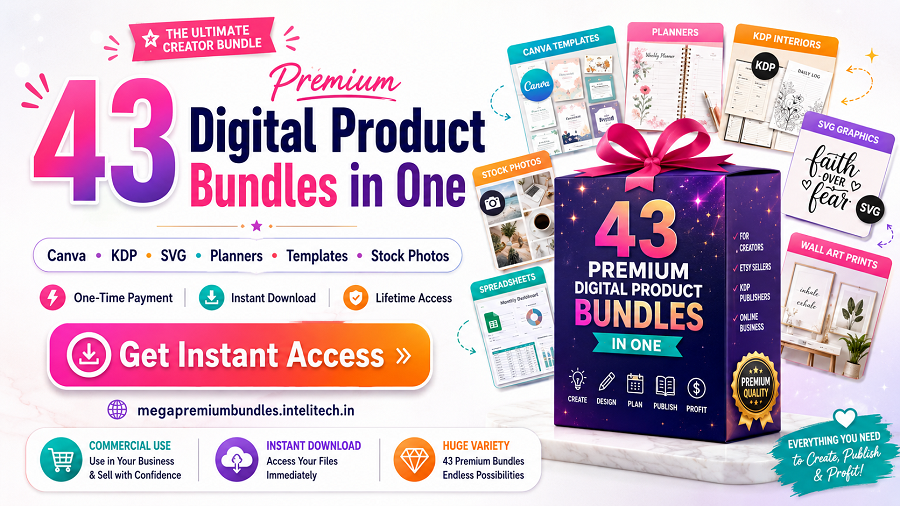
Browse these high-value bundles for website creators, developers, designers, startups, content creators, and digital product sellers. Use the collection as a practical resource when you need editable assets, production shortcuts, or inspiration for multiple projects.
View the complete bundle collection | Buy individual bundles

Resource note: Review included files, software requirements, and licence terms before purchasing or using any bundle.
Explore Common Formats and Examples
Digital delivery changes the cost structure. There may be no packaging or shipping per order, yet creation time, software, hosting, payment processing, platform fees, taxes, promotion, customer service, and updates remain real expenses. This is why digital products can scale efficiently without becoming effortless. A responsible plan includes both the opportunity for repeat sales and the continuing work needed to maintain trust.
Use a real project as the test environment. Generic opinions are less useful than observing whether the resource completes a task under a deadline. Record the steps that worked, the edits required, the missing information, and the final result. A real-use test produces evidence that can guide a purchase, improve a product, or simplify a workflow.
| Feature | Digital product reality | Practical implication |
|---|---|---|
| Delivery | Download, email link, member portal, app, or streaming | No physical shipping is required |
| Inventory | A master file or access-controlled resource | One core product can serve many buyers |
| Formats | PDF, ZIP, PNG, SVG, MP4, MP3, templates, software, and online access | Format follows the intended outcome |
| Costs | Creation, platform, payment, marketing, support, tax, and update costs | Delivery is inexpensive, not cost-free |
| Value | Time saved, knowledge transferred, quality improved, or work simplified | Buyers pay for the result |
| Scalability | Automated delivery and repeatable fulfilment | Growth need not match physical production |
Compare Digital and Physical Product Economics
Buyers do not usually pay for the existence of a file. They pay for saved time, organized knowledge, improved quality, convenience, confidence, entertainment, or access. A plain spreadsheet can be valuable when it solves an expensive problem. A beautiful bundle can be disappointing when it lacks instructions or compatibility. Value is therefore connected to usefulness and fit, not simply visual polish or file count.
Keep the system easy to maintain. Document the source, licence, date, version, software requirements, and support contact. Store an untouched original, a working copy, and a backup. Clear records are especially important when resources are used for clients, team projects, advertising, or products that may generate revenue.
Understand Value, Licensing, and Ownership
Focus on the exchange of value. The seller packages knowledge, design, functionality, access, or convenience into a digital form. The buyer receives that value through a download, account, email link, app, or online portal. No parcel needs to be manufactured and shipped for every order, but the business still requires research, creation, presentation, delivery systems, customer support, and responsible licensing.
Apply the principle by creating a three-column decision note: desired outcome, evidence that confirms the need, and obstacles that could prevent success. This turns a broad topic into an operational plan. It can reveal whether you need a simpler product, clearer instructions, a different format, or more validation before moving forward.
Follow the Buyer and Seller Workflow
The category is broad. A digital product can be a small printable checklist, complex software, a stock-graphics collection, an online course, a subscription library, or an editable business template. The best format is the one that makes the intended result easiest for the customer. Beginners should resist copying a format merely because it is popular. Start with the problem, then select the most practical delivery method.
Imagine the first ten minutes after access. The user should know what to open, where to begin, which software is required, and what a successful result looks like. Reduce friction with a README file, descriptive folders, visible version numbers, sample outputs, and concise steps. These details influence perceived quality, support volume, reviews, and actual usage.
Practical Quality-Control Checklist
- Identify who creates the resource and who benefits.
- Confirm delivery and software requirements.
- Separate file ownership from permission to use content.
- Remember automated delivery still needs maintenance.
- Begin with a small project to learn safely.
Explore a High-Value Digital Product Collection
Explore Our Powerful Digital Products Bundle
Browse these high-value bundles for website creators, developers, designers, startups, content creators, and digital product sellers. Use the collection as a practical resource when you need editable assets, production shortcuts, or inspiration for multiple projects.
View the complete bundle collection | Buy individual bundles
Resource note: Review included files, software requirements, and licence terms before purchasing or using any bundle.
Choose a Practical Starting Point
Digital delivery changes the cost structure. There may be no packaging or shipping per order, yet creation time, software, hosting, payment processing, platform fees, taxes, promotion, customer service, and updates remain real expenses. This is why digital products can scale efficiently without becoming effortless. A responsible plan includes both the opportunity for repeat sales and the continuing work needed to maintain trust.
Use a real project as the test environment. Generic opinions are less useful than observing whether the resource completes a task under a deadline. Record the steps that worked, the edits required, the missing information, and the final result. A real-use test produces evidence that can guide a purchase, improve a product, or simplify a workflow.
Set Up Delivery, Organization, and Support
Buyers do not usually pay for the existence of a file. They pay for saved time, organized knowledge, improved quality, convenience, confidence, entertainment, or access. A plain spreadsheet can be valuable when it solves an expensive problem. A beautiful bundle can be disappointing when it lacks instructions or compatibility. Value is therefore connected to usefulness and fit, not simply visual polish or file count.
Keep the system easy to maintain. Document the source, licence, date, version, software requirements, and support contact. Store an untouched original, a working copy, and a backup. Clear records are especially important when resources are used for clients, team projects, advertising, or products that may generate revenue.
Free Productivity Resource: Zee Sharp
Zee Sharp is a growing suite of free online tools for productivity, development, and creativity. No sign-up. No watermarks. Just tools. It can complement a digital product workflow when you need fast utilities without installing additional software.
Avoid Common Beginner Mistakes
Focus on the exchange of value. The seller packages knowledge, design, functionality, access, or convenience into a digital form. The buyer receives that value through a download, account, email link, app, or online portal. No parcel needs to be manufactured and shipped for every order, but the business still requires research, creation, presentation, delivery systems, customer support, and responsible licensing.
Apply the principle by creating a three-column decision note: desired outcome, evidence that confirms the need, and obstacles that could prevent success. This turns a broad topic into an operational plan. It can reveal whether you need a simpler product, clearer instructions, a different format, or more validation before moving forward.
A Simple Review Routine
- Identify who creates the resource and who benefits.
- Confirm delivery and software requirements.
- Separate file ownership from permission to use content.
- Remember automated delivery still needs maintenance.
- Begin with a small project to learn safely.
Expand Your Creative Resource Library
Explore Our Powerful Digital Products Bundle
Browse these high-value bundles for website creators, developers, designers, startups, content creators, and digital product sellers. Use the collection as a practical resource when you need editable assets, production shortcuts, or inspiration for multiple projects.
View the complete bundle collection | Buy individual bundles
Resource note: Review included files, software requirements, and licence terms before purchasing or using any bundle.
Use a Simple Decision Framework
The category is broad. A digital product can be a small printable checklist, complex software, a stock-graphics collection, an online course, a subscription library, or an editable business template. The best format is the one that makes the intended result easiest for the customer. Beginners should resist copying a format merely because it is popular. Start with the problem, then select the most practical delivery method.
Imagine the first ten minutes after access. The user should know what to open, where to begin, which software is required, and what a successful result looks like. Reduce friction with a README file, descriptive folders, visible version numbers, sample outputs, and concise steps. These details influence perceived quality, support volume, reviews, and actual usage.
Take the Next Practical Steps
Digital delivery changes the cost structure. There may be no packaging or shipping per order, yet creation time, software, hosting, payment processing, platform fees, taxes, promotion, customer service, and updates remain real expenses. This is why digital products can scale efficiently without becoming effortless. A responsible plan includes both the opportunity for repeat sales and the continuing work needed to maintain trust.
Use a real project as the test environment. Generic opinions are less useful than observing whether the resource completes a task under a deadline. Record the steps that worked, the edits required, the missing information, and the final result. A real-use test produces evidence that can guide a purchase, improve a product, or simplify a workflow.
Frequently Asked Questions
Is this topic suitable for complete beginners?
Yes, provided you start with a narrow outcome, learn the relevant file or platform basics, and test a small project before committing significant time or money.
Do digital products create completely passive income?
They can support automated delivery and repeatable sales, but research, marketing, customer support, updates, accounting, and platform management still require attention.
Which format is easiest to start with?
The easiest format is one you already know how to create and the intended user can open easily. PDFs, checklists, spreadsheets, and editable templates are common starting points.
How should files and licences be organized?
Store the original download, working copies, receipt, licence, source link, version, and project notes in one clearly named folder with a reliable backup.
What is the best first step?
Choose one audience, one recurring problem, and one measurable outcome. Then create or evaluate the smallest resource capable of producing that outcome.
Further Reading on SenseCentral
- How to Start Selling Digital Products With No Inventory
- Digital Product Business Ideas You Can Start From Home
- What to Look for Before Buying Digital Downloads
- How to Use Digital Product Bundles for Multiple Projects
Explore more practical guides, comparisons, and digital resource recommendations at SenseCentral.
References and Useful External Resources
- Shopify: What Are Digital Products?
- Etsy Seller Handbook: How to Sell Digital Downloads
- Gumroad Help Center: Start Selling
- Canva Licensing Explained
Editorial note: Platform features, fees, policies, tax handling, and licence terms can change. Verify current details on the official website before making a business or purchasing decision.
Practical Implementation Notes
Turn this guide into action by documenting one decision at a time. Record the audience, intended result, required file formats, software, licence, budget, and deadline. Then identify the smallest next step that produces evidence: compare three products, interview three potential users, build one sample, or complete one real project. Evidence reduces uncertainty more effectively than collecting more ideas.
Review the result after use. Note what saved time, what caused confusion, which instructions were missing, and which parts were never used. Buyers can use this review to improve future purchasing decisions. Sellers can use it to refine the product, previews, onboarding, and support. Over time, this habit creates a more useful resource library and a stronger understanding of genuine value.
Keep expectations realistic. Digital products can be scalable, efficient, and profitable, but outcomes vary. Avoid guarantees and focus on controllable factors: usefulness, accuracy, organization, customer fit, honest communication, responsible licensing, consistent promotion, and ongoing improvement.
- Key Takeaways
- Table of Contents
- Understand the Basics: Digital Products vs Physical Products: Which Is Better
- See How the Digital Product Model Works
- Build Faster With Ready-to-Use Resources
- Explore Common Formats and Examples
- Compare Digital and Physical Product Economics
- Understand Value, Licensing, and Ownership
- Follow the Buyer and Seller Workflow
- Explore a High-Value Digital Product Collection
- Choose a Practical Starting Point
- Set Up Delivery, Organization, and Support
- Free Productivity Resource: Zee Sharp
- Avoid Common Beginner Mistakes
- Expand Your Creative Resource Library
- Use a Simple Decision Framework
- Take the Next Practical Steps
- Frequently Asked Questions
- Is this topic suitable for complete beginners?
- Do digital products create completely passive income?
- Which format is easiest to start with?
- How should files and licences be organized?
- What is the best first step?
- Further Reading on SenseCentral
- References and Useful External Resources
- Practical Implementation Notes