Digital Product Ideas for Busy Entrepreneurs
Digital products sell best when they remove friction from a real task. A buyer rarely wakes up wanting “a downloadable file.” The buyer wants to save time, avoid uncertainty, organize work, look more professional, or reach a result without starting from a blank page. This guide explains digital product ideas for busy entrepreneurs with practical examples, product-design advice, positioning ideas, and quality checks that can help SenseCentral readers make better decisions.
- Key Takeaways
- Table of Contents
- Understand the Buyer Before Creating the Product
- Practical Digital Product Ideas
- 1. One-page business dashboard
- 2. SOP starter library
- 3. Meeting decision tracker
- 4. Quick-launch content calendar
- 5. Client proposal kit
- 6. Founder weekly review
- Comparison Table: Choosing the Right Product Approach
- How to Design a Product Buyers Can Use Quickly
- Start with the smallest successful outcome
- Use sensible defaults
- Include layered instructions
- Design for realistic use
- Free Productivity Resource: Zee Sharp
- How to Position and Describe the Product
- Digital Product Quality and Buyer-Confidence Checklist
- Common Mistakes Digital Sellers Should Avoid
- Creating for everyone
- Adding volume without coherence
- Hiding important requirements
- Using design as a substitute for usability
- Failing to create a feedback loop
- Internal Links and Useful Resources
- Frequently Asked Questions
- What makes a digital product idea worth creating?
- Should sellers create one product or a bundle first?
- How detailed should digital product instructions be?
- How can sellers make a template feel more valuable?
- Can digital products be beginner-friendly and still serve advanced users?
- How often should a digital product be updated?
- Final Thoughts
- Further Reading and References
Key Takeaways
- Build around a specific buyer, situation, and outcome rather than a broad file type.
- Reduce time to first result with examples, previews, instructions, and sensible defaults.
- Use bundles only when the included products support one connected outcome.
- Explain compatibility, editing requirements, licensing, and limitations before purchase.
- Improve products by reviewing support questions, buyer feedback, and repeated points of confusion.
Understand the Buyer Before Creating the Product
The most useful starting point is not a design tool or a marketplace trend. It is a clearly described buyer situation. For this topic, the likely audience includes busy entrepreneurs and people with closely related needs. Their constraints may include limited time, limited confidence, limited budget, or too many competing priorities. These constraints should shape the format, depth, instructions, and price of the product.
Write a one-sentence buyer story before production: “This product helps a specific person complete a specific task under a specific constraint.” That sentence can guide every important decision. A time-strapped buyer may value a shorter template with strong defaults. A creative buyer may value flexibility and visual examples. A first-time buyer may value simple language, compatibility notes, and a clearly numbered setup process.
It is also important to distinguish the buyer from the user. A business owner may purchase a template for an assistant. A parent may purchase a printable for a child. A coach may purchase a workbook for clients. When the purchaser and end user are different, the product should help both people: the purchaser needs confidence in value and licensing, while the user needs clear instructions and a smooth experience.
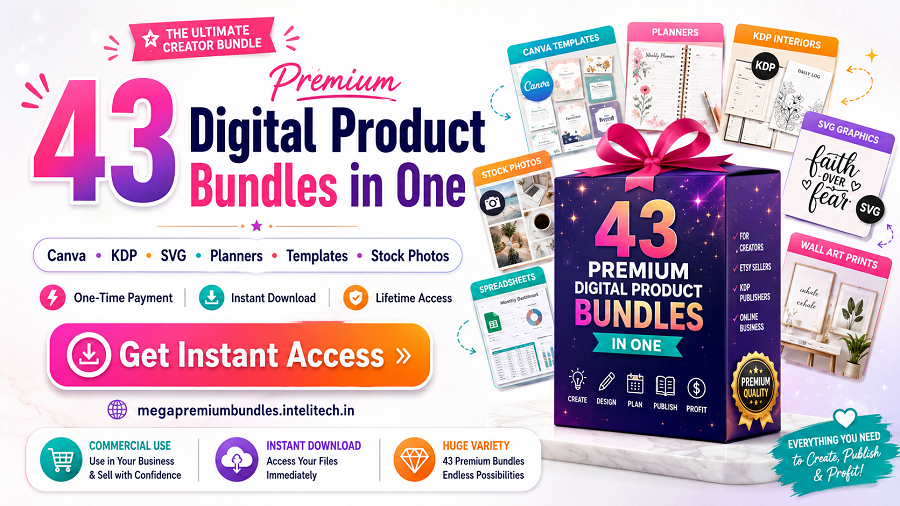
Useful Resource: Explore Our Powerful Digital Products Bundle
Browse high-value bundles for website creators, developers, designers, startups, content creators, and digital product sellers.
Explore Our Powerful Digital Products Bundle
Practical Digital Product Ideas
Strong ideas are specific enough to be understood immediately but flexible enough to be reused. The examples below can be sold individually, combined into a focused bundle, or used as entry products that lead buyers toward a larger product line.
1. One-page business dashboard
A clean dashboard that shows priorities, leads, cash checkpoints, and this week's decisions. The strongest version should be intentionally narrow: it should help busy entrepreneurs move from a familiar problem to a visible result without learning a complicated system. Include a sample, a completed example, editable fields, and a short explanation of when to use the resource.
To add value, offer two levels of use. The first should deliver a result in ten to twenty minutes. The second can show how the buyer can customize, reuse, or expand the resource. This makes the product accessible to beginners while preserving enough depth for repeat use.
2. SOP starter library
Editable procedures for onboarding, customer support, publishing, and routine administration. The strongest version should be intentionally narrow: it should help busy entrepreneurs move from a familiar problem to a visible result without learning a complicated system. Include a sample, a completed example, editable fields, and a short explanation of when to use the resource.
To add value, offer two levels of use. The first should deliver a result in ten to twenty minutes. The second can show how the buyer can customize, reuse, or expand the resource. This makes the product accessible to beginners while preserving enough depth for repeat use.
3. Meeting decision tracker
A compact record of decisions, owners, deadlines, and follow-up questions. The strongest version should be intentionally narrow: it should help busy entrepreneurs move from a familiar problem to a visible result without learning a complicated system. Include a sample, a completed example, editable fields, and a short explanation of when to use the resource.
To add value, offer two levels of use. The first should deliver a result in ten to twenty minutes. The second can show how the buyer can customize, reuse, or expand the resource. This makes the product accessible to beginners while preserving enough depth for repeat use.
4. Quick-launch content calendar
A repeatable monthly content system with prompts, repurposing notes, and publishing status. The strongest version should be intentionally narrow: it should help busy entrepreneurs move from a familiar problem to a visible result without learning a complicated system. Include a sample, a completed example, editable fields, and a short explanation of when to use the resource.
To add value, offer two levels of use. The first should deliver a result in ten to twenty minutes. The second can show how the buyer can customize, reuse, or expand the resource. This makes the product accessible to beginners while preserving enough depth for repeat use.
5. Client proposal kit
Proposal, scope, pricing, timeline, and approval templates that reduce administrative work. The strongest version should be intentionally narrow: it should help busy entrepreneurs move from a familiar problem to a visible result without learning a complicated system. Include a sample, a completed example, editable fields, and a short explanation of when to use the resource.
To add value, offer two levels of use. The first should deliver a result in ten to twenty minutes. The second can show how the buyer can customize, reuse, or expand the resource. This makes the product accessible to beginners while preserving enough depth for repeat use.
6. Founder weekly review
A guided weekly review focused on bottlenecks, revenue activities, delegation, and next actions. The strongest version should be intentionally narrow: it should help busy entrepreneurs move from a familiar problem to a visible result without learning a complicated system. Include a sample, a completed example, editable fields, and a short explanation of when to use the resource.
To add value, offer two levels of use. The first should deliver a result in ten to twenty minutes. The second can show how the buyer can customize, reuse, or expand the resource. This makes the product accessible to beginners while preserving enough depth for repeat use.
Comparison Table: Choosing the Right Product Approach
| Product idea | Buyer value | Creation effort | Best format |
|---|---|---|---|
| One-page business dashboard | A clean dashboard that shows priorities, leads, cash checkpoints, and this week's decisions. | Low to moderate | Editable template or bundle |
| SOP starter library | Editable procedures for onboarding, customer support, publishing, and routine administration. | Low to moderate | Editable template or bundle |
| Meeting decision tracker | A compact record of decisions, owners, deadlines, and follow-up questions. | Low to moderate | Editable template or bundle |
| Quick-launch content calendar | A repeatable monthly content system with prompts, repurposing notes, and publishing status. | Low to moderate | Editable template or bundle |
| Client proposal kit | Proposal, scope, pricing, timeline, and approval templates that reduce administrative work. | Low to moderate | Editable template or bundle |
| Founder weekly review | A guided weekly review focused on bottlenecks, revenue activities, delegation, and next actions. | Low to moderate | Editable template or bundle |
A comparison table is useful because it forces sellers to evaluate more than appearance. The right product format depends on the buyer’s preferred tool, the amount of setup required, the frequency of use, and the type of result expected. A visually impressive product can still disappoint if the buyer cannot understand how to use it.
How to Design a Product Buyers Can Use Quickly
Start with the smallest successful outcome
Define the first useful result the buyer should achieve. This might be publishing one social post, planning one week, calculating one budget, creating one lesson, or outlining one offer. Then design the first page, tab, or template around that result. A buyer who experiences an early win is more likely to continue using the product and view the purchase positively.
Use sensible defaults
Blank templates create freedom, but too much blank space can recreate the exact stress the buyer wanted to avoid. Add sample text, example categories, starter formulas, placeholder imagery, and recommended settings. Clearly label examples so buyers know what to replace. Defaults should accelerate understanding without making the product feel rigid.
Include layered instructions
Use a one-page quick-start guide for buyers who want immediate action, then provide a more detailed guide for customization and troubleshooting. Screenshots, callouts, and short examples are often more useful than long technical paragraphs. Explain file types, required software, mobile limitations, printing guidance, and whether a free or paid account is needed.
Design for realistic use
Test the product in the conditions buyers are likely to face. Open it on a normal laptop, view it on mobile where relevant, print a sample, duplicate the template, change fonts, replace images, and follow the instructions as though you have never seen the file. This reveals confusing labels and hidden dependencies that creators often overlook.
Free Productivity Resource: Zee Sharp
Zee Sharp is a growing suite of free online tools for productivity, development, and creativity. No sign-up, no watermarks—just practical tools.
How to Position and Describe the Product
Product positioning should connect features to buyer outcomes. “Includes 40 pages” is a feature. “Plan an entire month without rebuilding your layout each week” is a benefit. Both pieces of information matter, but the benefit should lead because it explains why the feature is useful.
A strong product description normally answers five questions: Who is this for? What problem does it solve? What exactly is included? What is required to use it? What happens immediately after purchase? Screenshots and mockups should support these answers rather than simply decorating the listing.
Use honest specificity. Avoid promises such as guaranteed income, instant success, or effortless results. A template can make work faster and clearer, but it cannot replace judgment, skill, audience research, or consistent execution. Realistic language builds trust and reduces refunds.
For content marketing, publish articles that mirror different stages of buyer awareness. One article can explain the problem, another can compare formats, another can provide a tutorial, and another can help the reader choose between a single product and a bundle. Link these articles together so readers can move naturally from education to evaluation.
Useful Resource: Explore Our Powerful Digital Products Bundle
Browse high-value bundles for website creators, developers, designers, startups, content creators, and digital product sellers.
Explore Our Powerful Digital Products Bundle
Digital Product Quality and Buyer-Confidence Checklist
- Clear outcome: The product promises one understandable result.
- Defined audience: The product page identifies who will benefit and who may not.
- Accurate previews: Images show actual pages, tabs, layouts, or files.
- Compatibility details: Required software, versions, devices, and account types are stated.
- Quick-start path: Buyers can achieve a first result without reading a long manual.
- Editable elements: The description explains what can and cannot be changed.
- Organized delivery: Folders and filenames are easy to understand.
- License clarity: Personal use, commercial use, resale, and redistribution rules are explicit.
- Support route: Buyers know where to find help and what information to include.
- Quality testing: Links, formulas, fonts, print settings, and downloads have been checked.
Common Mistakes Digital Sellers Should Avoid
Creating for everyone
A broad product often produces vague copy and unnecessary features. Start with one primary buyer and one main use case. Additional audiences can be addressed later through variations, bundles, or separate listings.
Adding volume without coherence
A large bundle is not automatically valuable. Files should work together, use consistent naming, and support a connected result. Remove filler that makes navigation harder or duplicates the same function without a meaningful difference.
Hiding important requirements
Do not bury software requirements, account limitations, font needs, or licensing restrictions. These details influence whether the buyer can use the product and should appear in the main description, FAQ, and instruction file.
Using design as a substitute for usability
Attractive presentation matters, but buyers remember whether the product worked. Prioritize readable typography, clear labels, logical structure, and tested instructions before adding decorative elements.
Failing to create a feedback loop
Track repeated questions and update the product. A single question may be unusual; the same question from several buyers usually indicates a clarity problem. Improvements can include a new screenshot, a revised instruction page, a renamed folder, or a short tutorial.
Internal Links and Useful Resources
- SenseCentral product guides and comparisons
- More SenseCentral articles about digital products
- SenseCentral Canva template resources
- SenseCentral productivity resources
Useful Resource: Explore Our Powerful Digital Products Bundle
Browse high-value bundles for website creators, developers, designers, startups, content creators, and digital product sellers.
Explore Our Powerful Digital Products Bundle
Frequently Asked Questions
What makes a digital product idea worth creating?
A worthwhile idea solves a recognizable problem for a defined buyer, can be explained in one or two sentences, and creates a result that can be previewed. Validate it through search behavior, buyer questions, competitor reviews, audience conversations, and a small first version.
Should sellers create one product or a bundle first?
A focused single product is often easier to test. Once buyers respond positively, related resources can be added as an upgrade or bundle. Start with a bundle only when the components are simple, cohesive, and clearly support one outcome.
How detailed should digital product instructions be?
Instructions should cover download access, file types, required tools, first-use steps, customization, saving or exporting, common errors, licensing, and support. Use both a quick-start section and detailed troubleshooting guidance.
How can sellers make a template feel more valuable?
Improve usefulness rather than simply increasing page count. Add examples, multiple practical variations, reusable components, a clean organization system, tested instructions, and a clear license. Show how the parts work together.
Can digital products be beginner-friendly and still serve advanced users?
Yes. Use layered design: a guided default workflow for beginners and optional customization for experienced users. Avoid forcing every buyer through advanced settings before they can achieve a basic result.
How often should a digital product be updated?
Review it whenever the software changes, links break, buyer questions repeat, or design conventions shift. A quarterly quality check is useful for active shops, while major updates should be driven by actual compatibility or usability needs.
Final Thoughts
The central lesson behind digital product ideas for busy entrepreneurs is that buyers value reduced friction. They want a trustworthy starting point, a clear path, and confidence that the resource fits their tools and situation. Sellers who combine focused outcomes, realistic previews, thoughtful instructions, and responsive improvement can create products that feel useful from the first click and continue delivering value over time.
Further Reading and References
- Canva Help Center — official guidance for editing, sharing, and exporting Canva designs.
- Notion Help Center — official documentation for pages, databases, sharing, and templates.
- Amazon KDP Help — official publishing, formatting, and content guidance.
- Microsoft Excel Help & Learning — official spreadsheet guidance and feature documentation.
- Etsy Seller Handbook — marketplace education for listings, customer experience, and shop management.
Disclosure: Some links in this article may be promotional or affiliate links. SenseCentral may earn a commission if a reader purchases through an eligible link, at no additional cost to the reader.