To enable intelligent comparisons to be made between different engines’ ability to pull or operate at various speeds, we shall now consider engine design parameters and their relationship in influencing performance capability.
Piston displacement or swept volume
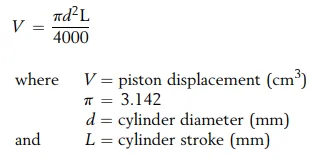
When the piston moves from one end of the cylinder to the other, it will sweep or displace air equal to the cylinder volume between TDC and BDC. Thus the full stroke movement of the piston is known as either the swept volume or the piston displacement.
The swept or displaced volume may be calculated as follows:
Mean effective pressure
The cylinder pressure varies considerably while the gas expands during the power stroke. Peak pressure will occur just after TDC, but this will rapidly drop as the piston moves towards BDC. When quoting cylinder pressure, it is therefore more helpful to refer to the average or mean effective pressure throughout the whole power stroke. The units used for mean effective pressure may be either kilonewtons per square metre (kN/m2 ) or bars (note: 1 bar = 100 kN/m2 ).