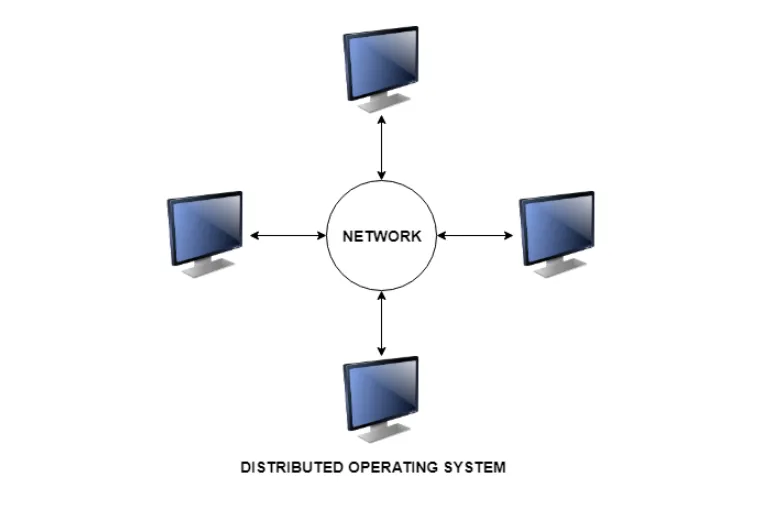
A distributed system contains multiple nodes that are physically separate but linked together using the network. All the nodes in this system communicate with each other and handle processes in tandem. Each of these nodes contains a small part of the distributed operating system software.
A diagram to better explain the distributed system is:
Types of Distributed Systems
The nodes in the distributed systems can be arranged in the form of client/server systems or peer to peer systems. Details about these are as follows:
Client/Server Systems
In client server systems, the client requests a resource and the server provides that resource. A server may serve multiple clients at the same time while a client is in contact with only one server. Both the client and server usually communicate via a computer network and so they are a part of distributed systems.
Peer to Peer Systems
The peer to peer systems contains nodes that are equal participants in data sharing. All the tasks are equally divided between all the nodes. The nodes interact with each other as required as share resources. This is done with the help of a network.
Advantages of Distributed Systems
Some advantages of Distributed Systems are as follows:
- All the nodes in the distributed system are connected to each other. So nodes can easily share data with other nodes.
- More nodes can easily be added to the distributed system i.e. it can be scaled as required.
- Failure of one node does not lead to the failure of the entire distributed system. Other nodes can still communicate with each other.
- Resources like printers can be shared with multiple nodes rather than being restricted to just one.
Disadvantages of Distributed Systems
Some disadvantages of Distributed Systems are as follows:
- It is difficult to provide adequate security in distributed systems because the nodes as well as the connections need to be secured.
- Some messages and data can be lost in the network while moving from one node to another.
- The database connected to the distributed systems is quite complicated and difficult to handle as compared to a single user system.
- Overloading may occur in the network if all the nodes of the distributed system try to send data at once.