Let us study the height of the water surface in the case where a cylindrical vessel filled with liquid is rotating at constant angular velocity o. The movement at constant angular velocity like this is sometimes called gyrostatics, where the liquid surface poses a concave free surface. Then let us take cylindrical coordinates (r,O,z) as shown in Fig. 3.21. Consider a minute element of mass m on the equipressure plane. The forces acting on it are -mg due to the gravitational acceleration g in the vertical direction and -mro2 due to the centripetal acceleration rw2 in the horizontal direction.
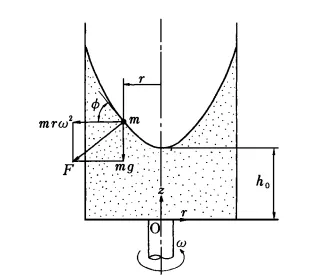
Since the vessel and liquid move in a body and the liquid stays in a relatively stationary state, the resultant force F is vertical to the free surface as in the previous case. If 4 is the angle formed by the free surface and the horizontal direction,
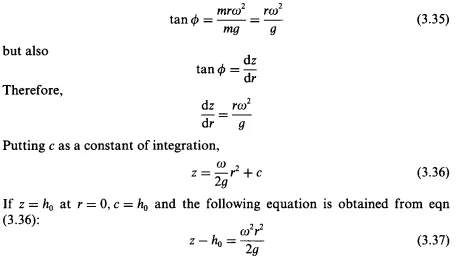
The free surface is now a rotating parabolic surface.