
Routing Protocols are the set of defined rules used by the routers to communicate between source & destination. They do not move the information to the source to a destination, but only update the routing table that contains the information.
Network Router protocols helps you to specify way routers communicate with each other. It allows the network to select routes between any two nodes on a computer network.
Types of Routing Protocols
There are mainly two types of Network Routing Protocols
- Static
- Dynamic
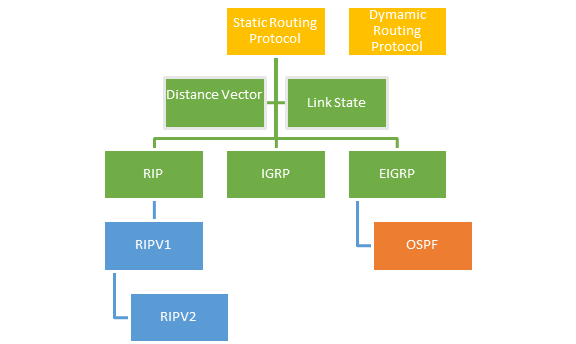
Routing Protocols
Static Routing Protocols
Static routing protocols are used when an administrator manually assigns the path from source to the destination network. It offers more security to the network.
Advantages
- No overhead on router CPU.
- No unused bandwidth between links.
- Only the administrator is able to add routes
Disadvantages
- The administrator must know how each router is connected.
- Not an ideal option for large networks as it is time intensive.
- Whenever link fails all the network goes down which is not feasible in small networks.
Dynamic Routing Protocols
Dynamic routing protocols are another important type of routing protocol. It helps routers to add information to their routing tables from connected routers automatically. These types of protocols also send out topology updates whenever the network changes’ topological structure.
Advantage:
- Easier to configure even on larger networks.
- It will be dynamically able to choose a different route in case if a link goes down.
- It helps you to do load balancing between multiple links.
Disadvantage:
- Updates are shared between routers, so it consumes bandwidth.
- Routing protocols put an additional load on router CPU or RAM.