Joule’s experiment

Rajil TL
1 Min Read
Disclosure: This website may contain affiliate links, which means I may earn a commission if you click on the link and make a purchase. I only recommend products or services that I personally use and believe will add value to my readers. Your support is appreciated!

• Joule’s experiment (1840-1849) to investigate the equivalence of heat and work.

• Prior to Joule, heat was considered to be a invisible fluid known as caloric and flows from a body of higher caloric to one with a lower caloric.

• Caloric theory of heat

• Joule’s experiment laid the foundation of the first law of thermodynamics.

Joule’s experiment
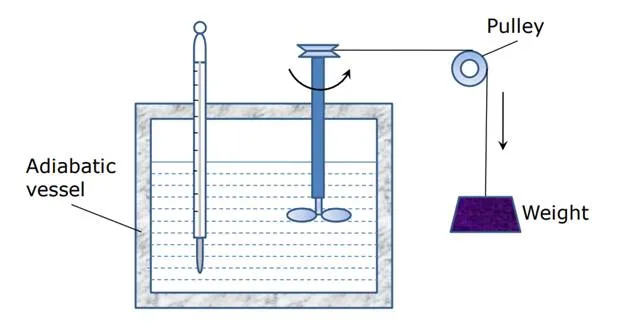
• Work, W1-2 done on the system can be measured by the fall of the weight.

• The system temperature rises as work is done on the system.

• Let the insulation now be removed.

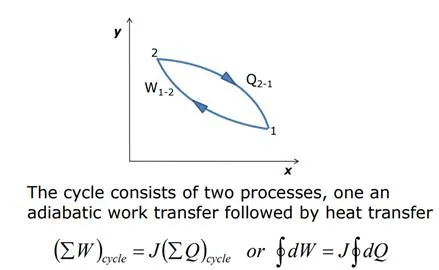
• The system reaches its initial state by heat transfer across the system boundaries.

• Therefore the work done is proportional to the heat transfer.

• The constant of proportionality is the Joule’s equivalent.
Share This Article

Rajil TL is a SenseCentral contributor focused on tech, apps, tools, and product-building insights. He writes practical content for creators, founders, and learners—covering workflows, software strategies, and real-world implementation tips. His style is direct, structured, and action-oriented, often turning complex ideas into step-by-step guidance. He’s passionate about building useful digital products and sharing what works.

Leave a review