Parallel Reactions

Rajil TL
1 Min Read
Disclosure: This website may contain affiliate links, which means I may earn a commission if you click on the link and make a purchase. I only recommend products or services that I personally use and believe will add value to my readers. Your support is appreciated!

The net rate of disappearance of A

Instantaneous selectivity

If α > β use high concentration of A. Use PFR.
If α < β use low concentration of A. Use CSTR.


Series Reactions (p. 283)

Example: Series Reaction in a batch reactor

This series reaction could also be written as         

Reaction (1) : -r1A=k1CA

Reaction (2): -r2B=k2CB

Mole Balance on every species

Species A:Combined mole balance and rate law for a control volume batch reactor.
Net Rate of Reaction of A
 rA=r1A+0
Rate Law
 r1A=-k1ACA
Relative Rates
 r1B=-r1A
 
Integrating with CA=CA0 at t=0 and then rearranging
Mole Balance
Species B:
Net Rate of Reaction of B
 
Rate Law
 r2B=-k2CB
Relative Rates
 
 
Combine
Using the integrating factor, i.f.:
Evaluate
   
at t = 0, CB = 0
When should you stop the reaction to obtain the maximum amount of B? Let’s see.
Optimization of the Desired Product B
Then
Species CCC = CA0 – CB – CA
And

 Finding the Selectivity

 in a CSTR

Concentration-Time Trajectories

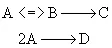
Schemes for maximizing the selectivity for Van Der Vusse Kinetics
Share This Article

Rajil TL is a SenseCentral contributor focused on tech, apps, tools, and product-building insights. He writes practical content for creators, founders, and learners—covering workflows, software strategies, and real-world implementation tips. His style is direct, structured, and action-oriented, often turning complex ideas into step-by-step guidance. He’s passionate about building useful digital products and sharing what works.

Leave a review