
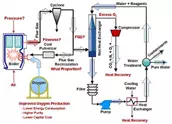
Combustion or burning is the sequence of exothermic chemical reactions between a fuel and an oxidant accompanied by the production of heat and conversion of chemical species. The release of heat can result in the production of light in the form of either glowing or a flame. Fuels of interest often include organic compounds (especially hydrocarbons) in the gas, liquid or solid phase.
In a complete combustion reaction, a compound reacts with an oxidizing element, such as oxygen or fluorine, and the products are compounds of each element in the fuel with the oxidizing element. For example:
CH4 + 2O2 → CO2 + 2H2O + energy
CH2S + 6F2 → CF4 + 2HF + SF6
A simple example can be seen in the combustion of hydrogen and oxygen, which is a commonly used reaction in rocket engines:
2H2 + O2 → 2H2O(g) + heat
The result is water vapor.
Complete combustion is almost impossible to achieve. In reality, as actual combustion reactions come to equilibrium, a wide variety of major and minor species will be present such as carbon monoxide and pure carbon (soot or ash). Additionally, any combustion in air, which is 78% nitrogen, will also create several forms of nitrogen oxides.