Skip to content
Wed, Oct 14, 2026 / Ideas for a clearer worldINDEPENDENT INSIGHTS · PRACTICAL TOOLS · EXPLAINERS
Sign in
High voltage / August 11, 2021

Sphere-Sphere Intersection

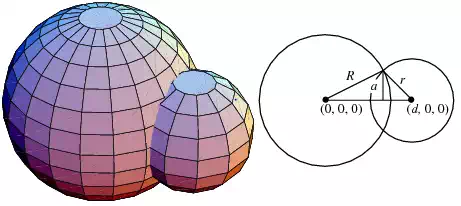
Let two spheres of radii  and  be located along the x-axis centered at  and , respectively. Not surprisingly, the analysis is very similar to the case of the circle-circle intersection. The equations of the two spheres are (1) (2) Combining (1) and (2) gives (3) Multiplying through and rearranging give (4) Solving for  gives (5) The intersection of the spheres is therefore a curve lying in a plane parallel to […]

Let two spheres of radii Description: Description: Description: R and Description: Description: Description: r be located along the x-axis centered at Description: Description: Description: (0,0,0) and Description: Description: Description: (d,0,0), respectively. Not surprisingly, the analysis is very similar to the case of the circle-circle intersection. The equations of the two spheres are

Description: Description: Description: x^2+y^2+z^2Description: Description: Description: =Description: Description: Description: R^2(1)
Description: Description: Description: (x-d)^2+y^2+z^2Description: Description: Description: =Description: Description: Description: r^2.(2)

Combining (1) and (2) gives

Description: Description: Description:  (x-d)^2+(R^2-x^2)=r^2. (3)

Multiplying through and rearranging give

Description: Description: Description:  x^2-2dx+d^2-x^2=r^2-R^2. (4)

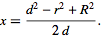
Solving for Description: Description: Description: x gives

Description: Description: Description:  x=(d^2-r^2+R^2)/(2d). (5)

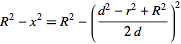
The intersection of the spheres is therefore a curve lying in a plane parallel to the Description: Description: Description: yz-plane at a single Description: Description: Description: x-coordinate. Plugging this back into (◇) gives

Description: Description: Description: y^2+z^2Description: Description: Description: =Description: Description: Description: R^2-x^2=R^2-((d^2-r^2+R^2)/(2d))^2(6)
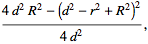
Description: Description: Description: http://mathworld.wolfram.com/images/equations/Sphere-SphereIntersection/Inline17.webpDescription: Description: Description: =Description: Description: Description: (4d^2R^2-(d^2-r^2+R^2)^2)/(4d^2),(7)

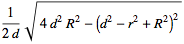
which is a circle with radius

Description: Description: Description: aDescription: Description: Description: =Description: Description: Description: 1/(2d)sqrt(4d^2R^2-(d^2-r^2+R^2)^2)(8)
Description: Description: Description: http://mathworld.wolfram.com/images/equations/Sphere-SphereIntersection/Inline23.webpDescription: Description: Description: =Description: Description: Description: 1/(2d)[(-d+r-R)(-d-r+R)(-d+r+R)(d+r+R)]^(1/2).(9)

The volume of the three-dimensional lens common to the two spheres can be found by adding the two spherical caps. The distances from the spheres’centers to the bases of the caps are

Description: Description: Description: d_1Description: Description: Description: =Description: Description: Description: x(10)
Description: Description: Description: d_2Description: Description: Description: =Description: Description: Description: d-x,(11)

so the heights of the caps are

Description: Description: Description: h_1Description: Description: Description: =Description: Description: Description: R-d_1=((r-R+d)(r+R-d))/(2d)(12)
Description: Description: Description: h_2Description: Description: Description: =Description: Description: Description: r-d_2=((R-r+d)(R+r-d))/(2d).(13)

The volume of a spherical cap of height Description: Description: Description: h^' for a sphere of radius Description: Description: Description: R^' is

Description: Description: Description:  V(R^',h^')=1/3pih^('2)(3R^'-h^'). (14)

Letting Description: Description: Description: R_1=R and Description: Description: Description: R_2=r and summing the two caps gives

Description: Description: Description: VDescription: Description: Description: =Description: Description: Description: V(R_1,h_1)+V(R_2,h_2)(15)
Description: Description: Description: http://mathworld.wolfram.com/images/equations/Sphere-SphereIntersection/Inline45.webpDescription: Description: Description: =Description: Description: Description: (pi(R+r-d)^2(d^2+2dr-3r^2+2dR+6rR-3R^2))/(12d).(16)

This expression gives Description: Description: Description: V=0 for Description: Description: Description: d=r+R as it must. In the special case Description: Description: Description: r=R, the volume simplifies to

Description: Description: Description:  V=1/(12)pi(4R+d)(2R-d)^2. (17)

In order for the overlap of two equal spheres to equal half the volume of each individual sphere, the spheres must be separated by a distance

Description: Description: Description: dDescription: Description: Description: =Description: Description: Description: (x^3-12x+8)_2(18)
Description: Description: Description: http://mathworld.wolfram.com/images/equations/Sphere-SphereIntersection/Inline54.webpDescription: Description: Description: =Description: Description: Description: 2sqrt(3)sin(2/9pi)-2cos(2/9pi)(19)
Description: Description: Description: http://mathworld.wolfram.com/images/equations/Sphere-SphereIntersection/Inline57.webpDescription: Description: Description: =Description: Description: Description: 0.694592710... 

Sphere to Plane Contact Force (3D)

his block implements a contact force between a sphere and a plane. The force is active above and below the plane. This is part of the Simscape Multibody Contact Forces Library
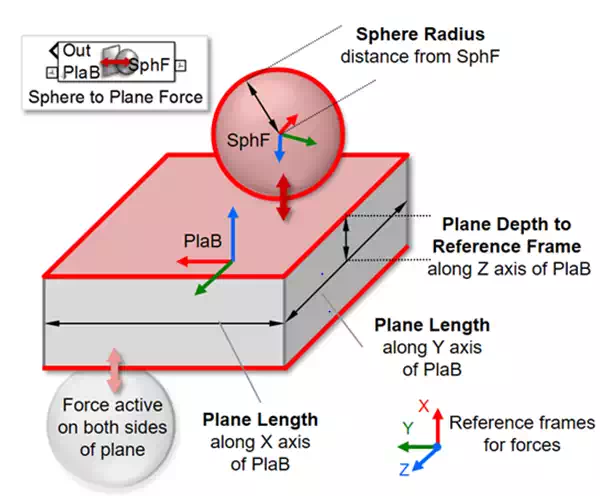
Frame connected to PlaB port:

  • Located at midpoint of plane (x, y, and z).
  • Z-axis is normal to the surfaces where force is active.

Frame connected to the SphF port:

  • Located at center of sphere.
  • Orientation does not matter.

Output signal is a bus with intermediate calculations and total force.