WHAT IS A FIRST-ORDER HOMOGENEOUS ODE?
Now any differential equation with  is a first-order ODE. This type of equation does not have any higher-order derivative.
Next is ‘homogeneous.’
Now any first-order ODE is homogeneous if the total degree for each term is the same.
For example, 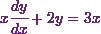 is a first-order homogeneous ODE. This is because each term has a degree 1.
Again, 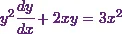 is also a first-order homogeneous ODE. This is because each term has a total degree as 2.
But 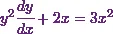 is not a homogeneous ODE. This is because each term does not have the same degree.
HOW CAN I SOLVE A FIRST-ORDER HOMOGENEOUS ODE?
Now there is a standard method to solve any first-order homogeneous ODE.
That is,
Choose  .
.
Replace  and with
  and
and  respectively.
Solve the equation.
Bring back .
Next, I will solve an example on the first-order homogeneous ODE.
EXAMPLE
According to Stroud and Booth (2013)* “Find the general solution of 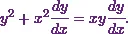 ”
”
SOLUTION
Here the given ordinary differential equation (ODE) is:
![\[y^2+ x^2\cfrac{dy}{dx} = xy \cfrac{dy}{dx}.\]](https://appassets.softecksblog.in/engineering_mathematics/assets/em2/7_files/image010.webp)
This equation has only and no  Hence this is a first-order ODE.
Now, in this equation, each term has a total degree of  .
.
For example,  has a degree .
Similarly,  has the same degree of .
But the term  has the total degree as . This is because
  has a degree of
  and also has a degree of .
So together it’s  .
.
Thus I can say that this is a homogeneous equation.
Now I’ll solve this equation using the same method as I’ve described above.
STEP 1
First of all, I’ll give this equation a number, say,
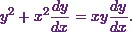
Now I choose .
Therefore, I’ll differentiate with respect to . For that, I’ll use the product rule of differentiation.
Thus it will be
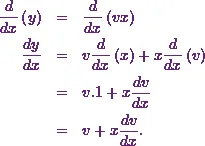
Now I’ll substitute and  in equation (1).
Thus it will be

Now I’ll simplify it to get
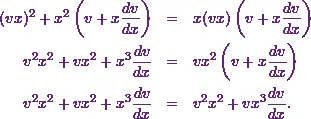
Next I’ll cancel  to get
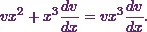
Now I can see that each term also has as a common term.
So I’ll take that out like

Since  I can cancel that from both sides of the equation.
Thus it becomes
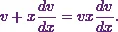
It’s not possible to simplify it any more.
So now my job is to solve it.
STEP 2
First of all, I’ll take the term on one side.
So equation (2) will be
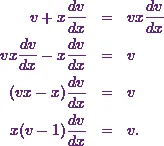
Now it’s very clear that I can separate and variables to solve the equation.
In other words, I’ll use ‘separation of variables’ method to solve this equation.
Therefore the equation will be
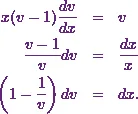
Now I’ll integrate both sides of the equation to get .
Thus it will be
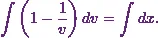
So this gives
![\[v - \ln v &=& \ln x + \ln C.\]](https://appassets.softecksblog.in/engineering_mathematics/assets/em2/7_files/image032.webp)
Here  is the integration constant.
As a next step, I’ll bring back in the solution.
STEP 3
Next, I’ll replace with  .
.
So it will be
![\[\frac{y}{x}- \ln \frac{y}{x} = \ln x + \ln C.\]](https://appassets.softecksblog.in/engineering_mathematics/assets/em2/7_files/image035.webp)
Now I’ll bring logarithmic expressions on one-side.
Therefore it becomes
![\[\frac{y}{x} = \ln x + \ln C + \ln \frac{y}{x}.\]](https://appassets.softecksblog.in/engineering_mathematics/assets/em2/7_files/image036.webp)
Next, I’ll work on the logarithmic functions of this solution.
As I already know  , I can say
  .
.
So the equation will become
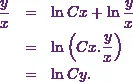
Next I’ll take anti-logarithm on both sides.
Thus it will be
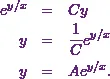
Here 
Hence I can conclude that the general solution of the equation is 
This is the answer to this example.