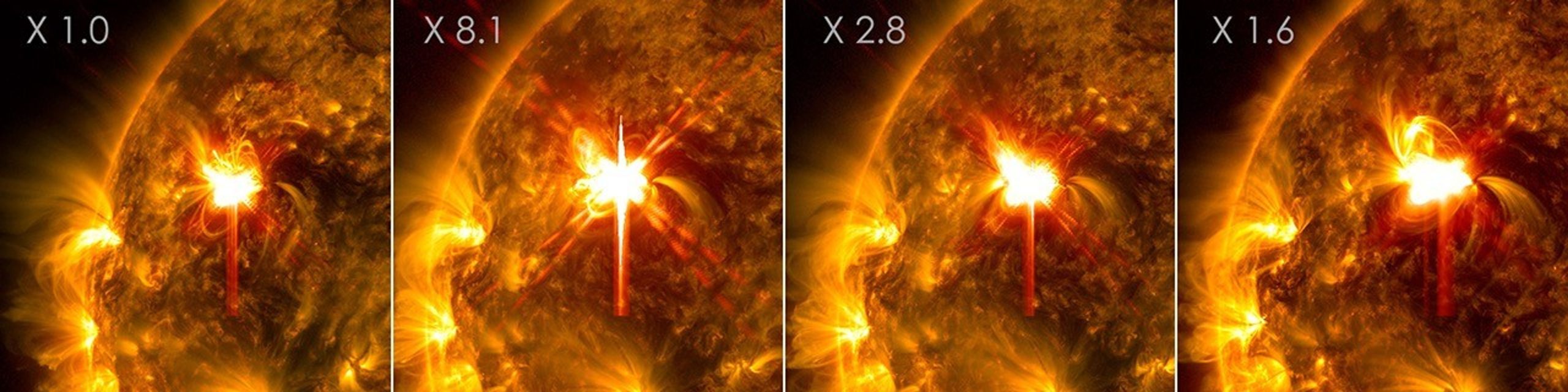
February 2026 has delivered one of the clearest reminders in recent memory that space weather is not just an abstract astronomical topic. It is an active, measurable force with real implications for communications systems, navigation networks, satellites, power infrastructure, and human spaceflight. In the first days of the month, the Sun produced an unusually intense sequence of major eruptions. NASA reported that the Sun emitted three strong flares on February 1 and a fourth on February 2, while the agency’s Solar Dynamics Observatory captured the events in detail. Those four early flares were classified as X1.0, X8.1, X2.8, and X1.6, respectively. X-class is the most powerful class used in standard flare classification, which immediately made this burst notable even before the full scale of the month’s activity was understood.
Then the pattern widened. NASA’s later February visualization summarized that, in early February alone, the Sun emitted more than 50 flares, including several X-class events. NOAA’s Space Weather Prediction Center also tracked the same active solar region, labeled AR 4366, and noted on February 5 that since emerging on January 30 it had already produced 21 C-class flares, 38 M-class flares, and 5 X-class flares. That combination of frequency and intensity turned the opening week of the month into a real-world case study in solar behavior during an active phase of the solar cycle.
What exactly happened on the Sun?
A solar flare is a sudden release of magnetic energy from the Sun’s atmosphere. These eruptions occur when twisted magnetic field lines in active regions become unstable and reconnect, releasing enormous amounts of energy across the electromagnetic spectrum. The radiation from a flare can reach Earth in roughly eight minutes, because it travels at the speed of light. The most immediate effects are usually felt in the upper atmosphere, where intense X-ray and ultraviolet radiation can ionize layers of the ionosphere and interfere with high-frequency radio communications.
That is why strong flares are often described in operational terms, not just scientific ones. NASA explicitly notes that flares and related solar eruptions can affect radio communications, electric power grids, navigation signals, and spacecraft and astronaut safety. NOAA’s February 5 update illustrates this point well. The agency reported an X1.5 flare from AR 4366 and emphasized that the same region had already produced an X8.1 flare on February 1, accompanied by a coronal mass ejection, or CME, that could produce glancing effects near Earth on February 5 to 6. A flare and a CME are not identical events, but they often occur together. A flare is an electromagnetic blast; a CME is a large cloud of charged solar plasma and magnetic field that can travel outward through space and interact with Earth’s magnetosphere.
The distinction matters. A flare can produce rapid radio blackouts on the sunlit side of Earth almost immediately. A CME, by contrast, can take hours to days to arrive. When a CME interacts strongly with Earth’s magnetic field, it can drive geomagnetic storms. Those storms can enhance auroras, but they can also disturb satellite operations, increase atmospheric drag on spacecraft, create issues for power transmission systems, and introduce errors into some positioning and timing services.
Why the timing matters: the Sun is still in a heightened state
One reason this episode is so important is that it fits into a broader pattern of elevated solar activity. NASA says the Sun reached the most active phase of the current solar cycle, known as solar maximum, in 2024. Even though that peak has already been identified, the Sun remains in a heightened period of activity. That means bursts like the February sequence are not isolated curiosities. They are part of a larger phase in which active regions can appear quickly, grow more magnetically complex, and generate repeated eruptions over short periods.
For the public, solar maximum is often associated with spectacular auroral displays. For engineers and operators, however, it is a period that demands closer monitoring. The same physical conditions that produce beautiful auroras also increase the probability of service disruptions or operational anomalies. This is especially relevant in a world that is more dependent than ever on satellite communications, precision navigation, orbital assets, and data infrastructure that can be indirectly affected by upper-atmosphere disturbances.
That is one reason NASA and NOAA play complementary roles. NASA, as the research arm, studies the Sun and the heliophysical environment in depth using spacecraft such as the Solar Dynamics Observatory. NOAA, through the Space Weather Prediction Center, translates observational and model-based information into practical forecasts, watches, warnings, and alerts. February’s flare sequence is a strong example of how research-grade solar observations and public operational forecasting now function as parts of the same national and global resilience system.
The significance of AR 4366
AR 4366 became the focal point of much of the early-month discussion because it behaved like a highly productive flare engine. NOAA’s running tally on February 5 showed that the region was not simply producing one isolated major event. It was repeatedly releasing energy across multiple intensity classes. The count of 21 C-class, 38 M-class, and 5 X-class flares in just a few days demonstrates the kind of magnetic instability that space-weather forecasters watch closely.
Scientifically, such a region is valuable because it allows researchers to compare how flare productivity changes as a sunspot group rotates into view, evolves, and potentially destabilizes. Operationally, it also gives forecasters an ongoing target. If a region is especially complex and is rotating into an Earth-facing position, the risk profile changes. A powerful event from a far-side or edge-on region may be visually dramatic but less geoeffective. A similar event from a well-placed Earth-facing region can matter much more for real-world systems.
This is why the phrase “continued monitoring” appears so often in official updates. Solar forecasting is not a one-and-done announcement. It is an evolving assessment based on changing solar geometry, magnetic complexity, flare history, and whether any associated CME is expected to intersect Earth. In practical terms, that means the first burst of activity is only the start of the story. The bigger question is whether the active region remains productive and whether any associated plasma clouds are Earth-directed.
Why these flares matter beyond astronomy headlines
Major solar flares can sound distant because they happen 150 million kilometers away, but their consequences can become local very quickly. High-frequency radio users, aviation operators on polar routes, mariners, emergency communications planners, power-grid analysts, satellite operators, and mission control teams all have reasons to care about severe solar activity. Even when a specific event produces only minor or glancing impacts, the event contributes to risk awareness and to better calibration of forecasting systems.
For satellite operators, one issue is not only radiation exposure but the changing behavior of Earth’s upper atmosphere during active space weather. When the upper atmosphere heats and expands, satellites in low Earth orbit can encounter increased drag. That can alter orbital predictions and require adjustments. For navigation and timing services, ionospheric disturbances can degrade signal quality or reduce accuracy. For crewed spaceflight, radiation and system reliability concerns become more important when solar activity spikes.
For ordinary readers, the most visible outcome may be aurora. Yet the aurora is just the photogenic edge of a much larger chain of interactions. Charged particles and disturbed magnetic fields create the light show, but the same processes can also complicate infrastructure on which modern economies depend. That is why space weather is increasingly discussed in the language of resilience, forecasting, and preparedness rather than only in the language of skywatching.
What scientists are learning from this burst
Every active solar episode gives scientists more data on how eruptions begin, how fast they escalate, and how well forecast models anticipate both their onset and their effects. NASA’s multi-wavelength imagery is especially useful because different wavelengths reveal different layers and temperatures in the solar atmosphere. A flare can look very different depending on whether researchers are emphasizing hot flare plasma, coronal structure, or other features. Those layered observations help scientists reconstruct how energy builds and releases in active regions.
The February burst is also a reminder that the most operationally important science is often the science that improves lead time. The better researchers understand magnetic complexity and flare precursors, the better forecasters can estimate whether an active region is merely noisy or genuinely dangerous. There is still no perfect long-range prediction system for flare timing, but every high-activity window adds to the comparative database used to improve models.
This matters because space-weather forecasting is moving in the same general direction as meteorology did over decades: toward higher resolution, faster updates, and better risk translation. Solar events will never be controlled, but they can be better interpreted. That shift has real value for utilities, satellite fleets, transportation systems, defense planners, and scientific missions.
The bigger picture for 2026
It would be a mistake to treat February’s flare surge as the “end” of the story simply because the first burst made headlines. NASA has already made clear that the Sun remains in an active phase following the 2024 solar-maximum peak. That means 2026 could continue to deliver intervals of heightened flare production, coronal mass ejections, and geomagnetic effects. Some periods will be quieter, some more intense, but the background level of vigilance remains elevated.
For science communicators, this is a chance to bring public attention to an underappreciated field. Space weather sits at the intersection of astrophysics, plasma physics, Earth science, communications technology, and infrastructure risk. It is one of the clearest examples of how fundamental science connects directly to everyday systems. A strong flare is at once a plasma event, a forecasting challenge, a data opportunity, and a potential operational hazard.
For policymakers and infrastructure operators, the lesson is even simpler: resilience to space weather is no longer optional. The more connected and space-reliant modern life becomes, the more important it is to design systems that can tolerate temporary disturbances, recover quickly, and incorporate live operational guidance.
Final takeaway
The early-February 2026 flare surge matters because it combined frequency, intensity, and practical relevance. NASA documented a sequence of strong X-class events and then summarized more than 50 flares in the opening part of the month. NOAA tracked the unusually productive AR 4366 region and continued to evaluate Earth-impact potential as new eruptions occurred. Together, those updates show why solar activity deserves close attention in 2026.
This was not just a dramatic week on the Sun. It was a reminder that our technological civilization still operates inside a space environment shaped by a variable star. The science is fascinating on its own, but the real significance lies in how well humanity can observe, forecast, interpret, and adapt to that variability. February’s solar outburst was a vivid demonstration that the Sun is still very much an active force in modern life.