Find the value of the voltage source  that delivers 2 Amps current through the circuit as shown in fig.
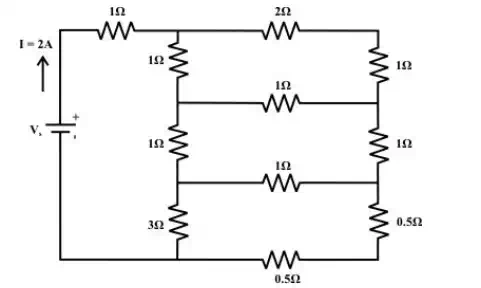
Solution:
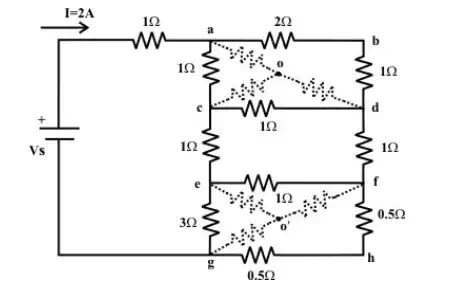
Convert the three terminals Δ-network (a-c-d & e-f-g) into an equivalent Y – connected network. Consider the Δ-connected network ‘a-c-d’ and the corresponding equivalent Y -connected resistor values are given as

Similarly, for the -connected network ‘e-f-g’ the equivalent the resistances of Y – connected network are calculated as

Now the original circuit is redrawn after transformation and it is further simplified by applying series-parallel combination formula.

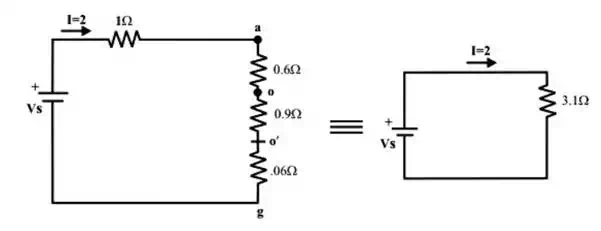
The source Vs that delivers 2A current through the circuit can be obtained as

(a)
Solution:
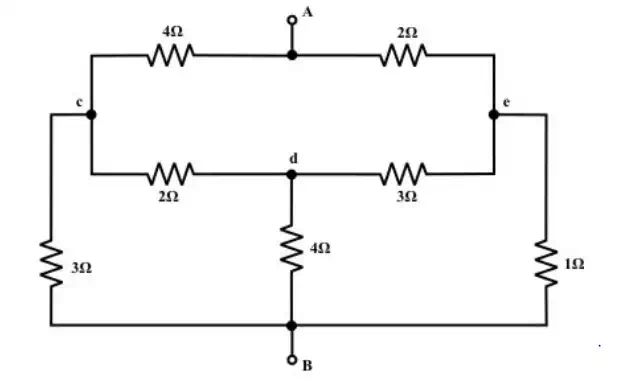
A ‘ ’ is substituted for the ‘Y ’ between points c, d, and e as shown in fig(b); then unknown resistances value for Y to Δ transformation are computed below.

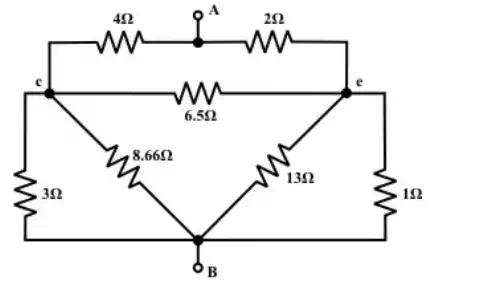
(b)
Next we transform ‘Δ’connected 3-terminal resistor to an equivalent ‘Y ’ connected network between points ‘A’; ‘c’ and ‘e’ (see fig.(b)) and the corresponding Y connected resistances value are obtained using the following expression. Simplified circuit after conversion is shown in fig.(c)
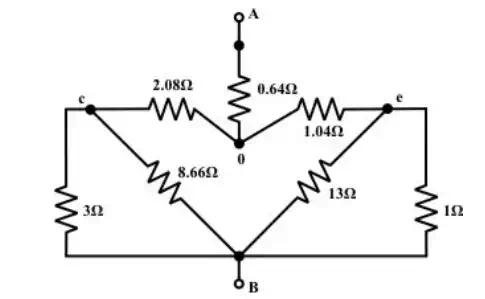
(c)

The circuit shown in fig.(c) can further be reduced by considering two pairs of parallel branches 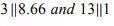 and the corresponding simplified circuit is shown in fig.(d).
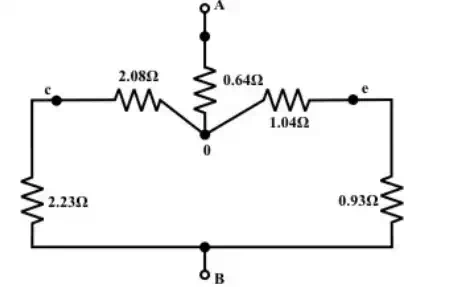
(d)
Now one can find the equivalent resistance between the terminals ‘ A ’ and ‘ B ’ as