




Business cycles are the rhythmic fluctuations in the aggregate level of economic activity of a nation. Business cycle comprises of following phases −
● Depression
● Recovery
● Prosperity
● Inflation
● Recession
Business cycles occur because of reasons such as good or bad climatic conditions, under consumption or over consumption, strikes, war, floods, draughts, etc
Theories of Business Cycles
Schumpeter’s Theory of Innovation
According to Schumpeter, an innovation is defined as the development of a new product or introduction of a new product or a process of production, development of new market or a change in the market.
Over − Investment Theory
Professor Hayek says, “primary cause of business cycles is monetary overestimate”. He says business cycles are caused by over investment and consequently by over production. When a bank charges rate of interest below the equilibrium rate, the business has to borrow more funds which leads to business fluctuations.
Monetary Theory
According to Professor Hawtrey, all the changes in the business cycles take place due to monetary policies. According to him the flow in the monetary demand leads to prosperity or depression in the economy. Cyclical fluctuations are caused by expansion and contraction of bank credit. These conditions increase or decrease the flow of money in the economy.
Stabilization Policies
Stabilization policies are also known as counter cycle policies. These policies try to counter the natural ups and downs of business cycles. Expansionary stabilization policies are useful to reduce unemployment during contraction and contractionary policies are used to reduce inflation during expansion.
Instruments of Stabilization Policies
The flow chart of stablilization policies is described below:
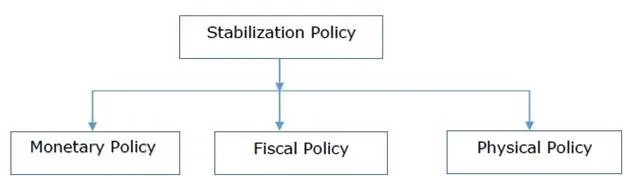
Monetary Policy
Monetary policy is employed by the government as an effective tool to promote economic stability and achieve certain predetermined objectives. It deals with the total money supply and its management in an economy. Objectives of monetary policy include exchange rate stability, price stability, full employment, rapid economic growth, etc.
Fiscal Policy
Fiscal policy helps to formulate rational consumption policy and helps to increase savings. It raises the volume of investments and the standards of living. Fiscal policy creates more jobs, reduces economic inequalities and controls, inflation and deflation. Fiscal policy as an instrument to fight depression and create full employment conditions is much more effective as compared to monetary policy.
Physical Policy
When monetary policy and fiscal policy are inadequate to control prices, government adapts physical policy. These policies can be introduced swiftly and thus the result is quite rapid. Theses controls are more discriminatory as compared to monetary policy. They tend to vary effectively in the intensity of the operation of control from time to time in various sectors.


