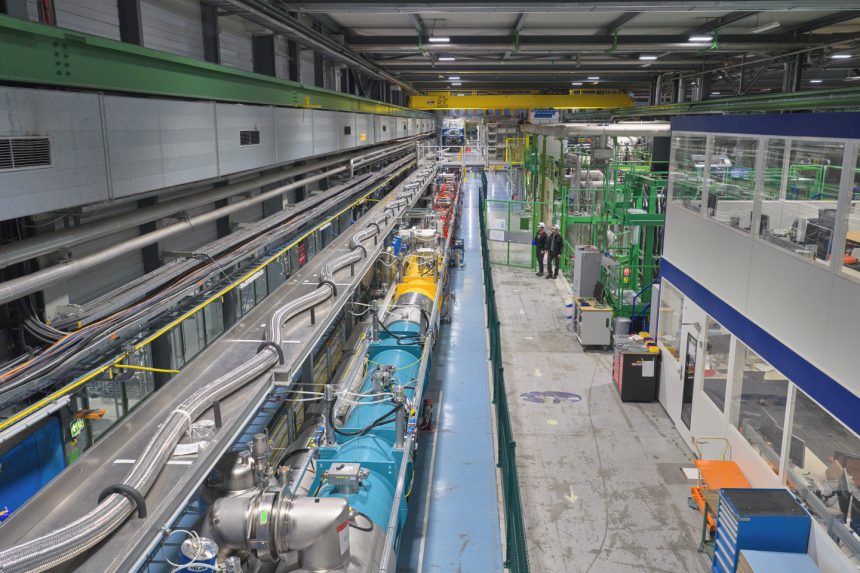
Particle physics is often associated with headline-grabbing discoveries, but the most important stories in the field are frequently the engineering milestones that make future discoveries possible. That is exactly why CERN’s latest High-Luminosity Large Hadron Collider update matters. On 23 February 2026, CERN announced the start of the cryogenic cooldown of a 95-meter-long full-scale test stand known as the Inner Triplet String, or IT String. This is not a symbolic demonstration. It is a full-system rehearsal for one of the most ambitious accelerator upgrades in the laboratory’s recent history.
- Why this week’s test matters right now
- What the High-Luminosity LHC is trying to achieve
- Why “luminosity” matters more than raw power here
- The technology at the center of the upgrade
- Why cooling to 1.9 kelvin is such a defining step
- The timeline from test stand to physics impact
- Why this matters beyond CERN
- What success would look like
- Final takeaway
The goal of the broader project is to transform the Large Hadron Collider into the High-Luminosity LHC, often abbreviated HiLumi LHC or HL-LHC. CERN says the upgrade is intended to increase the number of particle collisions—a property known as luminosity—by a factor of ten compared with the original design. That change is not a minor tuning. It is a step that will massively increase the quantity of useful physics data and allow researchers to study rare processes with much greater statistical power.
Why this week’s test matters right now
The specific milestone announced this week is the cooldown of the IT String to 1.9 kelvin, or about minus 271.3 degrees Celsius. That extreme temperature is not a dramatic flourish. It is required because the superconducting magnet systems that the HiLumi upgrade depends on must operate under ultra-cold conditions. The LHC already relies on powerful superconducting magnets, but the HiLumi project introduces new generations of hardware, new integration challenges, and new operational demands. Cooling the IT String is therefore the beginning of a true systems-level validation, not a single-component test.
CERN describes the IT String as a full-scale replica of the underground configuration that will eventually be installed in the accelerator complex. This is crucial. Large scientific machines do not fail only because one individual component is weak. They often fail, or become inefficient, at the interfaces where multiple systems meet: magnets, cryogenics, power systems, alignment hardware, protection systems, and operational procedures. The IT String exists to test those interfaces before installation in the tunnel, when mistakes would be far more expensive and disruptive.
In plain language, this week’s milestone is the dress rehearsal for a future machine that has to work almost perfectly under extreme conditions. If the rehearsal goes well, the eventual installation becomes safer, smoother, and more scientifically reliable.
What the High-Luminosity LHC is trying to achieve
The original LHC transformed physics by enabling the discovery of the Higgs boson and by creating an unprecedented platform for testing the Standard Model. But the first era of the LHC was never expected to answer every major question. Modern particle physics now faces a dual challenge: extracting far more precision from known phenomena while still remaining open to surprises beyond established theory. The HiLumi LHC is built for exactly that mission.
By increasing luminosity, the upgraded collider will generate many more collisions at the major interaction points, especially around the ATLAS and CMS experiments. More collisions mean more chances to observe rare processes that are simply too uncommon to study effectively in smaller data sets. It also means smaller uncertainties when measuring known processes. Precision improves because the data volume improves.
CERN emphasizes that this will allow physicists to study the behavior of the Higgs boson with unprecedented precision. One of the most important goals is to probe how the Higgs interacts with itself. That self-interaction is a central clue to understanding the Higgs field’s role in the structure of the universe, the shape of the Higgs potential, and the physics of the early universe. It is one of those measurements that sounds narrow on paper but could influence fundamental questions about cosmic history and stability.
Why “luminosity” matters more than raw power here
To non-specialists, it can be surprising that the upgrade is framed mainly around luminosity rather than a dramatic increase in collision energy. Energy determines what kinds of particles can be produced; luminosity determines how many useful collisions happen over time. For the next phase of LHC science, the limiting factor in many analyses is not only energy but statistical reach. Some processes are so rare that seeing enough examples to measure them properly requires enormous collision counts.
That is why the phrase “factor of ten” is so important. It means researchers are aiming for a major expansion in physics opportunity even without building a wholly separate next-generation collider from scratch. The HL-LHC extends the scientific life of the existing LHC infrastructure by making it vastly more productive. It is an optimization strategy at an extraordinary scale.
This also explains why the engineering is so demanding. To achieve higher luminosity, beams must be focused more tightly and controlled more precisely near the collision points. That, in turn, requires magnets and supporting systems that go well beyond what the current machine uses in its baseline configuration.
The technology at the center of the upgrade
One of the most significant elements of the HiLumi program is the new inner triplet beam-focusing magnet system. CERN and Fermilab both highlight that these magnets are based on niobium-tin (Nb3Sn), a superconducting compound that can produce higher magnetic fields than the niobium-titanium technology used in the current LHC magnets. That difference is essential because stronger focusing enables tighter beams and therefore higher collision rates at the experiments.
But the innovation does not stop with the magnets themselves. CERN also points to several technologies that have never before been used in a proton accelerator at this scale: superconducting crab cavities that rotate or “tilt” the particle bunches before collision, crystal collimators designed to manage errant particles more efficiently, and high-temperature superconducting electrical transfer lines intended to power the upgraded magnets more effectively. Each of these components is challenging on its own. Together, they create an integration problem of enormous complexity.
This is part of what makes the IT String so valuable. Individual systems have already been tested separately. The current phase is about collective performance. Can the magnets, cryogenic infrastructure, protection systems, powering systems, and operational procedures behave reliably as a unified machine? That question cannot be fully answered with isolated component tests. It requires a full-chain setup that mirrors reality as closely as possible.
Why cooling to 1.9 kelvin is such a defining step
The number 1.9 K deserves special attention because it represents more than “very cold.” It is the operating regime in which the superconducting system can achieve the required performance with minimal electrical resistance and maximal magnetic efficiency. Reaching that temperature over a 95-meter integrated test stand is a significant engineering act involving sophisticated liquid-helium refrigeration and distribution. CERN notes that the cooldown is expected to take several weeks, which gives a sense of both the scale and delicacy of the process.
At such temperatures, small problems can become large ones. Materials behave differently. Thermal contraction changes mechanical relationships. Stability, protection, and recovery systems must be carefully managed. The cryogenic environment is not just a support condition; it is part of the machine’s operational identity. Testing the entire system under actual cryogenic load is therefore one of the most meaningful pre-installation milestones the project can achieve.
For non-experts, it may help to think of this as the equivalent of not just turning on a race car’s engine in a garage, but testing the entire vehicle at race temperature, under race conditions, before it ever reaches the track.
The timeline from test stand to physics impact
CERN says the major installation effort for the HiLumi LHC is set to begin with Long Shutdown 3, a four-year intensive work period starting this summer. The upgraded machine is expected to enter operation in 2030. That timeline underlines how much of big science is long-horizon work. The headlines may arrive years apart, but the enabling decisions and validations happen now, often in careful steps that outsiders rarely notice.
The current milestone is therefore not an isolated engineering note. It is a gating event on the path to 2030 science. The better the integration is understood now, the fewer surprises there should be during installation and commissioning. That improves not only project efficiency but also the credibility of the scientific schedule.
It also shows how modern fundamental science depends on patience. If the public later celebrates landmark Higgs measurements or unexpected new phenomena in the HL-LHC era, those future results will be built on steps like this week’s cryogenic rehearsal.
Why this matters beyond CERN
The HiLumi project is not a purely local European effort. CERN notes that the program involves an international collaboration of almost 50 institutes across more than 20 countries. Fermilab, for example, emphasizes that it developed and shipped key cryoassemblies containing niobium-tin magnets for use in the upgrade and will deliver additional assemblies through 2027. This kind of distributed collaboration reflects how frontier physics now works: no single institution alone carries the full burden of design, manufacturing, testing, and scientific exploitation.
That international structure has scientific and political significance. Scientifically, it pools expertise in superconducting magnet technology, cryogenics, systems engineering, and detector readiness. Politically, it reinforces the idea that large-scale basic science remains one of the strongest long-term models of multinational cooperation. Projects like the HiLumi LHC are difficult, expensive, and slow, but they are also shared investments in knowledge and capability.
The technology developed for the upgrade may also have spillover value. Accelerator engineering, superconducting systems, cryogenic techniques, and control architectures often find applications beyond the original physics mission. Even when the public focus is on particles, the surrounding innovations can influence medicine, industry, imaging, and future research infrastructure.
What success would look like
Success for the current phase does not mean discovering a particle next week. It means validating that the integrated system behaves as intended under extreme cryogenic conditions, revealing problems early enough to solve them before tunnel installation, and building confidence that the full upgrade can proceed efficiently into Long Shutdown 3. In accelerator science, removing future failure modes is often as valuable as producing immediate new output.
Longer term, success means transforming the LHC into a machine capable of producing far richer data sets for Higgs physics, rare-decay searches, and precision studies that can expose subtle deviations from Standard Model predictions. Even if the HL-LHC does not uncover a single dramatic new particle, the precision frontier it opens could still reshape the field by tightening constraints on what new physics is possible.
And if something genuinely unexpected appears, that would be even more significant. As CERN’s leadership has emphasized, part of the purpose of exploring the unknown is that you do not know in advance what you will find. The HiLumi LHC is being built to make that unknown more accessible.
Final takeaway
CERN’s new HiLumi LHC milestone may sound technical, but it is one of the most important physics-engineering stories of the month. By beginning the cooldown of the 95-meter IT String to 1.9 kelvin, CERN and its partners have entered the full-system validation stage for the technologies that will define the collider’s next era. This matters because the High-Luminosity LHC is designed to increase collision counts by a factor of ten, enabling deeper Higgs studies, more precise measurements, and better access to rare phenomena.
In other words, this is the infrastructure of future discovery coming into focus. Before physics can make bigger claims, engineering has to prove the machine can deliver. This week’s achievement is not the end of that journey, but it is a major sign that the most powerful scientific instrument of the coming decade is being carefully prepared, one cryogenic step at a time.