Updated: January 2026
- Why CES 2026 feels like a turning point
- Breakthrough #1: Stairs (and other “home terrain”)
- Roborock Saros Rover: cleaning where robots used to surrender
- Dreame and the “legs” arms race
- Why stairs matter more than they sound
- Breakthrough #2: Laundry that goes beyond “folding theater”
- LG CLOiD and the “zero labor home” pitch
- SwitchBot and the widening field
- The laundry “truth test” for 2026 robots
- Breakthrough #3: Smart kitchens that reduce decision fatigue
- Samsung’s AI kitchen: vision, voice, and a more proactive fridge
- GE Profile’s barcode-scanning fridge: a surprisingly strong idea
- What changed under the hood
- 1) Better perception (vision that works in messy homes)
- 2) Mobility and manipulation are finally treated as first-class problems
- 3) The ecosystem push: smarter homes through standards
- 4) “Physical AI” is becoming a mainstream framing
- The reality check: speed, safety, privacy, and price
- Reality check #1: Speed is still the silent deal-breaker
- Reality check #2: Safety isn’t optional in a home
- Reality check #3: Privacy is the cost of “context”
- Reality check #4: Price will separate “cool” from “common”
- Buyer’s guide (2026): what’s worth buying now vs. waiting
- Buy now (best value today)
- Wait (likely to improve rapidly)
- What to look for in any “home robot” purchase
- How to make your home “robot-ready”
- Key takeaways
- FAQs
- 1) Are home humanoid robots actually ready to do my laundry in 2026?
- 2) Will stair-climbing robot vacuums be safe on every staircase?
- 3) Do “smart kitchen” fridges actually save time?
- 4) Should I worry about cameras and microphones in appliances?
- 5) What’s the smartest purchase inspired by CES 2026?
- References & further reading
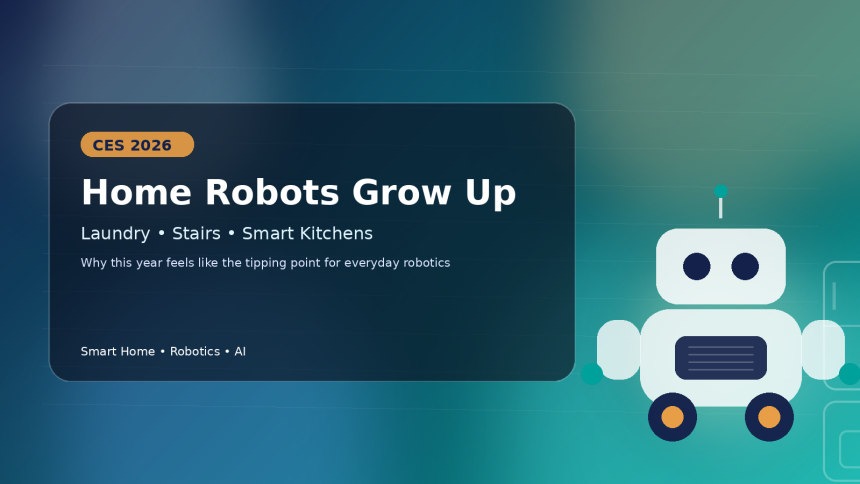
For years, “home robots” have mostly meant one thing: a round robot vacuum that politely avoids trouble and calls for help the second it meets a sock.
CES 2026 felt different. Not because every robot suddenly became flawless—but because the most interesting launches stopped chasing party tricks and started chasing
the three things that make a home hard: laundry, stairs, and the messy complexity of kitchens.
This year’s show wasn’t just “look what our robot can do” (in a perfect demo room, under perfect lighting, with a handler nearby).
It was “look what our system can do in the real workflow of a household”—moving between appliances, recognizing objects, and dealing with multi-level spaces.
That shift matters. It’s the difference between a gadget and a tool.
Why CES 2026 feels like a turning point
CES is famous for two equal and opposite forces: innovation and exaggeration.
But a few themes at CES 2026 pushed home robotics into a more believable era:
- Robots are being designed around homes (thresholds, stairs, clutter, tight kitchen paths), not lab floors.
- Appliances are getting “assistive intelligence”—systems that reduce your mental load, not just add screens.
- Robots are being framed as part of an ecosystem (appliance control, inventory, scheduling, voice, standards like Matter), not solo gadgets.
In other words: the best “robots” at CES 2026 weren’t always humanoids.
Sometimes they were a refrigerator that finally understands groceries, or a cleaner that can stop treating stairs like a dead end.
If you want to browse the wider CES 2026 stream of announcements, start here:
CES official site.
Breakthrough #1: Stairs (and other “home terrain”)
Stairs have been the punchline of robot vacuum marketing for a decade:
“Now with better navigation!” (…still can’t clean upstairs.)
CES 2026 finally attacked the problem directly with designs that treat elevation as part of the job, not a boundary.
Roborock Saros Rover: cleaning where robots used to surrender
One of the most talked-about concepts was the Roborock Saros Rover, a robot vacuum built around a wheel-leg architecture.
The key idea isn’t just that it can climb—it’s that it aims to clean while navigating steps, reducing the “no-go zones” that define so many multi-floor homes.
If you want the specifics, see:
The Verge’s hands-on coverage
and Roborock’s own announcement:
Roborock Newsroom press release.
The deeper story here: we’re watching robot vacuums evolve from “flat-floor appliances” to “mobile cleaning robots.”
That shift unlocks new use-cases—split-level homes, stair landings, thick thresholds, and cluttered playrooms.
Dreame and the “legs” arms race
Roborock wasn’t alone. CES 2026 also highlighted how aggressively the category is moving toward better mobility.
Dreame showed a stair-capable concept (often described as the vacuum “growing legs”).
Here’s one write-up:
TechNode on Dreame’s stair-climbing concept.
If you’ve ever carried a vacuum upstairs, you already understand the appeal.
The bigger question is reliability: can these robots climb safely on different stair materials (wood, carpet, mixed surfaces) without scuffing edges or taking tumbles?
CES 2026 suggests the industry is ready to try—but consumers should still expect early versions to be premium-priced and conservative in real homes.
Why stairs matter more than they sound
Stair capability isn’t just about laziness. It changes the economics of home automation:
- One robot can service more square footage without a second unit upstairs.
- Less human intervention means automation becomes a habit, not a weekend experiment.
- Accessibility gains matter for older adults and anyone with mobility constraints.
For more CES 2026 cleaning-tech coverage (including mops and floorcare trends), see:
Vacuum Wars CES 2026 coverage.
Breakthrough #2: Laundry that goes beyond “folding theater”
Laundry is the ultimate home-robot challenge: it demands perception (what am I looking at?), manipulation (how do I grip fabric?), and workflow (wash → dry → sort → fold → put away).
Historically, CES laundry robots have looked impressive and worked… only under perfect demo conditions.
CES 2026 didn’t fully solve laundry—but it made it harder to dismiss.
LG CLOiD and the “zero labor home” pitch
LG’s CLOiD stood out because it’s positioned not as a single-task folding machine, but as a home assistant integrated with appliances—moving items between spaces and triggering appliance workflows.
In demos and descriptions, CLOiD is framed as a robot that can handle tasks like loading laundry, initiating cycles, and managing post-dry folding/stacking scenarios.
Useful starting points:
LG’s official CLOiD announcement
and
The Verge’s overview of CLOiD’s CES plans.
The “so what?”: CLOiD represents a shift toward robot + appliance orchestration.
Instead of trying to replace every household step, the robot coordinates with appliances that already do heavy lifting (washer, dryer, oven, dishwasher).
That’s a more realistic pathway to usefulness.
SwitchBot and the widening field
CES 2026 coverage also points to more than one company chasing home-task humanoids.
That competition matters: it pushes price down, improves component supply chains, and accelerates software toolkits.
One CES 2026 roundup mentioning this trend:
The Guardian on CES 2026 standouts.
The laundry “truth test” for 2026 robots
If you’re watching the category, here are the real metrics—not the stage demo:
- Speed: Can it finish a basket in less time than you would?
- Fabric diversity: Towels, denim, baby clothes, mixed loads, odd shapes.
- Error recovery: What does it do when it drops something or gets confused?
- Workflow integration: Can it operate your appliances safely and consistently?
CES 2026 shows progress. But laundry will likely remain the “hardest mode” of home robotics for a while—especially at consumer-friendly prices.
Breakthrough #3: Smart kitchens that reduce decision fatigue
The kitchen is where “AI” has often felt like a solution searching for a problem.
CES 2026 pushed kitchens toward something more practical: inventory awareness and meal-planning assistance that reduces daily cognitive load.
Samsung’s AI kitchen: vision, voice, and a more proactive fridge
Samsung showcased “AI-Enriched Kitchens,” including a Bespoke AI Refrigerator Family Hub with expanded AI Vision capabilities and
software features aimed at ingredient management and recipe suggestions.
Samsung also highlighted integration of Google Gemini in the Family Hub experience, positioning the fridge as a more conversational kitchen assistant.
Read Samsung’s CES 2026 tour here:
Samsung Newsroom: “A Home Companion…”.
For a third-party perspective on the broader appliance lineup:
Reviewed.com: Samsung appliances at CES 2026.
What’s different (and more useful) about this direction is the focus on systems:
the fridge, oven, and other appliances share context so the kitchen becomes less “smart screens” and more “smart workflow.”
GE Profile’s barcode-scanning fridge: a surprisingly strong idea
One of the most immediately practical kitchen ideas at CES 2026:
a refrigerator with a built-in barcode scanner that adds items to a shopping list as they run low.
This targets a real pain point: “What do we need from the store?” and “Did we already buy this?”
Official announcement:
GE Appliances Pressroom.
Coverage and context:
The Verge on GE’s barcode scanner fridge,
Engadget’s CES 2026 look,
and a business-focused summary:
Mint on the GE Profile smart fridge.
Is it “robotics”? Not in the humanoid sense. But it’s exactly the point of CES 2026:
the best home automation in 2026 is increasingly about removing friction from daily routines, not showing off futuristic gestures.
What changed under the hood
So why does CES 2026 feel like a step change, not just another cycle of glossy demos?
A few underlying shifts are converging:
1) Better perception (vision that works in messy homes)
Home robots struggle because homes are visually chaotic: reflective surfaces, changing lighting, occlusions, clutter, pets, kids, and constantly moving objects.
What’s improving is not just camera resolution, but the quality of interpretation—object recognition, scene understanding, and “what should I do next?”
2) Mobility and manipulation are finally treated as first-class problems
A vacuum that climbs stairs isn’t a minor feature; it’s an engineering re-think.
Likewise, a robot like CLOiD is built around reaching, gripping, and aligning with appliances that were never designed for robots.
These are hard problems—and CES 2026 suggests companies are finally paying that complexity tax instead of dodging it.
3) The ecosystem push: smarter homes through standards
Robots get more useful when they can control and understand other devices.
That’s why smart home standards matter. If you want a backgrounder on the interoperability push, see:
Connectivity Standards Alliance: Matter.
If you’re building a power-user smart home, you’ve probably heard of:
Home Assistant.
CES 2026 is where these worlds start to merge: robots, appliances, and smart-home layers are converging into a single “home operating system” idea.
4) “Physical AI” is becoming a mainstream framing
The robotics industry increasingly frames robots as AI with a body—software that must be safe, robust, and predictable when it touches your stuff.
A CES 2026 business roundup that captures the scale of the humanoid wave:
Investor’s Business Daily on humanoid robots at CES 2026.
The reality check: speed, safety, privacy, and price
Before you declare 2026 “the year of the home robot,” here’s the grounded view.
CES 2026 showed real progress, but early buyers will still face trade-offs.
Reality check #1: Speed is still the silent deal-breaker
Many humanoid demos still look slow compared to a human doing the same task.
And speed affects everything: how long the robot blocks a hallway, how long you wait for a chore to finish, and how patient you must be when something goes wrong.
Reality check #2: Safety isn’t optional in a home
A robot that climbs stairs must avoid falls. A robot that grips laundry must avoid pinching fingers. A robot that interacts with ovens must be extremely conservative.
When evaluating early products, look for:
- Conservative movement policies (slow is sometimes a safety feature).
- Clear obstacle detection and stop behavior.
- Manual override and simple “pause/stop” controls.
Reality check #3: Privacy is the cost of “context”
Smart kitchens and home robots often rely on cameras and microphones for awareness.
That doesn’t automatically mean “bad,” but it does mean you should demand control:
- Local processing when possible
- Clear settings for data retention
- Options to disable cloud features without breaking core functions
If you want a practical consumer view of this tension in smart appliances, this Reviewed piece raises useful questions:
Reviewed: Samsung’s CES 2026 appliances.
Reality check #4: Price will separate “cool” from “common”
The most advanced home robots shown at CES 2026 are likely to be expensive at first.
That doesn’t mean they won’t matter—it means the early market will look like premium appliances did in the beginning:
first high-end homes, then wider adoption as reliability improves and costs fall.
Buyer’s guide (2026): what’s worth buying now vs. waiting
If you’re excited by CES 2026 and considering a purchase, use this quick framework.
Buy now (best value today)
- Robot vacuums/mops with strong mapping, object avoidance, and auto-empty docks (single-floor or per-floor units).
- Smart kitchen helpers that reduce friction (inventory, grocery lists, meal planning)—especially if they don’t require you to change your habits.
- Appliance upgrades that save time weekly (washer/dryer combos, dishwashers, smart ovens with useful presets).
Wait (likely to improve rapidly)
- Stair-climbing robot vacuums: promising, but expect first-gen constraints and premium pricing.
- Humanoid chore robots: exciting, but still early on speed, reliability, and real-world edge cases.
What to look for in any “home robot” purchase
- Failure recovery: Does it handle messy reality without you babysitting?
- Maintenance: How often do you clean sensors, replace parts, or empty bins?
- Support: Are replacement parts and service clearly available?
- Ecosystem fit: If you already use Apple / Google / Alexa / SmartThings / Home Assistant, does it integrate cleanly?
How to make your home “robot-ready”
If CES 2026 taught us anything, it’s that home robotics works best when the environment is predictable.
You don’t need to redesign your life—just remove the biggest friction points.
Quick wins
- Declutter floors (especially cables, socks, small toys).
- Improve lighting in hallways and kitchens—vision systems love consistency.
- Standardize storage (bins, baskets, hampers) so robots deal with fewer “mystery objects.”
- Label zones in your smart home app (“Laundry,” “Kitchen,” “Living Room”) for smoother automation routines.
If you’re adopting smart kitchens
- Choose one primary grocery list system (don’t fragment across five apps).
- Decide your privacy baseline (what data you’re okay sharing for convenience).
- Pick frictionless features: barcode scanning and auto-lists work because they match real behavior.
Key takeaways
- CES 2026 marks a shift from “robot stunts” to “robot utility”—especially around stairs, appliance coordination, and kitchen workflows.
- Mobility is the new battleground: multi-floor homes are finally being treated as the default, not an edge case.
- Smart kitchens are getting practical: inventory + grocery planning is the kind of “AI” people actually feel.
- Humanoid home robots are progressing, but speed, cost, and real-world reliability will decide adoption.
- The best 2026 strategy: buy proven automation now (cleaning + workflow appliances), and watch the first-gen “stair + laundry” robots mature.
FAQs
1) Are home humanoid robots actually ready to do my laundry in 2026?
They’re closer than ever, but “ready” depends on your expectations and budget. CES 2026 demos suggest meaningful progress, especially for staged workflows
(load laundry, start cycle, fold/stack). But mixed fabrics, speed, and error recovery will still be the deciding factors.
2) Will stair-climbing robot vacuums be safe on every staircase?
Early designs will likely be conservative—slow movement, careful sensing, and limited stair types at first.
If you have slick wood, unusual stair geometry, or very cluttered steps, expect limitations until the category matures.
3) Do “smart kitchen” fridges actually save time?
The useful ones do—when they reduce repeated decisions (what to buy, what to cook, what’s expiring) without forcing you to learn a complicated new system.
Barcode scanning and automatic list-building are compelling because they match how people already shop and restock.
4) Should I worry about cameras and microphones in appliances?
You should at least review the settings. Modern smart appliances often rely on sensors for context, but you should look for clear opt-outs,
data retention controls, and the ability to keep core functions working even if you disable cloud features.
5) What’s the smartest purchase inspired by CES 2026?
A proven automation product that you’ll use weekly: a high-quality robot vacuum/mop, an efficient laundry solution, or a kitchen system that reduces grocery friction.
Then watch the emerging “stairs + laundry humanoid” market evolve over the next 12–24 months.
References & further reading
- CES (official site)
- Roborock Newsroom: Saros Rover announcement
- The Verge: Roborock Saros Rover coverage
- TechNode: Dreame stair-climbing concept
- Vacuum Wars: CES 2026 cleaning tech roundup
- LG Newsroom: CLOiD “Zero Labor Home”
- The Verge: LG CLOiD details
- Samsung Newsroom: AI Kitchen & Gemini integration
- Reviewed: Samsung appliances at CES 2026
- GE Appliances Pressroom: Kitchen Assistant fridge
- The Verge: GE smart fridge barcode scanner
- Engadget: GE smart fridge at CES
- Mint: GE Profile CES 2026 fridge summary
- The Guardian: CES 2026 standout tech
- Investor’s Business Daily: humanoid robots at CES 2026
- Connectivity Standards Alliance: Matter standard
- Home Assistant (smart home platform)
- Interesting Engineering: humanoid robots at CES 2026