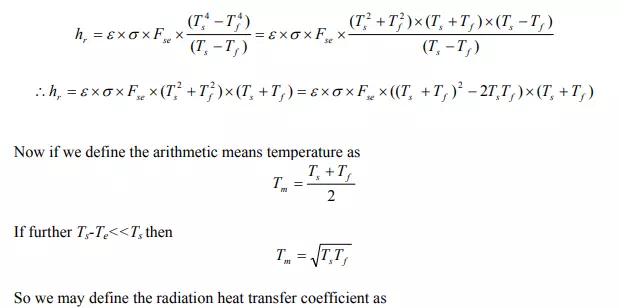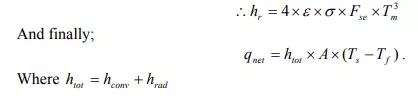
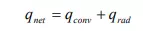
Since these two modes of heat transfer are completely independent, there would be no mutual effect between them. Thus net heat exchange of the surface is the sum of the two
This hypothetical approach seems to be similar to the parallel electrical resistances as shown previously, but the problem here is that no radiation resistance has been defined yet. So let us use a radiant heat transfer in order to express the radiation heat transfer, q rad, as a linear function in the temperature difference between the surface temperature and the fluid temperature.
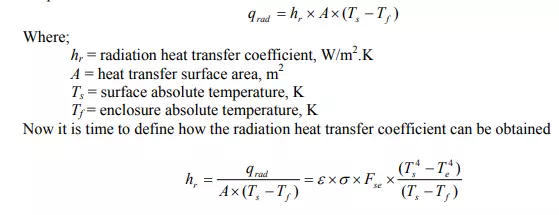
In the above equation, Te is used to express the enclosure temperature as this is the more general case. But for most of the cases, the fluid adjacent to the surface has the same temperature as that of the enclosure. So for this most likely circumstance the following agree: