This reaction is defined as that reaction which proceeds from reactants to final products through one or more intermediate stages. The overall reaction is a result of several successive or consecutive steps.
A → B → C and so on
| Example of Sequential Reactions |
· Decomposition of ethylene oxide(CH2)2O  CH3CHOCH3CHO CH3CHOCH3CHO 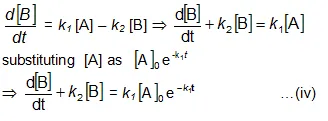 CO + CH4· The pyrolysis of acetone(CH3)2CO CO + CH4· The pyrolysis of acetone(CH3)2CO 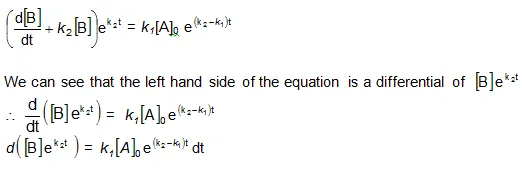 CH4 + CH2 =C=O CH2 =C=O CH4 + CH2 =C=O CH2 =C=O 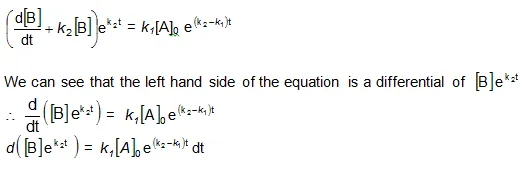 C2H4 + CO C2H4 + CO |
For the reaction
 …….(i)
 ………(ii)
 ……….(iii)
Integrating equation (i), we get

Now we shall integrate equation (ii) and find the concentration of B related to time t.
Integration of the above equation is not possible as we are not able to separate the two variables, [B] and t. Therefore we multiply equation (4) by an integrating factor  , on both the sides of the equation.
Integrating with in the limits 0 to t.
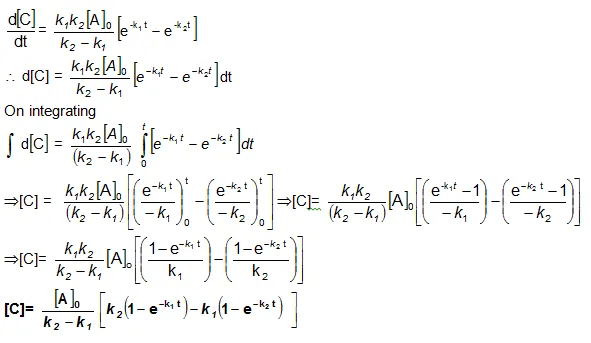
Now in order to find [C], substitute equation (vi) in equation (iii), we get
Bmax and tmax:
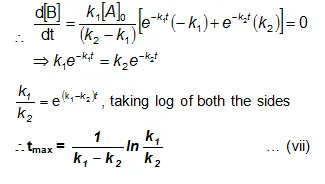
We can also attempt to find the time when [B] becomes maximum. For this we differentiate equation (vi) and find d[B]/dt & equate it to zero.
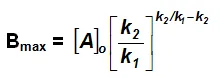
Substituting equation (vii) in equation (vi)