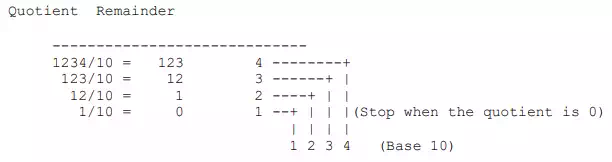
– Convert from Decimal to Any Base Let’s think about what you do to obtain each digit. As an example, let’s start with a decimal number 1234 and convert it to decimal notation. To extract the last digit, you move the decimal point left by one digit, which means that you divide the given number by its base 10.
1234/10 = 123 + 4/10
The remainder of 4 is the last digit. To extract the next last digit, you again move the decimal point left by one digit and see what drops out.
123/10 = 12 + 3/10
The remainder of 3 is the next last digit. You repeat this process until there is nothing left. Then you stop. In summary, you do the following:
Now, let’s try a nontrivial example. Let’s express a decimal number 1341 in binary notation. Note that the desired base is 2, so we repeatedly divide the given decimal number by 2.

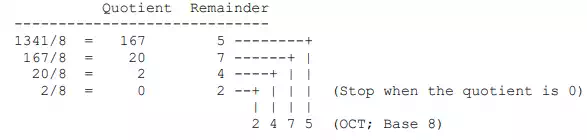
Let’s express the same decimal number 1341 in octal notation.
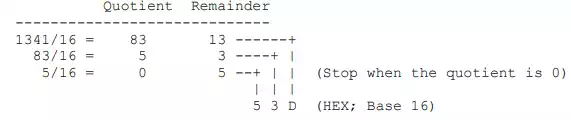
Let’s express the same decimal number 1341 in hexadecimal notation.
In conclusion, the easiest way to convert fixed point numbers to any base is to convert each part separately. We begin by separating the number into its integer and fractional part. The integer part is converted using the remainder method, by using a successive division of the number by the base until a zero is obtained. At each division, the reminder is kept and then the new number in the base r is obtained by reading the remainder from the lat remainder upwards.
The conversion of the fractional part can be obtained by successively multiplying the fraction with the base. If we iterate this process on the remaining fraction, then we will obtain successive significant digit. This methods form the basis of the multiplication methods of converting fractions between bases
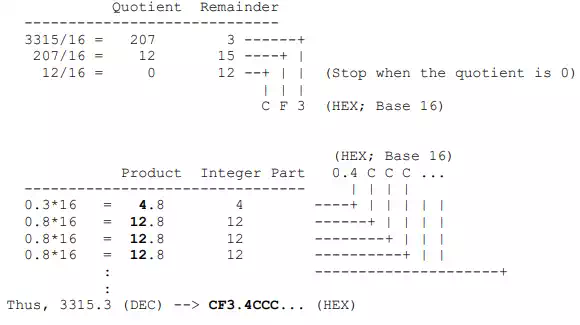
Example. Convert the decimal number 3315 to hexadecimal notation. What about the hexadecimal equivalent of the decimal number 3315.3?