




According to Covered Interest Rate theory, the exchange rate forward premiums (discounts) nullify the interest rate differentials between two sovereigns. In other words, covered interest rate theory says that the difference between interest rates in two countries is nullified by the spot/forward currency premiums so that the investors could not earn an arbitrage profit.
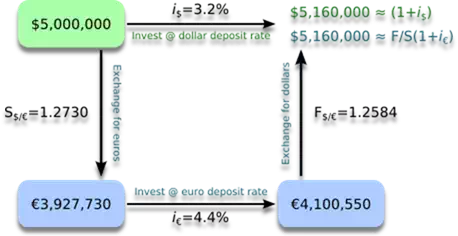
Example
Assume Yahoo Inc., the U.S. based multinational, has to pay the European employees in Euro in a month’s time. Yahoo Inc. can do this in many ways, one of which is given below −
● Yahoo can buy Euro forward a month (30 days) to lock in the exchange rate. Then it can invest this money in dollars for 30 days after which it must convert the dollars to Euro. This is known as covering, as now Yahoo Inc. will have no exchange rate fluctuation risk.
● Yahoo can also convert the dollars to Euro now at the spot exchange rate. Then it can invest the Euro money it has obtained in a European bond (in Euro) for 1 month (which will have an equivalently loan of Euro for 30 days). Then Yahoo can pay the obligation in Euro after one month.
Under this model, if Yahoo Inc. is sure that it will earn an interest, it may convert fewer dollars to Euro today. The reason for this being the Euro’s growth via interest earned. It is also known as covering because by converting the dollars to Euro at the spot rate, Yahoo is eliminating the risk of exchange rate fluctuation.


