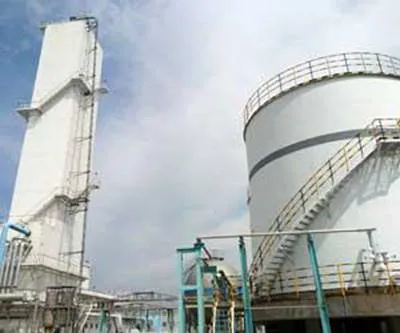
The most common method for air separation is cryogenic distillation. Cryogenic air separation units (ASUs) are built to provide nitrogen or oxygen and often co-produce argon. These components of air must be removed to meet product quality specifications. In addition, they must be removed prior the air entering the distillation portion of the plant; because very low temperatures would cause the water and carbon dioxide to freeze and deposit on the surfaces within the process equipment.
Most new air separation plants employ a “molecular sieve” “pre-purification unit” (PPU) to remove carbon dioxide and water from the incoming air by adsorbing these molecules onto the surface of “molecular sieve” materials at near-ambient temperature. Molecular sieve 13X-APG, JLOX-300 conbined with activated alumina is designed for cryogenic air separation to remove of moisture and CO2. Activated alumina removes most of the water and 13X-APG , JLOX-300 removes most of the CO2.