Ohm’s law is the most important, basic law of electricity. It defines the relationship between the three fundamental electrical quantities: current, voltage, and resistance. When a voltage is applied to a circuit containing only resistive elements (i.e. no coils), current flows according to Ohm’s Law, which is shown below.
I = V / R 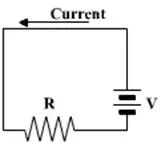
| Where: | |
| I = | Electrical Current (Amperes) |
| V = | Voltage (Voltage) |
| R = | Resistance (Ohms) |
Ohm’s law states that the electrical current (I) flowing in an circuit is proportional to the voltage (V) and inversely proportional to the resistance (R). Therefore, if the voltage is increased, the current will increase provided the resistance of the circuit does not change. Similarly, increasing the resistance of the circuit will lower the current flow if the voltage is not changed. The formula can be reorganized so that the relationship can easily be seen for all of the three variables.
The Java applet below allows the user to vary each of these three parameters in Ohm’s Law and see the effect on the other two parameters. Values may be input into the dialog boxes, or the resistance and voltage may also be varied by moving the arrows in the applet. Current and voltage are shown as they would be displayed on an oscilloscope with the X-axis being time and the Y-axis being the amplitude of the current or voltage. Ohm’s Law is valid for both direct current (DC) and alternating current (AC). Note that in AC circuits consisting of purely resistive elements, the current and voltage are always in phase with each other.