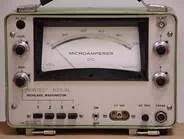
Analog instruments are the simplest of the instruments available for eddy current inspections. They are used for crack detection, corrosion inspection, or conductivity testing. These types of instruments contain a simple bridge circuit, which compares a balancing load to that measured on the test specimen. If any changes in the test specimen occur which deviate from normal you will see a movement on the instruments meter.
Analog meters such as the D’Arsonval design pictured in the applet below, must “rectify” the AC into DC. This is most easily accomplished through the use of devices called diodes. Without going into elaborate detail over how and why diodes work as they do, remember that they each act like a one-way valve for electrons to flow. They act as a conductor for one polarity and an insulator for another. Arranged in a bridge, four diodes will serve to steer AC through the meter movement in a constant direction.
An analog meter can easily measure just a few microamperes of current and is well suited for use in balancing bridges.