




Elastic behaviour of materials
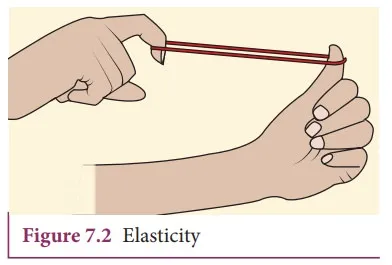
In a solid, interatomic forces bind two or more atoms together and the atoms occupy the positions of stable equilibrium. When a deforming force is applied on a body, its atoms are pulled apart or pushed closer. When the deforming force is removed, interatomic forces of attraction or repulsion restore the atoms to their equilibrium positions. If a body regains its original shape and size after the removal of deforming force, it is said to be elastic and the property is called elasticity. The force which changes the size or shape of a body is called a deforming force.
Examples: Rubber, metals, steel ropes.
Plasticity:
If a body does not regain its original shape and size after removal of the deforming force, it is said to be a plastic body and the property is called plasticity.
Example: Glass
