EXAMPLE 1
According to Stroud and Booth (2013)* “If  express in its simplest form
![\[x\frac{\partial V}{\partial x} + y\frac{\partial V}{\partial y} + z\frac{\partial V}{\partial z}.\]](https://appassets.softecksblog.in/engineering_mathematics/assets/em2/5_files/image002.webp)
SOLUTION
Here the given function is 
And, I have to find out the value of 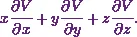
So I’ll start with  .
.
STEP 1
First of all, I’ll differentiate  partially with respect to
  to get
![\[\frac{\partial V}{\partial x} = \frac{\partial }{\partial x}\left(x^2 + y^2 + z^2\right).\]](https://appassets.softecksblog.in/engineering_mathematics/assets/em2/5_files/image008.webp)
(1) 
Next, I’ll differentiate partially with respect to  to get
![\[\frac{\partial V}{\partial y} = \frac{\partial }{\partial y}\left(x^2 + y^2 + z^2\right).\]](https://appassets.softecksblog.in/engineering_mathematics/assets/em2/5_files/image011.webp)
(2) 
Finally, I’ll differentiate partially with respect to  to get
![\[\frac{\partial V}{\partial z} = \frac{\partial }{\partial z}\left(x^2 + y^2 + z^2\right).\]](https://appassets.softecksblog.in/engineering_mathematics/assets/em2/5_files/image014.webp)
(3) 
So, now I’ll find out the value of
STEP 2
For that, I’ll use the values of  and
and  from equations (1), (2) and (3) respectively.
Thus it will be
![\[x\cfrac{\partial V}{\partial x} + y\cfrac{\partial V}{\partial y} + z\cfrac{\partial V}{\partial z}= x. 2x + y. 2y + z. 2z.\]](https://appassets.softecksblog.in/engineering_mathematics/assets/em2/5_files/image018.webp)
Therefore I get
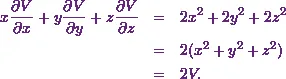
Hence I can conclude that this is the answer to this example.
Now I’ll go to the next example.
EXAMPLE 2
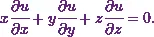
According to Stroud and Booth (2013)* “If 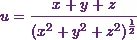 , show that
  ”
”
SOLUTION
In this example, the given function is
And, I have to prove that 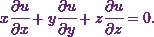
So I’ll start with  .
.
STEP 1
First of all, I’ll differentiate  partially with respect to to get
![\[\frac{\partial u}{\partial x} = \frac{\partial }{\partial x}\left(\cfrac{x+y+z}{(x^2+y^2+z^2)^{\frac{1}{2}}}\right)\\= \frac{(x^2+y^2+z^2)^{\frac{1}{2}}.1-\frac{1}{2}(x^2+y^2+z^2)^{-\frac{1}{2}}(2x)(x+y+z)}{x^2+y^2+z^2}.\]](https://appassets.softecksblog.in/engineering_mathematics/assets/em2/5_files/image025.webp)
Therefore I get
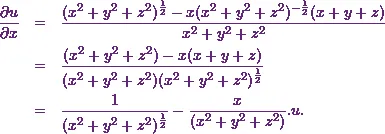
Thus I can say  will be

In the same way I can also get the value of  .
.
Thus will be
![\[\frac{\partial u}{\partial y}= \frac{1}{(x^2+y^2+z^2)^{\frac{1}{2}}}-\frac{y}{(x^2+y^2+z^2)}.u.\]](https://appassets.softecksblog.in/engineering_mathematics/assets/em2/5_files/image030.webp)
Therefore I can say  will be

Similarly I can also get the value of  .
.
Thus will be
![\[\frac{\partial u}{\partial z}= \frac{1}{(x^2+y^2+z^2)^{\frac{1}{2}}}-\frac{z}{(x^2+y^2+z^2)}.u.\]](https://appassets.softecksblog.in/engineering_mathematics/assets/em2/5_files/image034.webp)
Therefore I can say  will be

So, now I’ll find out the value of 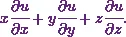
STEP 2
For that, I’ll use the values of  and from equations (4), (5) and (6) respectively.
Thus it will be

Hence I can conclude that I have proved 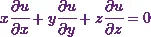 .
.
This is the answer to this example.