




Flash memory may refer to any of the following:
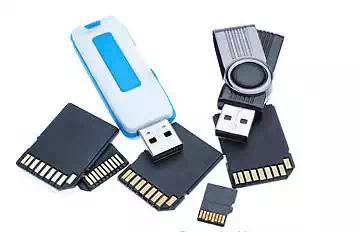
1. Alternatively referred to as flash storage, flash memory is a non-volatile computer memory. It was first invented by Fujio Masuoka in the early 1980s while at Toshiba and introduced to the market in 1984. It was also later developed by Intel. Flash memory is an integrated circuit that does not need continuous power to retain data, but is a bit more expensive than magnetic storage. Today, flash memory is very popular and solid-state drives are a practical replacement for large hard drives if you have the extra money.
Flash memory is widely used with car radios, cell phones, digital cameras, PDAs, solid-state drives, and printers. The picture is an example of a MicroSD flash memory card. For additional information and examples, see our flash memory card page.
2. Flash is also an improper name used to describe a USB jump drive.
CF
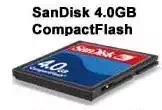
Short for CompactFlash, CF is a 50-pin connection storage device. CompactFlash is a storage medium commonly found in PDAs, digital cameras, and other portable devices. The CF card had a pretty large range of sizes, in terms of storage capacity, ranging from 2 MB to 128 GB. The picture shows a SanDisk 4.0 GB CompactFlash card.
Types of CF
The two types of CF cards, along with their physical dimensions, are listed below.
· Type I – 43 mm x 36 mm x 3.3 mm.
· Type II – 43 mm x 36 mm x 5 mm.

