




The total pressure at any depth, resulting from the combined weight of the formation rock and fluids, whether water, oil or gas, is known as the overburden pressure. In the majority of sedimentary basins the overburden pressure increases linearly with depth and typically has a pressure gradient of 1 psi/ft, fig. 1.2.
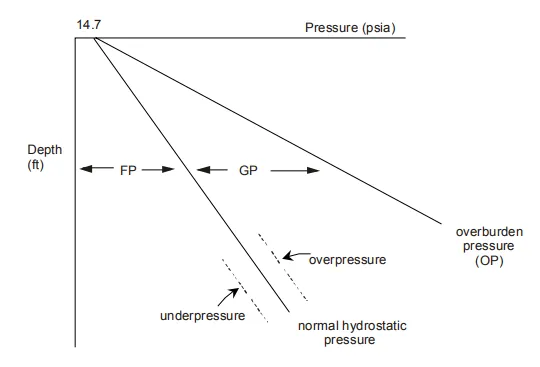
At a given depth, the overburden pressure can be equated to the sum of the fluid pressure (FP) and the grain or matrix pressure (GP) acting between the individual rock particles, i.e.

That is, a reduction in fluid pressure will lead to a corresponding increase in the grain pressure, and vice versa.
Fluid pressure regimes in hydrocarbon columns are dictated by the prevailing water pressure in the vicinity of the reservoir. In a perfectly normal case the water pressure at any depth can be calculated as

in which dp/dD, the water pressure gradient, is dependent on the chemical composition (salinity), and for pure water has the value of 0.4335 psi/ft. Addition of the surface pressure of one atmosphere (14.7 psia) results in the expression of the pressure in absolute rather than gauge units (psig), which are measured relative to atmospheric pressure. In many instances in reservoir engineering the main concern is with pressure differences, which are the same whether absolute or gauge pressures are employed, and are denoted simply as psi.
