The two previous mechanisms convert a linear motion into a rotational motion. The Geneva mechanism uses a continuously rotating driver to index the table, as pictured in Figure 17. If the driven member has six slots for a six-station dial indexing machine, each turn of the driver will cause the table to advance one-sixth of a turn. The driver only causes movement of the table through a portion of its rotation. For a six-slotted driven member, 120° of a complete rotation of the driver is used to index the table. The other 240° is dwell. For a four-slotted driven member, the ratio would be 90° for index and 270° for dwell. The usual number of indexing’s per revolution of the table is four, five, six, and eight.
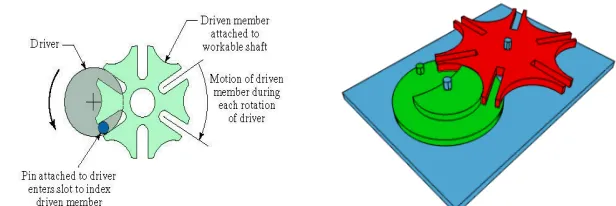
Geneva mechanism
CAM Mechanisms:
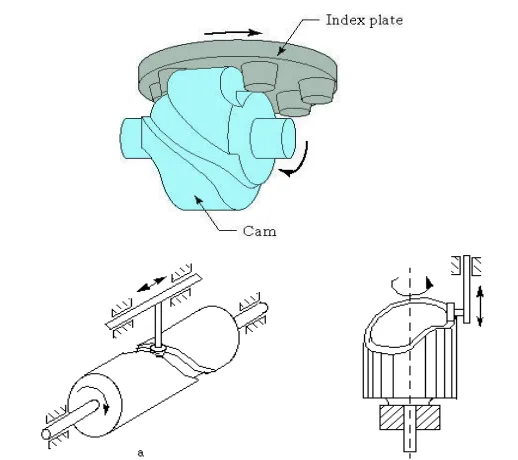
Various forms of cam mechanism, an example of which is illustrated in Figure 18, provide probably the most accurate and reliable method of indexing the dial. They are in widespread use in industry despite the fact that the cost is relatively high compared to alternative mechanisms. The cam can be designed to give a variety of velocity and dwell characteristics.