A GSM network comprises of many functional units. These functions and interfaces are explained in this chapter. The GSM network can be broadly divided into:
· The Mobile Station (MS)
· The Base Station Subsystem (BSS)
· The Network Switching Subsystem (NSS)
· The Operation Support Subsystem (OSS)
Given below is a simple pictorial view of the GSM architecture.

The additional components of the GSM architecture comprise of databases and messaging systems functions:
- Home Location Register (HLR)
- Visitor Location Register (VLR)
- Equipment Identity Register (EIR)
- Authentication Center (AuC)
- SMS Serving Center (SMS SC)
- Gateway MSC (GMSC)
- Chargeback Center (CBC)
- Transcoder and Adaptation Unit (TRAU)
The following diagram shows the GSM network along with the added elements:
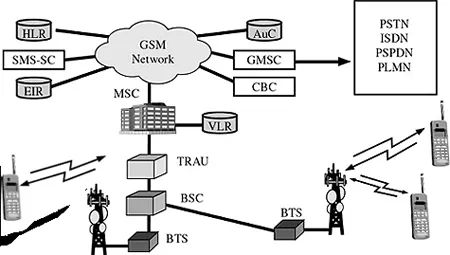
The MS and the BSS communicate across the Um interface. It is also known as the air interface or the radio link. The BSS communicates with the Network Service Switching (NSS) center across the A interface.
GSM network areas
In a GSM network, the following areas are defined:
· Cell : Cell is the basic service area; one BTS covers one cell. Each cell is given a Cell Global Identity (CGI), a number that uniquely identifies the cell.
· Location Area : A group of cells form a Location Area (LA). This is the area that is paged when a subscriber gets an incoming call. Each LA is assigned a Location Area Identity (LAI). Each LA is served by one or more BSCs.
· MSC/VLR Service Area : The area covered by one MSC is called the MSC/VLR service area.
· PLMN : The area covered by one network operator is called the Public Land Mobile Network (PLMN). A PLMN can contain one or more MSCs.