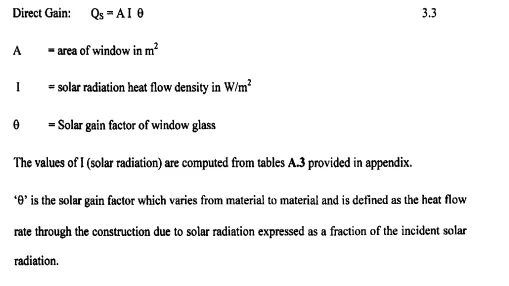
Steady state conditions do not occur in nature. The equation and calculation methods given below are valid if and only if, both out-door and indoor temperatures are constant. The basis of the below mentioned methods is the assumption of steady state conditions. This is an obvious simplification of the actual situation but the results can be taken as reliable if the fluctuations of temperature do not exceed f 3 deg. C. Such a situation may prevail in the winter of moderdte climates when the interior is heated and kept at a given temperature or in a warm-humid climate where the indoor temperature is kept constant by air conditioning. Calculations based on steady state assumptions are useful to determine the rate of heat loss or heat gain, also for the purpose of establishing the size and capacity of heating and cooling installations. The steady state calculation methods can also be considered as preliminary studies, to lead up to the understanding of the more complex non-steady-state heat transfer problems.
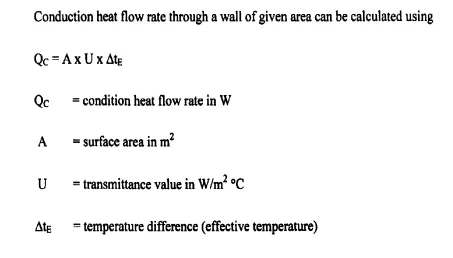
Conduction of heat: Qc:
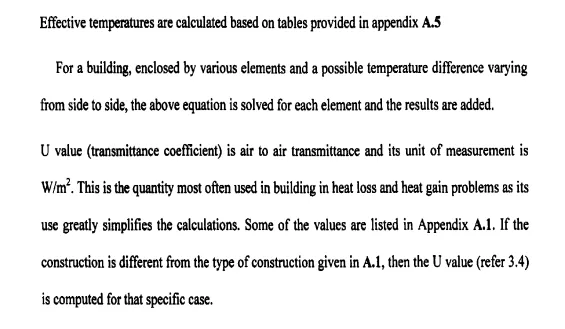
Convection: Qv:
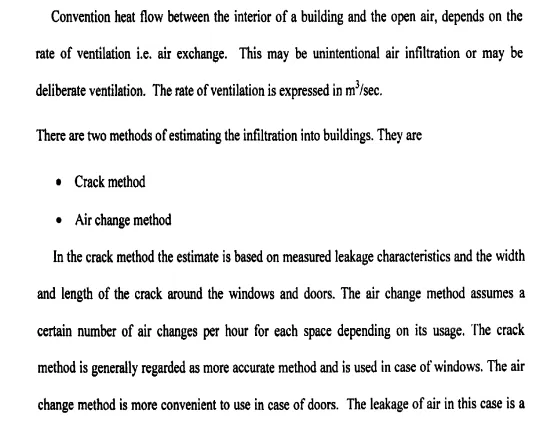
Radiation through glazing surfaces: QS :