




The rows below move from left to right in chronological development. The columns, from top to bottom represent geometric knowledge, bodily orientation in space and the built environment of each culture. Starting with pre-civilization, one can observe that the concept of geometry was undeveloped. Their geometric knowledge, migration through space, and method of dwelling was almost exclusively influenced by nature and movement. Next comes the development of calendar and circular cultures. The ability to trace simple shapes in sand gave the first signs of geometrical hierarchy, and their observance of the cosmos allowed them to begin forecasting the rising of the sun, seasons, and astronomical events. A defining parameter was the worship of the world axis. This coincided with the ability to live in larger settlements and organize themselves in a system of grouped circular structures.
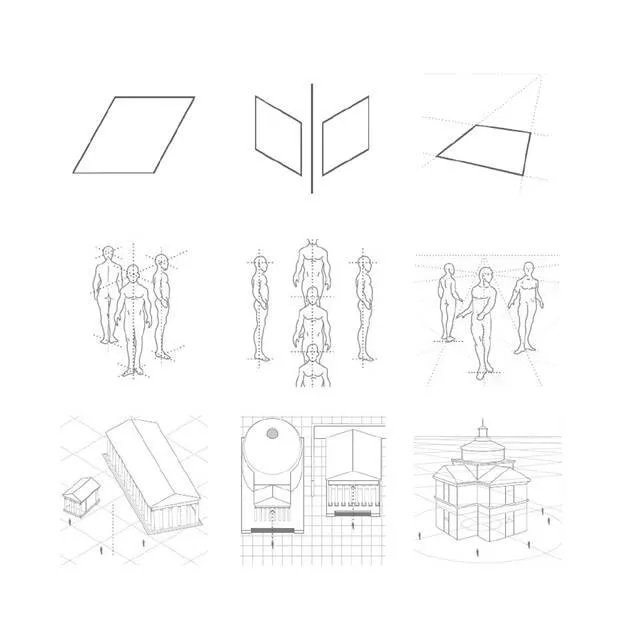
Next, comes the Egyptian’s elementary arithmetic and more complex geometric typologies. Almost simultaneously arose the ability to work in stone and build more complex structures, oriented loosely on perpendicular axes. This contrasts the system of the Greeks, who saw each object as a representation of beauty and perfection, inherited by an order deriving from the heavens and Gods. Each object, especially temples, were placed so that they could be experienced as delimited, plastic objects in space. The Romans had a more elaborate social-caste system. To organize their society, their architectural typologies were rigidly organized by axiality. A soldier could enter any Roman encampment and know where to find each programmatic function. The spatial organization of the Renaissance can be characterized by the discovery of perspective, creation of objects in space, and predefined dramatic views.

