- What “an offer” really means (and why it matters)
- The Irresistible Offer Formula (simple, practical)
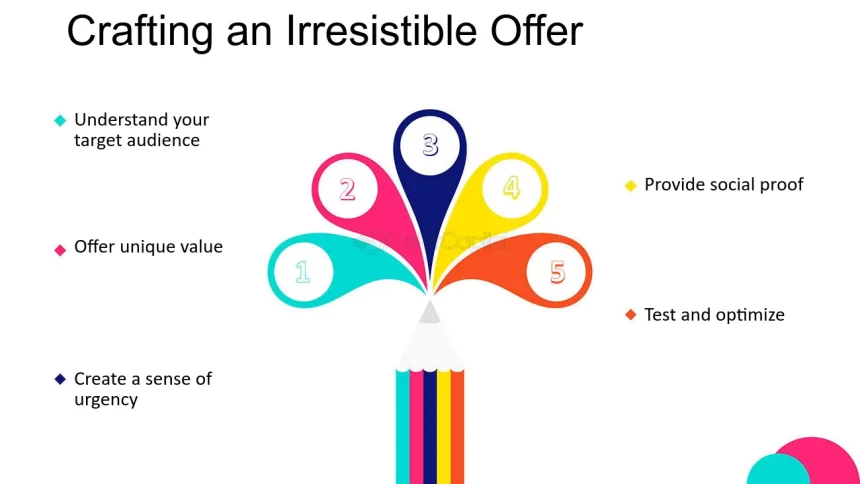
- What to include in an irresistible offer (the full checklist)
- 1) A clear, specific promise (the “main outcome”)
- 2) A defined “best-fit” customer
- 3) A “mechanism” (how you deliver the result)
- 4) Deliverables + scope (what’s included, what’s not)
- 5) Proof (why they should trust you)
- 6) Risk reversal (remove the fear)
- 7) Bonuses (increase value without huge extra cost)
- 8) Urgency & scarcity (ethical only)
- 9) A clear price with clear terms
- How to build an offer stack (step-by-step)
- Step 1: Start with the customer’s “job” and pain
- Step 2: Decide your “core offer” (the main deliverable)
- Step 3: Add “speed boosters” (bonuses that reduce time-to-result)
- Step 4: Add “friction removers” (bonuses that reduce effort)
- Step 5: Add proof and believability
- Step 6: Add risk reversal
- Step 7: Name and package the offer
- Irresistible offer examples (services, coaching, SaaS, e-commerce)
- Example 1: Local service (car workshop / home services)
- Example 2: Coach/consultant
- Example 3: SaaS
- Example 4: E-commerce bundle
- Example 5: Digital product (templates/course)
- Pricing your offer without guessing
- 1) Anchor price to value, then adjust for trust
- 2) Offer 3 tiers (most businesses should)
- 3) Use pricing to remove friction
- How to test and improve your offer fast
- Test #1: The 10-second clarity test
- Test #2: “Would you buy this?” interviews (5–10 calls)
- Test #3: Landing page split tests
- Common mistakes that make offers weak
- Mistake 1: Selling features instead of outcomes
- Mistake 2: Being vague
- Mistake 3: No proof, no risk reversal
- Mistake 4: Overstuffing bonuses that don’t help
- Mistake 5: Fake urgency
- Key Takeaways
- FAQs
- What’s the difference between a value proposition and an offer?
- Do I need a guarantee to make an offer irresistible?
- How many bonuses should I include?
- How do I avoid people abusing my guarantee?
- What if my offer is great but the price still feels high?
- Should I create different offers for different customer segments?
- How do I write a strong offer headline?
- Where should I place the offer on a landing page?
- References & further reading
Ever feel like your product is “good”… but people still hesitate? In most cases, the problem isn’t your product. It’s your offer—the complete package of value, outcomes, proof, price, bonuses, terms, and risk-reversal that makes “yes” feel obvious.
This guide shows you how to build an irresistible offer step-by-step, with templates you can copy and examples across services, coaching, e-commerce, and SaaS.
What “an offer” really means (and why it matters)
An offer is not just your product, and it’s not just the price. Your offer is the entire promise and package a buyer evaluates before they decide:
- Outcome: What result do I get?
- Time & effort: How long will it take and how hard is it?
- Risk: What if it doesn’t work for me?
- Trust: Do I believe you can deliver?
- Value: Is this worth the money compared to alternatives?
That’s why two businesses can sell similar things and get totally different results: one has a “meh” offer, the other has an offer that removes doubt and amplifies value.
If you want a quick lens for thinking about value, read about value propositions and perceived value from UX and marketing perspectives—especially helpful when you sell digital products or services online.
Helpful resources:
NNGroup on value propositions,
NNGroup on perceived value,
HubSpot value proposition guide.
The Irresistible Offer Formula (simple, practical)
Here’s a practical formula you can use for almost any business:
Irresistible Offer = Outcome + Proof + Terms that reduce risk
Then you enhance the offer using what I call the “conversion multipliers”:
- Clarity: the offer is easy to understand in 5 seconds
- Specificity: measurable results, clear scope, clear deliverables
- Risk reversal: guarantees, trials, milestones, or performance-based terms
- Bonuses: extras that increase value without exploding costs
- Urgency/scarcity (ethical): a real reason to act now
- Fit: the offer is designed around the customer’s “job to be done”
To deepen the “job to be done” idea (why customers choose what they choose), see:
HBR: Jobs to Be Done and
Christensen Institute JTBD.
What to include in an irresistible offer (the full checklist)
If you’re building an offer from scratch, include these components—then refine based on your market:
1) A clear, specific promise (the “main outcome”)
Not “get fit.” Not “grow your business.” Instead:
- “Lose 4–6 kg in 8 weeks without giving up rice (with a 20-min/day plan).”
- “Get your first 50 email subscribers in 14 days using a proven content sprint.”
- “Cut customer support tickets by 25% in 30 days with a self-serve knowledge base.”
Tip: If you can’t measure it, you can’t sell it. Use numbers, time, and constraints (“without X”, “even if Y”).
2) A defined “best-fit” customer
Irresistible offers feel personal. That’s hard if you sell to “everyone.” Define who it’s for:
- Industry (coaches, salons, local services, SaaS founders)
- Stage (beginner vs. intermediate vs. advanced)
- Constraint (no time, low budget, no tech skills, etc.)
When your audience is clear, your messaging gets sharper—and the offer becomes easier to believe.
3) A “mechanism” (how you deliver the result)
People buy believable methods, not vague promises. Explain how in a simple way:
- Framework (e.g., 3-step process)
- System (templates, scripts, checklists)
- Tooling (dashboards, automation, audits)
If you’re building value propositions systematically, explore:
Strategyzer: Value Proposition Canvas and
Strategyzer value proposition overview.
4) Deliverables + scope (what’s included, what’s not)
Weak offers are fuzzy. Strong offers are specific. List your deliverables:
- What the buyer gets (files, sessions, implementations, access)
- Timeline and milestones
- Boundaries (what you won’t do)
This reduces misunderstandings and makes your offer feel “real.”
5) Proof (why they should trust you)
Proof can be:
- Case studies (before/after)
- Testimonials (with context)
- Demonstrations (screenshots, mini-audits, sample outputs)
- Process proof (your framework, your SOPs)
Important: If you use testimonials or endorsements, be honest and transparent. For U.S. audiences, review FTC guidance on endorsements and advertising basics.
Resources:
FTC endorsement guidance,
FTC advertising basics.
6) Risk reversal (remove the fear)
Most buyers hesitate because they fear:
- “What if it doesn’t work for me?”
- “What if I waste time/money?”
- “What if the seller disappears?”
Risk reversal can be:
- Money-back guarantee: refund within 7/14/30 days
- Milestone-based payments: pay after delivery stages
- Trial period: test before committing
- Performance guarantee: “If X isn’t delivered, we do Y at no cost”
Learn more:
Copyblogger on lowering buyer risk,
Risk reversal examples.
7) Bonuses (increase value without huge extra cost)
Bonuses work best when they remove friction or speed up results. Examples:
- Templates and swipe files
- Implementation checklist
- Onboarding call or setup support
- Private community access
- Done-for-you audits or reviews
Bonuses should feel like: “Oh wow—this makes it easier.”
8) Urgency & scarcity (ethical only)
Urgency is powerful—but only if it’s real. Ethical urgency examples:
- Limited onboarding slots per month
- Bonus expires on a real date
- Price increases after a launch window
Avoid fake countdown timers or “only 2 left” when it’s not true. Trust is part of the offer.
9) A clear price with clear terms
Don’t just state a price—explain how it works:
- One-time vs. monthly vs. package
- What happens at renewal (if applicable)
- Refund policy and cancellation policy
- What “support” means (email, chat, response times)
How to build an offer stack (step-by-step)
Use this 7-step workflow to build your offer quickly and logically.
Step 1: Start with the customer’s “job” and pain
Write down:
- Job: what they’re trying to accomplish
- Pain: what makes it hard now
- Desired outcome: what success looks like
- Constraints: time, budget, skill, confidence
Tools:
Value Proposition Canvas,
HubSpot templates,
Unbounce value prop guide.
Step 2: Decide your “core offer” (the main deliverable)
Examples:
- A 4-week coaching program
- A done-for-you website + SEO setup
- A SaaS plan for teams
- A product bundle
Rule: Make the core offer simple enough to explain in one sentence.
Step 3: Add “speed boosters” (bonuses that reduce time-to-result)
Ask: what would help them get results faster?
- Setup help
- Templates
- Implementation roadmap
- Weekly review checkpoints
Step 4: Add “friction removers” (bonuses that reduce effort)
Ask: what feels hard, confusing, or annoying for them?
- Pre-built swipe files
- Video walkthroughs
- Checklists
- Examples (so they don’t start from zero)
Step 5: Add proof and believability
Believability often matters more than “bigger promises.” Add:
- 1–3 short case studies
- Before/after screenshots
- Demo video
- A “what happens next” timeline
If you need help crafting a strong UVP/USP statement:
Unbounce UVP guide.
Step 6: Add risk reversal
Choose a guarantee you can honor comfortably. A good guarantee is:
- Simple to understand
- Aligned with your delivery model
- Not easily abused
Examples you can adapt:
- “Try it for 14 days.” If it’s not for you, request a refund.
- “Milestone guarantee.” If we miss a milestone, we work free until it’s done.
- “Outcome guarantee (conditional).” If you complete the steps and don’t see improvement, we do extra support.
More ideas:
Copyblogger on irresistible offers,
Risk reversal concepts.
Step 7: Name and package the offer
Humans remember packages. Don’t sell “consulting.” Sell:
- “The 30-Day Lead Engine Setup”
- “The 7-Day Inbox Zero Sprint”
- “The Store Conversion Booster Kit”
Add a short promise under the name and a 3-bullet “what you get.”
If you want structured training on offer creation:
Acquisition.com offer training.
Irresistible offer examples (services, coaching, SaaS, e-commerce)
Below are examples you can model. Notice how each includes: clear outcome, scope, bonuses, and risk reversal.
Example 1: Local service (car workshop / home services)
Offer name: “Same-Day Safety & Savings Inspection”
- Outcome: Identify top 3 issues wasting fuel or reducing safety
- Deliverables: 30-point inspection + written report + priority plan
- Bonus: Free battery health test + tire pressure optimization
- Urgency: Only 10 slots/day (real capacity)
- Guarantee: If no actionable issues found, inspection fee becomes store credit
Why it’s irresistible: The customer gets clarity, convenience, and reduced risk—even if they don’t proceed with repairs.
Example 2: Coach/consultant
Offer name: “The 14-Day Clarity Sprint”
- Outcome: A clear niche + message + first offer draft
- Includes: 2 live calls + 2 async reviews + templates
- Bonus: Swipe file of high-converting landing page sections
- Risk reversal: If you complete the assignments and still feel unclear, you get an extra review call free
Why it’s irresistible: It compresses time-to-result and adds a fair, conditional guarantee.
Example 3: SaaS
Offer name: “Launch Plan (Teams)”
- Outcome: Get to “live” within 7 days
- Includes: onboarding, migration help, team training, priority support
- Bonus: setup checklist + templates library
- Risk reversal: 14-day free trial or cancellation in first month
Why it’s irresistible: It solves the real fear: “Will we actually implement this?”
Example 4: E-commerce bundle
Offer name: “Starter Bundle (Save 20%)”
- Outcome: Everything needed for 30 days of use
- Includes: product + refill + accessory
- Bonus: how-to guide + quick-start video
- Risk reversal: hassle-free returns policy
Why it’s irresistible: It increases perceived value while lowering decision fatigue.
Example 5: Digital product (templates/course)
Offer name: “Offer Builder Toolkit”
- Outcome: Create a complete offer page in 60 minutes
- Includes: copy blocks, pricing table, guarantee templates, FAQ templates
- Bonus: 10 offer examples for different industries
- Risk reversal: 7-day “use it or refund it” guarantee
Why it’s irresistible: It reduces effort and removes uncertainty with templates + guarantee.
Pricing your offer without guessing
Pricing is where many offers collapse—either too cheap (looks low-quality) or too expensive (feels risky). Here’s a practical way to price without guessing:
1) Anchor price to value, then adjust for trust
Price is not about your effort; it’s about the value and confidence a buyer has in getting that value.
- Higher trust + stronger proof → you can price closer to value
- Lower trust + less proof → add risk reversal, lower barrier, or segment a smaller starter offer
2) Offer 3 tiers (most businesses should)
A simple and effective structure:
- Starter: DIY or limited support (low risk, low commitment)
- Core: Best value (your main offer)
- Premium: Done-for-you or higher touch (fastest path)
This helps customers self-select and makes your “core” feel more reasonable.
3) Use pricing to remove friction
If customers hesitate, it’s often because the cost feels risky. You can reduce that by:
- Monthly options
- Milestone payments
- Short trials
- Conditional guarantees
How to test and improve your offer fast
You don’t need months to perfect an offer. You need fast feedback loops.
Test #1: The 10-second clarity test
Show your offer to someone and ask:
- What do you think this is?
- Who is it for?
- What result do you get?
If they can’t answer quickly, your offer is unclear.
Test #2: “Would you buy this?” interviews (5–10 calls)
Ask your ideal customers:
- What part excites you?
- What would stop you from buying?
- What would make this a “no-brainer”?
Test #3: Landing page split tests
Test one variable at a time:
- Different promise (headline)
- Different guarantee
- Different bonus
- Different pricing tier structure
If you’re optimizing landing pages, these are useful reads:
Unbounce value prop guide
and
Unbounce UVP guide.
Common mistakes that make offers weak
Mistake 1: Selling features instead of outcomes
Features matter, but outcomes sell. Translate features into results and relief.
Mistake 2: Being vague
“Improve your marketing” is vague. “Get 15 qualified leads/month in 60 days” is specific.
Mistake 3: No proof, no risk reversal
If people don’t trust you yet, they need either proof or protection (guarantee/terms) to say yes.
Mistake 4: Overstuffing bonuses that don’t help
Too many irrelevant bonuses create confusion. Choose bonuses that reduce time, effort, or uncertainty.
Mistake 5: Fake urgency
Short-term conversions are not worth long-term trust damage. Use ethical urgency only.
Key Takeaways
- An irresistible offer is the complete package: outcome, deliverables, proof, price, bonuses, and risk reversal.
- Make your promise specific and measurable (time, result, constraints).
- Use bonuses to reduce time-to-result and effort-to-implement.
- Add risk reversal (guarantee, trial, milestones) to remove fear.
- Price becomes easier when your offer is clear, believable, and designed for a specific customer.
FAQs
What’s the difference between a value proposition and an offer?
Your value proposition explains why someone should choose you (the core value and differentiation). Your offer is the full package that makes buying easy: value + proof + pricing + terms + bonuses + risk reversal.
Do I need a guarantee to make an offer irresistible?
Not always, but guarantees (or other risk reversals like trials and milestone payments) can dramatically reduce hesitation—especially for new brands without much proof.
How many bonuses should I include?
Usually 1–4 strong bonuses are enough. Prioritize bonuses that reduce time-to-result, effort, or uncertainty. Too many weak bonuses can reduce clarity.
How do I avoid people abusing my guarantee?
Use clear terms and a “fair” structure: time-bound refunds, milestone-based guarantees, or conditional guarantees tied to completion of steps. Keep it honest and enforceable.
What if my offer is great but the price still feels high?
Increase believability (proof), reduce risk (trial/guarantee), introduce a smaller starter option, or reposition the offer for a more urgent audience segment.
Should I create different offers for different customer segments?
Yes—often the fastest path to growth is building 2–3 segment-specific offers rather than trying to force one generic offer to fit everyone.
How do I write a strong offer headline?
Use: Result + Time + Constraint. Example: “Get your first 100 subscribers in 30 days (without running ads).”
Where should I place the offer on a landing page?
Show the main promise above the fold, then clarify deliverables, proof, bonuses, guarantee, and FAQ below. Make the next step (CTA) obvious and simple.
References & further reading
- FTC: Truth in Advertising
- FTC: Endorsements & Testimonials Guidance
- FTC: Advertising & Marketing Basics
- Strategyzer: Value Proposition Canvas (Official Template)
- Strategyzer: Business Model Canvas (Official Template)
- HBR: Know Your Customers’ Jobs to Be Done
- Christensen Institute: Jobs to Be Done Theory
- NNGroup: “Powered by AI” is not a value proposition
- HubSpot: How to write a value proposition
- HubSpot: Value proposition templates
- Unbounce: Value proposition guide
- Unbounce: Unique value proposition (UVP)
- Copyblogger: Craft an irresistible offer
- Copyblogger: Offers that raise response and lower risk
- Risk reversals in copywriting
- Acquisition.com: Offer creation training
- IxDF: Value proposition canvas overview