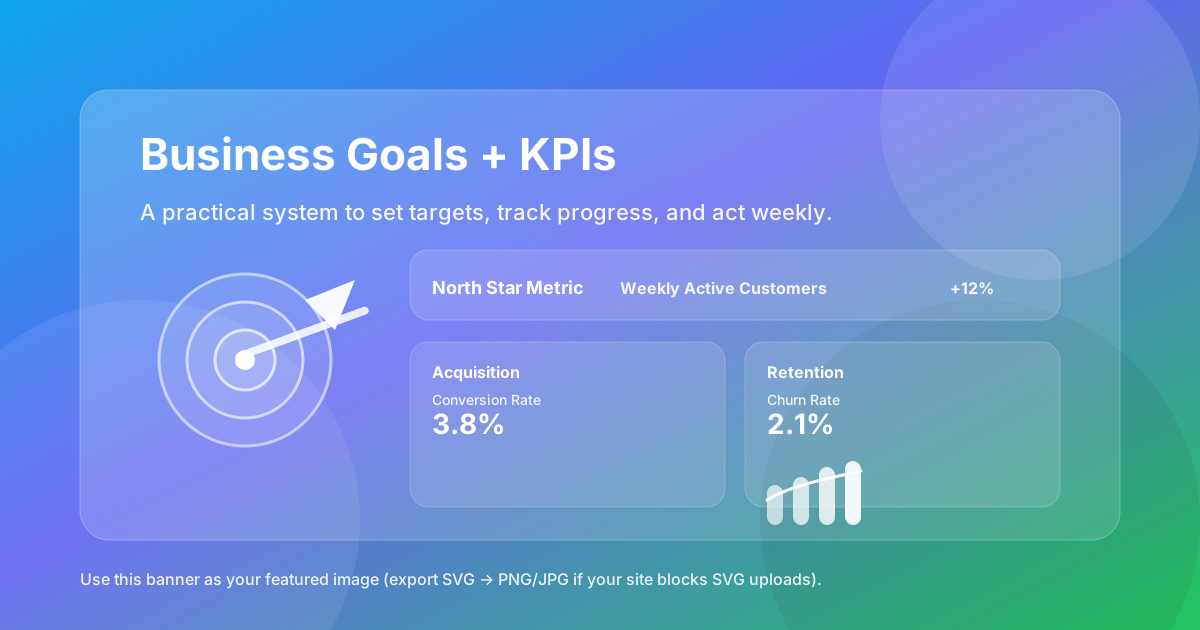
If your goals live in a document nobody opens, and your KPIs live in a dashboard nobody trusts, you don’t have a measurement problem—you have a focus and execution problem.
- Table of Contents
- Key Takeaways
- 1) Why Most Goals and KPIs Fail
- Problem A: Goals are vague
- Problem B: You track too many metrics
- Problem C: KPIs don’t connect to customer value
- Problem D: No one agrees on definitions
- Problem E: Reviews happen too late
- 2) Start With Strategy (Before You Touch Metrics)
- 3) Choose a Goal Framework: SMART, OKRs, Balanced Scorecard
- Option 1: SMART Goals (simple and widely useful)
- Option 2: OKRs (best for focus and alignment)
- Option 3: Balanced Scorecard (best to avoid “one-metric blindness”)
- 4) How to Choose KPIs That Actually Matter
- Step 1: Pick a “North Star Metric” that reflects customer value
- Step 2: Build a KPI tree (inputs → outputs)
- Step 3: Separate “vanity metrics” from “action metrics”
- Step 4: Use a small, balanced set of KPIs
- 5) Build a KPI Dictionary (So Everyone Measures the Same Thing)
- 6) Set Targets Without Guessing
- Step 1: Establish a baseline
- Step 2: Choose a target type
- Step 3: Use ranges and confidence
- Step 4: Connect targets to capacity and constraints
- 7) Dashboards + Cadence: Turning Data Into Decisions
- Recommended cadence (simple and effective)
- What your weekly KPI review should look like
- Tools to visualize and share KPIs
- 8) KPI Examples by Business Model
- 9) Common KPI Mistakes (and Fixes)
- Mistake 1: Tracking KPIs without owners
- Mistake 2: Measuring what’s easy instead of what’s important
- Mistake 3: Reviewing KPIs without decisions
- Mistake 4: Confusing correlation with causation
- Mistake 5: KPI “gaming”
- 10) A 30-Day Rollout Plan You Can Actually Follow
- Week 1: Align on strategy + constraint
- Week 2: Define KPIs (dictionary)
- Week 3: Instrument + validate data
- Week 4: Run the cadence
- 11) Copy-Paste Templates
- Template A: KPI Definition (KPI Dictionary)
- Template B: Quarterly OKR
- Template C: Weekly KPI Review Agenda
- FAQs
- How many KPIs should a small business track?
- What’s the difference between a metric and a KPI?
- Should KPIs be tied to employee performance reviews?
- How often should we review KPIs?
- What if our data is messy or incomplete?
- Conclusion: Make KPIs a Habit, Not a Homework Assignment
- References & Further Reading
Most businesses aren’t short on ambition. They’re short on a system. Teams set “growth” goals that are too vague, choose KPIs that are easy to pull (but don’t change decisions), and review numbers too late to do anything about them. The result is predictable: busy weeks, unclear progress, and strategies that feel “right” but aren’t improving performance.
This guide gives you a practical way to set business goals and track KPIs that actually matter—meaning they influence what you do next week, not just what you report next month. You’ll learn how to connect strategy to measurable outcomes, choose a small set of high-leverage metrics, build a KPI dictionary so everyone agrees on definitions, and create a review cadence that turns numbers into action.
Key Takeaways
- Goals must translate into decisions: if a KPI doesn’t change what you do weekly, it’s usually noise.
- Pick one “North Star” + a small support set: a single core value metric plus 8–15 operational KPIs beats 80 vanity metrics.
- Use leading + lagging indicators together: lagging KPIs tell you results; leading KPIs tell you what to do next.
- Define every KPI in a dictionary: owner, formula, data source, update frequency, and what “good” looks like.
- Review cadence matters more than dashboards: weekly actions + monthly learning + quarterly resets drive progress.
1) Why Most Goals and KPIs Fail
Let’s be honest: many goals are written to feel motivating, not to drive outcomes. And many KPIs are chosen because they’re available, not because they’re useful. Here are the most common failure patterns.
Problem A: Goals are vague
“Grow revenue.” “Increase brand awareness.” “Improve customer satisfaction.” These sound good but don’t tell a team what to do this week. A good goal creates clarity: what changes, by how much, by when, and who owns it.
Problem B: You track too many metrics
When everything is a KPI, nothing is. Leadership gets overwhelmed. Teams cherry-pick numbers that make them look good. Reviews become reporting theatre.
Problem C: KPIs don’t connect to customer value
Many businesses obsess over “vanity metrics” (likes, impressions, pageviews, downloads) that look impressive but don’t predict sustainable growth. A metric matters when it reflects real customer value and ties to outcomes (retention, repeat purchase, expansion, referrals, profit).
Problem D: No one agrees on definitions
If Marketing says “lead,” Sales says “lead,” and Finance says “lead” but all mean different things, your KPI discussion becomes an argument about reality. This is why KPI definitions (and data sources) are not optional.
Problem E: Reviews happen too late
If you review KPIs monthly, you often discover problems after a full cycle of damage. A strong operating cadence includes weekly reviews for leading indicators and constraints.
2) Start With Strategy (Before You Touch Metrics)
KPIs are not a replacement for strategy. They’re a way to test strategy. Before choosing KPIs, answer these five questions:
- Who is your customer? (Segment, use case, willingness to pay)
- What value do you deliver? (Outcome the customer actually wants)
- How do you win? (Differentiation: price, speed, quality, niche expertise, distribution)
- What is your constraint right now? (Leads? Conversion? Retention? Cash? Capacity? Delivery time?)
- What does “good” look like in 12 months? (Revenue, profit, retention, brand position, product maturity)
When strategy is clear, metrics become easier. Your KPIs should measure (1) customer value delivered, (2) your ability to deliver it repeatedly, and (3) the financial engine that keeps the business alive.
3) Choose a Goal Framework: SMART, OKRs, Balanced Scorecard
You don’t need a complex framework—but you do need structure. Here are three practical options. Many businesses combine them (for example: OKRs for quarterly execution, Balanced Scorecard for strategic coverage).
Option 1: SMART Goals (simple and widely useful)
SMART is a classic model to convert vague intentions into clear targets: Specific, Measurable, Achievable, Relevant, Time-bound.
Example: “Increase monthly qualified inbound leads from 250 to 400 by June 30 by publishing 12 SEO pages and improving conversion rate from 1.8% to 2.4%.”
Learn more about SMART goal writing here:
Atlassian’s SMART goals guide.
Option 2: OKRs (best for focus and alignment)
OKRs pair an Objective (what you want) with Key Results (how you measure progress). The magic is that OKRs force prioritization and alignment across teams.
Objective: Improve onboarding so new customers activate quickly.
Key Results:
- Increase activation rate from 32% to 45% by end of quarter
- Reduce time-to-first-value from 3.5 days to 1.5 days
- Increase week-4 retention from 18% to 25%
Useful OKR guides:
Google re:Work: Set goals with OKRs and
Asana: Setting OKRs.
Option 3: Balanced Scorecard (best to avoid “one-metric blindness”)
The Balanced Scorecard helps you measure performance from multiple perspectives (often financial, customer, internal processes, learning & growth). It prevents teams from “winning” one area while breaking another (for example: cutting support costs while retention drops).
Start here:
Balanced Scorecard basics and the classic overview from
Harvard Business Review.
4) How to Choose KPIs That Actually Matter
The best KPIs do two things:
- They predict outcomes you care about (growth, profit, retention, cash).
- They change behavior (what people do differently this week).
Step 1: Pick a “North Star Metric” that reflects customer value
A North Star Metric is the single measure that best captures the core value your product or service delivers. It should connect to long-term growth while staying customer-centric.
Examples:
- E-commerce: Repeat purchase rate (or orders from returning customers)
- SaaS: Weekly active teams using the core feature
- Marketplace: Successful matches or completed transactions
- Service business: Projects delivered on time with high satisfaction
Further reading:
Product School: North Star Metric,
Mixpanel: North Star metric.
Step 2: Build a KPI tree (inputs → outputs)
Think of KPIs as a chain:
- Input KPIs (leading): actions and drivers (sales calls, website conversion rate, onboarding completion)
- Output KPIs (lagging): results (revenue, profit, churn, NPS)
Example KPI chain (simplified):
- Traffic → Conversion rate → Qualified leads → Win rate → New customers → Revenue
- Activation → Engagement → Retention → Expansion → LTV → Profit
When a lagging metric dips (like revenue), your KPI tree tells you where to look for leading causes (traffic, conversion, win rate, retention).
Step 3: Separate “vanity metrics” from “action metrics”
Vanity metrics can still be tracked, but they should not be the main KPIs.
- Vanity: followers, impressions, pageviews, downloads
- Action: conversion rate, activated users, retention, repeat purchase, CAC payback, gross margin
If you want a deeper critique of KPI overload and what metrics actually measure, this is a useful read:
HBR: What Are Your KPIs Really Measuring?
Step 4: Use a small, balanced set of KPIs
A practical KPI set for most small-to-mid businesses:
- 1 North Star Metric (value delivered)
- 3–5 Growth KPIs (acquisition, conversion, retention)
- 3–5 Financial KPIs (cash, margin, profitability, CAC/LTV)
- 2–5 Operational KPIs (cycle time, quality, support speed)
5) Build a KPI Dictionary (So Everyone Measures the Same Thing)
A KPI without a definition is a debate waiting to happen. Create a one-page definition for every KPI. Here’s what to include:
| Field | What to write | Why it matters |
|---|---|---|
| KPI name | Clear and specific | Avoid confusion (“Revenue” vs “Net revenue”) |
| Purpose | What decision this KPI supports | Keeps the KPI actionable |
| Formula | Exact calculation | Stops metric drift |
| Data source | CRM, accounting, analytics, spreadsheet | Creates trust |
| Owner | One person accountable | Prevents “someone should…” |
| Update frequency | Daily/weekly/monthly | Matches the speed of decisions |
| Target + threshold | Green / yellow / red levels | Speeds up reviews |
| Notes | Edge cases, exclusions | Prevents misleading comparisons |
Example KPI definition:
- KPI: Customer Acquisition Cost (CAC)
- Purpose: Ensure growth is efficient and profitable
- Formula: (Sales + Marketing spend in period) ÷ (New customers acquired in period)
- Source: Accounting (spend) + CRM (new customers)
- Owner: Head of Growth / Marketing
- Update: Weekly view + monthly final
If you want external definitions and examples for common KPIs, these are helpful:
Investopedia: KPIs,
HubSpot: CAC,
IBM: Customer Lifetime Value.
6) Set Targets Without Guessing
Targets fail when they’re either (1) random, or (2) copied from a totally different business. Use this sequence instead:
Step 1: Establish a baseline
Before setting targets, collect 4–12 weeks of baseline data (even if imperfect). You need to know “where you are” before choosing “where to go.”
Step 2: Choose a target type
- Committed targets: must-hit numbers (cash runway, compliance, delivery SLAs)
- Growth targets: ambitious but plausible (pipeline, conversion, retention)
- Learning targets: for experiments (A/B test lift, onboarding completion)
Step 3: Use ranges and confidence
Instead of one number, consider ranges: “Increase conversion from 2.0% → 2.4–2.6% in 90 days.” Ranges reduce political fights and encourage learning.
Step 4: Connect targets to capacity and constraints
Targets must match reality: staffing, production capacity, support bandwidth, and cash. If you can only fulfill 200 orders/week without breaking delivery, a goal of 600 orders/week needs a capacity plan—not just a marketing plan.
7) Dashboards + Cadence: Turning Data Into Decisions
Dashboards are helpful, but cadence is what creates results. Your goal is to build a rhythm where KPIs trigger decisions quickly.
Recommended cadence (simple and effective)
- Weekly: Leading indicators + constraints + priorities (30–45 minutes)
- Monthly: Outcomes + financials + deep dives (60–90 minutes)
- Quarterly: Strategy refresh + OKR reset (half day)
What your weekly KPI review should look like
Keep it tight:
- Red metrics first: What’s off track?
- Diagnose via KPI tree: Which driver moved?
- Decide actions: 1–3 actions with owners and due dates
- Close the loop: Did last week’s actions move the numbers?
Tools to visualize and share KPIs
You don’t need fancy software. Start with what your team will actually use. Common options:
- Looker Studio for lightweight dashboards and sharing
- Looker Studio documentation for setup and reporting tips
- Power BI KPI dashboards for larger reporting needs
If you’re using GA4, it helps to align your KPI definitions to platform definitions (sessions, engaged sessions, engagement rate):
GA4 session metrics and
GA4 engagement rate & bounce rate.
8) KPI Examples by Business Model
Use these as starting points. Don’t copy blindly—adapt based on your strategy and constraint.
E-commerce KPIs
- North Star: Orders from returning customers (or repeat purchase rate)
- Acquisition: Website conversion rate, CAC, email list growth
- Revenue: Average order value (AOV), revenue per visitor
- Retention: 60/90-day repeat rate, refund rate
- Operations: On-time delivery rate, inventory stockout rate
CAC guidance (useful baseline):
Shopify: Customer acquisition cost.
SaaS / Subscription KPIs
- North Star: Weekly active customers experiencing “core value”
- Activation: % completing onboarding, time-to-first-value
- Retention: Logo churn, revenue churn, cohort retention
- Growth efficiency: CAC payback, LTV:CAC ratio
- Financial: Gross margin, net revenue retention (NRR), runway
Cohort analysis matters because averages hide the truth:
Stripe: SaaS cohort analysis.
Service business / agency KPIs
- North Star: Projects delivered on time with high client satisfaction
- Sales: Qualified leads/week, win rate, sales cycle length
- Delivery: Utilization rate, on-time milestones, rework hours
- Customer: Renewal rate, referrals, NPS
- Financial: Gross margin per project, cash runway
NPS background and calculation:
Bain: Net Promoter Score and
How to measure NPS.
Content business / media KPIs
- North Star: Returning readers (or engaged subscribers)
- Acquisition: Organic search clicks, newsletter signups
- Engagement: Returning visitor rate, engaged sessions (if relevant)
- Monetization: Revenue per subscriber, affiliate conversion rate
- Quality: Content publish consistency, topic cluster coverage
9) Common KPI Mistakes (and Fixes)
Mistake 1: Tracking KPIs without owners
Fix: Assign one owner per KPI. Teams can contribute, but one person must be accountable for explaining movement and proposing actions.
Mistake 2: Measuring what’s easy instead of what’s important
Fix: Start from customer value and business model. If you can’t measure something yet, treat it as an instrumentation project—not a reason to ignore it.
Mistake 3: Reviewing KPIs without decisions
Fix: End every KPI review with 1–3 actions, each with an owner and date. If no decision is made, the meeting is just reporting.
Mistake 4: Confusing correlation with causation
Fix: Use experiments where possible. For growth funnels, frameworks like AARRR can help map what to measure:
AARRR Pirate Metrics.
Mistake 5: KPI “gaming”
Fix: Balance metrics. If you measure “calls made,” add “qualified meetings” and “win rate.” If you measure “tickets closed,” add “CSAT” and “repeat contacts.” Always include quality measures.
10) A 30-Day Rollout Plan You Can Actually Follow
Week 1: Align on strategy + constraint
- Write a one-page strategy summary (customer, value, differentiation, constraint)
- Choose 1 North Star Metric
- Pick 8–15 supporting KPIs (balanced across growth, finance, ops)
Week 2: Define KPIs (dictionary)
- Create KPI definitions (formula, source, owner, cadence)
- Agree on targets (baseline + ranges)
- Decide review cadence and meeting owners
Week 3: Instrument + validate data
- Fix tracking gaps (analytics events, CRM stages, bookkeeping categories)
- Validate numbers with spot checks
- Create the first dashboard (simple, readable)
Week 4: Run the cadence
- Hold first weekly KPI review
- Document actions + owners
- Review what KPIs were actually useful and trim the rest
11) Copy-Paste Templates
Template A: KPI Definition (KPI Dictionary)
- KPI name:
- Why it matters:
- Formula:
- Included / excluded:
- Owner:
- Source of truth:
- Update frequency:
- Target (green/yellow/red):
- What actions move it:
Template B: Quarterly OKR
Objective: (short, inspiring, outcome-focused)
- KR1: (metric + baseline + target + date)
- KR2:
- KR3:
Initiatives: (top 3–5 projects that will move the KRs)
More OKR resources:
Asana OKR template.
Template C: Weekly KPI Review Agenda
- Wins (2 minutes)
- Red metrics (10–15 minutes)
- Driver diagnosis (10 minutes)
- Decisions & actions (10 minutes)
- Commitments for next week (3 minutes)
FAQs
How many KPIs should a small business track?
A practical range is 10–20 total, including one North Star. If you have more than 20, you’ll usually spend more time explaining numbers than acting on them.
What’s the difference between a metric and a KPI?
A metric is any measurable number. A KPI is a metric chosen as “key” because it ties directly to a goal and influences decisions. You can track many metrics, but only a few should be KPIs.
Should KPIs be tied to employee performance reviews?
Be careful. KPIs can be gamed when they become personal scorecards. Many teams use KPIs for learning and improvement, and use broader performance reviews for people evaluation.
How often should we review KPIs?
Review leading indicators weekly and lagging outcomes monthly. Do a quarterly reset for strategic goals (especially if using OKRs).
What if our data is messy or incomplete?
Start with the best available data, define it clearly, and improve tracking over time. The goal is not perfect data—it’s better decisions. If you wait for perfect data, you’ll wait forever.
Conclusion: Make KPIs a Habit, Not a Homework Assignment
When goals are clear and KPIs are chosen for action—not vanity—your business gets a powerful advantage: you can learn faster than competitors. Start with one North Star metric, define a small set of driver KPIs, and create a weekly rhythm that turns numbers into decisions. Over time, your dashboard becomes less of a report and more of a steering wheel.
References & Further Reading
- Google re:Work: Set goals with OKRs
- Atlassian: How to write SMART goals
- Investopedia: KPIs
- Balanced Scorecard: Basics overview
- HBR: The Balanced Scorecard (Kaplan & Norton)
- Product School: North Star Metric
- Mixpanel: North Star Metric
- Google Analytics: Session metrics
- Google Analytics: Engagement rate & bounce rate
- Looker Studio
- Microsoft: KPI dashboards (Power BI)
- Bain: Net Promoter Score (NPS)
- Net Promoter System: Measuring NPS
- Stripe: SaaS cohort analysis
- HubSpot: Customer acquisition cost (CAC)