Most people don’t fail because they “lack motivation.” They fail because their goals are vague, oversized, and disconnected from a daily system.
- Table of Contents
- Key Takeaways
- Why Most Goals Don’t Get Finished
- The Finish-Line Rule: What “Finished” Actually Means
- Step 1: Pick the Right Goal (Worth Finishing)
- Step 2: Choose a Format: SMART or OKR (Keep It Simple)
- Option A: SMART Goal (simple and personal)
- Option B: OKR (great for projects and measurable outcomes)
- Step 3: Break the Goal into Milestones & “Lead Measures”
- 3A) Create Milestones (the “stairs”)
- 3B) Choose 1–3 Lead Measures (your “engine”)
- 3C) Make it easier: motivation is unreliable
- Step 4: Plan Obstacles with WOOP + If–Then Plans
- 4A) Use WOOP (Wish, Outcome, Obstacle, Plan)
- 4B) Add If–Then Plans (Implementation Intentions)
- 4C) Protect yourself from the planning fallacy
- Step 5: Put the Goal on a Calendar (Time Blocking)
- 5A) Choose your “Power Window”
- 5B) Time block the lead measures
- 5C) Use Pomodoro or “Sprints” when focus is hard
- 5D) Prioritize with the Eisenhower Matrix
- 5E) Your weekly schedule (simple template)
- Step 6: Build a Scoreboard You’ll Actually Use
- The Weekly Review (The Secret to Finishing)
- Step 8: Add Accountability (Without Stress)
- Examples: 3 Finishable Goals (Fitness, Learning, Content)
- Example 1: Fitness (SMART + lead measures)
- Example 2: Learning (OKR + time blocking)
- Example 3: Content Publishing (the “ship” system)
- Common Mistakes & Quick Fixes
- Mistake 1: You set outcome goals but not action goals
- Mistake 2: Your goal is too big for your current schedule
- Mistake 3: You rely on “free time”
- Mistake 4: You miss one day and quit
- Mistake 5: You don’t review, so the plan breaks silently
- FAQ
- How many goals should I set at once?
- What if my goal depends on other people (clients, team, family)?
- How do I stay motivated when I’m tired?
- Is SMART better than OKR?
- How long should a goal cycle be?
- What if I miss a week completely?
- Creative Featured Image (Generated)
- References & Further Reading (External Links)
This guide gives you a complete, repeatable method to set goals that get finished. You’ll learn how to pick the right goal, translate it into a small set of measurable outcomes, build a simple habit-based “engine,” plan for obstacles (before they happen), schedule the work realistically, and review progress without guilt or drama.
Use this system for anything: fitness, learning, business, money, relationships, or a creative project (like writing a book or launching a blog). You don’t need a perfect plan. You need a finishable plan.
Key Takeaways
- Finishability beats ambition. Fewer goals, clearer metrics, and a smaller daily system wins.
- Outcomes need engines. Convert goals into lead measures (daily/weekly actions you control).
- Plan obstacles in advance. Use WOOP + if–then planning to prevent “I got busy” derailments.
- Schedule the work. If it’s not on your calendar, it’s wishful thinking.
- Review weekly. Weekly review turns failures into adjustments and keeps goals alive.
Why Most Goals Don’t Get Finished
Goals tend to fail for predictable reasons:
- Too many goals at once: Your attention gets fragmented, and nothing moves forward.
- Vague targets: “Get fit,” “be successful,” or “work harder” aren’t finishable because you can’t measure or plan them.
- No translation into behavior: A goal without a daily/weekly action plan is just a motivational poster.
- No plan for obstacles: Life happens. If you don’t plan for it, “busy” will win every time.
- No review cycle: Without a weekly checkpoint, goals drift until you forget them.
Research in goal-setting shows that goals can improve performance when they are clear and supported by feedback and commitment. But the “intention–action gap” is real: many people want to do something and still don’t follow through. That’s why this system focuses on translating a goal into simple plans, scheduled actions, and feedback loops rather than motivation alone.
The Finish-Line Rule: What “Finished” Actually Means
Before you plan anything, define the finish line. A goal is “finished” when it meets three conditions:
- It has a clear metric: a number, a deliverable, or a yes/no outcome.
- It has a time window: a deadline or a review period (like 4 weeks or 12 weeks).
- It has proof: something you can show—completed work, a test result, a published post, a saved amount, etc.
Example: “Get better at programming” becomes “Finish 24 coding exercises and build 1 small project in 8 weeks.” Now it’s measurable, time-bound, and provable.
If your goal can’t pass the Finish-Line Rule, it’s not a goal yet—it’s a desire. Desires are fine. But you can’t finish a desire.
Step 1: Pick the Right Goal (Worth Finishing)
Start with one primary goal for the next 4–12 weeks. Yes, one. You can have other responsibilities, but you should have only one “headline goal” you’re actively pushing.
Use the 3-Question Filter
- Does this matter in 6 months? If not, it might be a distraction.
- Can I influence it weekly? If not, it might be too dependent on other people or luck.
- Is it aligned with my identity? If you don’t want to become the kind of person who does the work, you won’t stick with it.
Make it “Small Enough to Finish, Big Enough to Matter”
One of the most common traps is choosing a goal that’s “true” but too large. For example:
- Too big: “Launch a successful business.”
- Finishable: “Publish a landing page + 5 blog posts + 1 lead magnet in 6 weeks.”
Tip: If your goal requires a complete life transformation, it’s not a 12-week goal. Shrink the scope until it feels doable with your current life constraints (time, energy, money).
Step 2: Choose a Format: SMART or OKR (Keep It Simple)
You only need one of these formats. Choose the one that feels easiest.
Option A: SMART Goal (simple and personal)
SMART goals are popular because they force clarity: Specific, Measurable, Assignable/Actionable, Realistic, Time-related. Start here if you want an easy structure.
Template: “By [date], I will [specific outcome] measured by [metric] by doing [core actions].”
Example: “By March 31, I will publish 12 high-quality how-to posts, measured by 12 published URLs, by writing 45 minutes per day and editing on Saturdays.”
Resource: Doran’s original SMART paper (PDF)
Option B: OKR (great for projects and measurable outcomes)
OKR stands for Objectives and Key Results. It’s useful when you want a motivating objective plus 2–4 measurable results.
Template:
- Objective: A short, inspiring direction.
- Key Results: 2–4 measurable outcomes that prove you’re making progress.
Example:
- Objective: Build a consistent writing habit and publish a helpful mini-library.
- Key Result 1: Publish 12 posts in 8 weeks.
- Key Result 2: Achieve an average time-on-page of 2:30 on those posts.
- Key Result 3: Collect 100 email subscribers via a free checklist.
Resource: Google re:Work guide to OKRs
Step 3: Break the Goal into Milestones & “Lead Measures”
Here’s the difference that changes everything:
- Lag measures: Results you want (weight lost, revenue, subscribers). You can’t fully control these.
- Lead measures: Actions that drive results (workouts completed, sales calls made, posts published). You can control these.
A finishable goal has both: a clear outcome and a small set of lead measures.
3A) Create Milestones (the “stairs”)
Break your timeline into checkpoints. For an 8-week goal, create 4 milestones (every 2 weeks). For a 12-week goal, create 3 milestones (every 4 weeks).
Example (12 posts in 8 weeks):
- Milestone 1 (Week 2): 3 posts
- Milestone 2 (Week 4): 6 posts
- Milestone 3 (Week 6): 9 posts
- Milestone 4 (Week 8): 12 posts
3B) Choose 1–3 Lead Measures (your “engine”)
Lead measures should be:
- Small: doable even on a bad day
- Scheduled: tied to a time and place
- Trackable: yes/no or a simple count
Examples of lead measures:
- Write 45 minutes/day (or 300 words/day)
- Walk 8,000 steps/day
- Practice 20 minutes/day
- Study 5 days/week for 30 minutes
- Ship 1 small improvement every day
3C) Make it easier: motivation is unreliable
When you’re tired, busy, or stressed, motivation drops. That’s where behavior design matters. A helpful lens is the Fogg Behavior Model: behavior happens when motivation, ability, and a prompt come together. To finish goals, you mainly improve ability (make it easier) and prompts (make it visible and scheduled).
Resource: Fogg Behavior Model
Practical “make it easier” checklist:
- Reduce setup time (keep tools ready)
- Lower the minimum (the “two-minute version”)
- Remove friction (block distractions, prepare environment)
- Make the first step obvious (a checklist, a template, a timer)
Step 4: Plan Obstacles with WOOP + If–Then Plans
Most goal plans assume ideal days. But real progress comes from how you handle imperfect days.
4A) Use WOOP (Wish, Outcome, Obstacle, Plan)
WOOP is a simple mental strategy: define what you want, imagine the best outcome, identify the biggest internal obstacle, and create a plan.
Example:
- Wish: Write consistently and publish 12 posts.
- Outcome: My blog becomes a helpful resource; I feel proud and confident.
- Obstacle: I open social media “for a minute” and lose focus.
- Plan: If I feel the urge to scroll, then I will set a 5-minute timer, write one paragraph, and only then decide.
Resource: WOOP (official site)
4B) Add If–Then Plans (Implementation Intentions)
Implementation intentions are if–then plans that connect a cue (a situation) to a response (a behavior). They reduce the need for willpower in the moment: you decide ahead of time.
Templates you can copy:
- If it’s 7:00 AM and I finish tea/coffee, then I will write for 25 minutes.
- If I feel too tired to do a full workout, then I will do a 10-minute “minimum workout.”
- If I miss a day, then I will do the next smallest step tomorrow (no guilt, no doubling).
- If I get stuck, then I will do 10 minutes of “messy progress” before researching more.
Resources (research & overview):
- Gollwitzer (1999) – Implementation intentions (PDF)
- Implementation intentions (alt PDF copy)
- Mental Contrasting + Implementation Intentions (MCII) study (open access)
4C) Protect yourself from the planning fallacy
People tend to underestimate how long things take. Build “buffers” into your plan: assume tasks will take 1.5× your initial estimate, and add one catch-up block per week.
Resource: Planning fallacy overview
Step 5: Put the Goal on a Calendar (Time Blocking)
To finish goals, you must convert them into calendar blocks. A to-do list is a wish list. A calendar is a commitment.
5A) Choose your “Power Window”
Pick a daily time when you usually have the most focus (for many people it’s morning). This becomes your default work window for lead measures.
5B) Time block the lead measures
Schedule your lead measures like appointments. Even 25 minutes counts.
Resource: Time blocking guide
5C) Use Pomodoro or “Sprints” when focus is hard
If you struggle with starting, use the Pomodoro Technique: work in short focused intervals with small breaks. It’s especially helpful for writing, studying, and deep work.
Resource: Pomodoro Technique (official)
5D) Prioritize with the Eisenhower Matrix
If you feel overwhelmed, sort tasks into four boxes: urgent/important, important/not urgent, urgent/not important, neither. Your goal progress usually lives in “important/not urgent”—so schedule it early.
Resource: Eisenhower Matrix guide
5E) Your weekly schedule (simple template)
- Mon–Fri: 25–60 minutes lead measure block (same time each day)
- Sat: 60–120 minutes milestone block (deeper work / catch-up)
- Sun: 20 minutes Weekly Review (see below)
Rule: If you miss a weekday block, don’t panic. Use the Saturday catch-up block. This is how you stay consistent in real life.
Step 6: Build a Scoreboard You’ll Actually Use
You don’t need a fancy tracker. You need a scoreboard that answers one question: “Am I doing the lead measures?”
Simple scoreboard options
- Paper: a printed habit tracker (yes/no checkmarks)
- Notes app: a weekly checklist
- Spreadsheet: a simple grid with dates and counts
- Task app: recurring tasks (Todoist, Notion, Trello)
Recommended tools (optional):
Two rules for a scoreboard that lasts
- Track only 1–3 lead measures. Tracking 12 habits is a hidden form of procrastination.
- Make tracking frictionless. Your tracker must be visible (home screen, notebook on desk, sticky note).
If you want an evidence-based habit formation perspective, habit automaticity grows with repetition over time; consistency matters more than intensity.
Resources:
The Weekly Review (The Secret to Finishing)
Weekly review is where goals become real. Without it, you don’t notice drift until it’s too late.
What to do in a 20-minute Weekly Review
- Check the scoreboard: Did you hit lead measures 70–80% of the time?
- Measure the outcome: Are key results moving (posts published, workouts completed, money saved)?
- Find the bottleneck: What stopped you most often (time, energy, distraction, unclear next step)?
- Adjust one thing: Change only one lever for next week (smaller minimum, new time block, remove distraction).
- Schedule next week: Put lead measure blocks on your calendar now.
Use a proven checklist if you like structure. Resource: GTD Weekly Review Checklist (PDF)
Finisher mindset: You’re not “good or bad” at goals. You’re running a system. Systems get tuned.
Step 8: Add Accountability (Without Stress)
Accountability doesn’t have to be public or dramatic. It just needs to make quitting slightly harder than continuing.
Low-pressure accountability options
- Accountability buddy: share weekly scoreboard screenshot or a one-line update.
- Public “ship” log: a simple list of outputs (posts published, workouts completed).
- Commitment device: make a small pledge you lose if you skip (money, donation, a consequence).
Resources:
Important: Keep stakes small. The point is consistency, not stress.
Examples: 3 Finishable Goals (Fitness, Learning, Content)
Example 1: Fitness (SMART + lead measures)
Goal: “By April 30, I will complete 24 workouts (3/week) and walk 8,000 steps on 5 days/week.”
- Milestones: 6 workouts by week 2, 12 by week 4, 18 by week 6, 24 by week 8
- Lead measures: schedule workouts Mon/Wed/Fri at 7:00 AM; daily steps tracked on phone
- WOOP obstacle: “Evening tiredness” → plan: “If I miss morning workout, then I do 10 minutes at lunch.”
- Scoreboard: checkboxes for workouts + steps count
Example 2: Learning (OKR + time blocking)
Objective: Become confident in conversational Spanish.
Key Results:
- Finish 30 lessons in 6 weeks
- Have 6 tutoring conversations (1/week)
- Learn 300 high-frequency words (50/week)
Lead measures: 25 minutes daily study + weekly conversation session scheduled.
Implementation intention: “If it’s 9:30 PM, then I do a 25-minute lesson before entertainment.”
Example 3: Content Publishing (the “ship” system)
Goal: Publish 12 how-to posts in 8 weeks.
- Lead measures: write 45 minutes/day; outline every Monday; edit every Saturday
- Milestones: 3 posts every 2 weeks
- Time blocks: 7:00–7:45 AM writing; Saturday 10:00–12:00 editing
- Scoreboard: “posts published” count + daily writing checkbox
- Weekly review: adjust writing time or minimum word count based on reality
Common Mistakes & Quick Fixes
Mistake 1: You set outcome goals but not action goals
Fix: Add 1–3 lead measures. Ask: “What do I do each day/week that makes this outcome likely?”
Mistake 2: Your goal is too big for your current schedule
Fix: Shrink the scope or lengthen the timeline. Keep the goal finishable.
Mistake 3: You rely on “free time”
Fix: Time-block a consistent window. “Free time” is where goals go to die.
Mistake 4: You miss one day and quit
Fix: Use a recovery rule: “Never miss twice.” If you miss, do the minimum the next day.
Mistake 5: You don’t review, so the plan breaks silently
Fix: 20-minute weekly review. Treat it like maintenance.
FAQ
How many goals should I set at once?
One main goal per 4–12 week cycle is ideal. You can keep “maintenance habits” (health, family, work), but only push one major outcome at a time.
What if my goal depends on other people (clients, team, family)?
Define a finish line based on what you control (lead measures). For example: “Send 30 proposals” instead of “Get 10 clients.” You can still track the outcome, but you don’t base success on it.
How do I stay motivated when I’m tired?
Don’t negotiate with tiredness—reduce the minimum. Create a “bad-day version” that still counts (10 minutes, 200 words, 1 small task). Consistency builds identity.
Is SMART better than OKR?
Neither is “better.” SMART is simpler for personal goals. OKRs are great when you want multiple measurable results for a single objective. Pick the one you’ll actually use.
How long should a goal cycle be?
Start with 4–8 weeks if you’ve struggled with consistency. Move to 12-week cycles once you trust your system. Short cycles create momentum.
What if I miss a week completely?
Restart with a smaller minimum and schedule the next week. Don’t “punish” yourself with double work. The goal is to rebuild consistency, not to suffer.
Creative Featured Image (Generated)
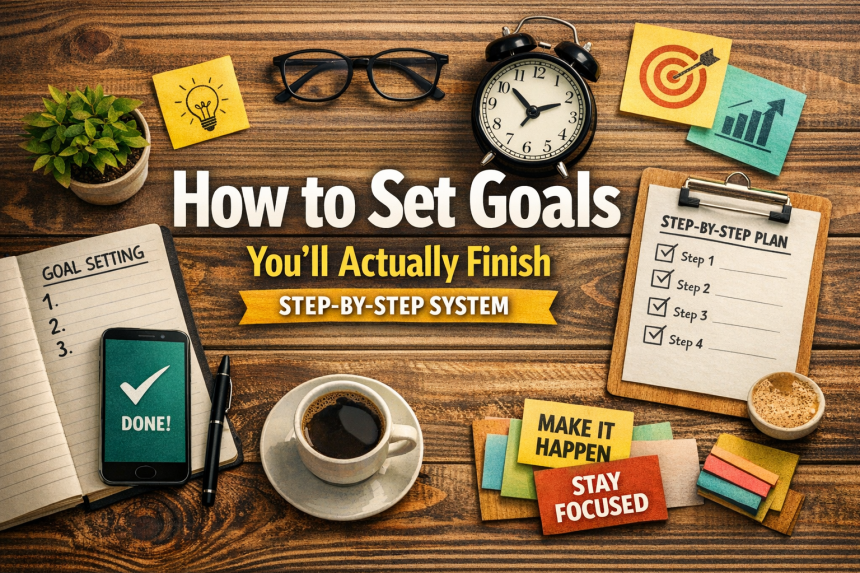
Image Alt Text: Goal setting system illustration with checklist, calendar time blocks, target, and progress chart.
Image Caption: A practical system turns goals into scheduled actions—and finished results.
Image Description: A modern featured image showing goal-planning visuals (checklists, time blocks, and progress) designed to match a productivity how-to guide.
References & Further Reading (External Links)
Use these sources to go deeper into the science and tools behind the system:
- Locke & Latham (2002) – Goal setting theory (PDF)
- Locke & Latham (2019) – 50 years of goal-setting theory (PDF)
- APA – Set goals (IDP guide)
- APA – Beyond goal setting to goal flourishing
- Doran (1981) – SMART goals (PDF)
- Gollwitzer (1999) – Implementation intentions (PDF)
- Duckworth et al. (2013) – MCII study (open access)
- WOOP (Wish–Outcome–Obstacle–Plan)
- Fogg Behavior Model
- Lally et al. – Habit formation study
- Gardner (2012) – Habit formation review (open access)
- Google re:Work – OKRs
- Asana – Eisenhower Matrix
- Pomodoro Technique (official)
- Todoist – Time blocking guide
- Planning fallacy overview
- GTD Weekly Review Checklist (PDF)
- StickK – Commitment contracts
Tip for WordPress: Paste this entire HTML into the WordPress Code Editor. If you use the Block Editor (Gutenberg), paste it into a “Custom HTML” block or the code editor view.