- Table of Contents
- Why Motivation Fails (and Why That’s Normal)
- What Consistency Really Means
- The SIMPLE Habit Framework (5 Steps)
- Step 1: Shrink the Habit (Minimum Viable Habit)
- Step 2: Install a Trigger (If–Then Plan)
- Step 3: Lower Friction (Environment Design)
- Step 4: Lock in a Reward (Track + Celebrate)
- Step 5: Build a Reset System (Never Miss Twice)
- Real Examples You Can Use Today
- Example 1: Fitness (Busy Schedule)
- Example 2: Studying (Exam Prep)
- Example 3: Writing (Content / Blogging)
- Example 4: Healthy Lifestyle Habits
- A 14-Day Consistency Plan (Simple and Realistic)
- Days 1–3: Start tiny and win
- Days 4–7: Remove friction
- Days 8–11: Add a reward and identity statement
- Days 12–14: Add a small upgrade
- Common Mistakes (and Quick Fixes)
- Mistake 1: Setting a habit that’s too big
- Mistake 2: Relying on vague intentions (“I’ll do it sometime”)
- Mistake 3: Trying to do five habits at once
- Mistake 4: Missing once and deciding you failed
- Mistake 5: Tracking too much
- Key Takeaways
- FAQs
- 1) How long does it take to build a habit?
- 2) Is discipline the same as motivation?
- 3) What if I’m extremely busy?
- 4) What if I miss several days?
- 5) How do I stay consistent when I don’t see results yet?
- 6) What’s the best habit tracker?
- 7) Should I build habits daily or a few times per week?
- 8) How do I stop relying on “mood”?
- References & Further Reading (External Links)
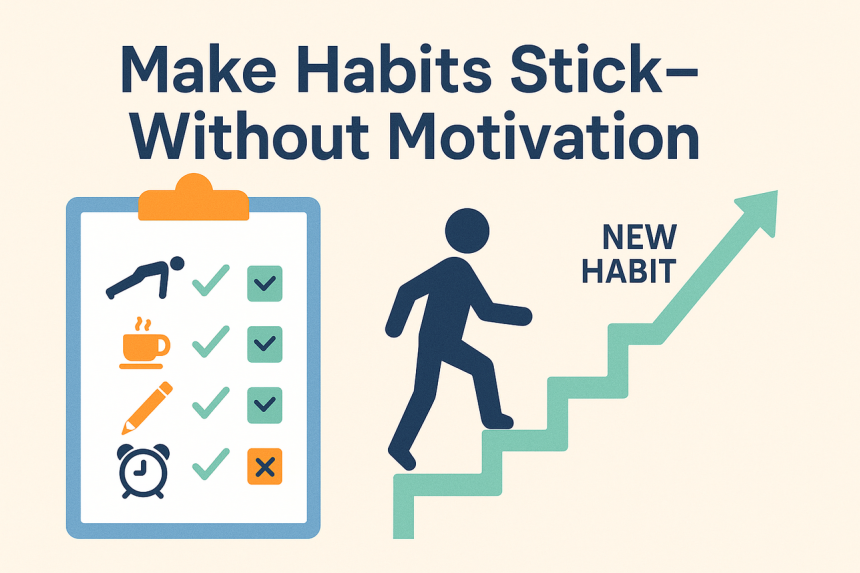
You don’t need more motivation. You need a better system.
If you’ve ever waited to “feel like it” before starting, you’ve already discovered the problem: motivation is unpredictable. Some days you’re energized and unstoppable. Other days you’re tired, busy, stressed, or simply not in the mood. And when motivation disappears, your plan disappears with it.
The good news: consistency is not a personality trait. It’s not “born discipline.” Consistency is a design problem. When your habits are designed well, you can keep going even when motivation is low.
In this guide, you’ll learn a simple, practical framework that helps you stay consistent through busy schedules, low energy days, travel, distractions, and setbacks—without relying on hype or willpower.
Table of Contents
Why Motivation Fails (and Why That’s Normal)
Motivation is a mental state—an “impetus” that gives direction to behavior. It rises and falls depending on sleep, stress, hormones, mood, environment, workload, social factors, and how hard the task feels in the moment. That means motivation is not a reliable fuel source.
When people say, “I can’t stay consistent,” what they usually mean is:
- “My habit is too big for my current life.”
- “I don’t have a clear trigger, so I forget or delay.”
- “My environment makes the habit harder than it needs to be.”
- “When I miss once, I spiral into guilt and stop.”
Notice how none of those are solved by “trying harder.” They’re solved by better habit engineering.
A helpful lens is the Fogg Behavior Model, which says behavior happens when Motivation, Ability, and a Prompt come together at the same time. When motivation drops (which it will), your consistency survives if you increase ability (make it easier) and tighten your prompt (make it obvious).
That’s exactly what the framework below will do.
What Consistency Really Means
Most people define consistency as “doing it every day perfectly.” That definition is so strict that it creates a fragile system—one missed day feels like failure.
Here’s a more useful definition:
Consistency = returning to the habit quickly after life interrupts you.
In other words, consistency isn’t “never missing.” It’s having a system that makes it easy to restart—without drama.
This shift matters because real life will always interrupt you: deadlines, family, travel, sickness, low energy days, unexpected events. A strong habit system expects interruptions and includes a reset plan.
The SIMPLE Habit Framework (5 Steps)
Use this SIMPLE framework anytime you want consistency without relying on motivation:
| Step | What You Do | Why It Works |
|---|---|---|
| Shrink | Make the habit tiny (minimum viable habit). | Low effort = high repeatability. |
| Install a Trigger | Use an “If–Then” plan and habit stacking. | Removes forgetting and decision fatigue. |
| Make it Easy | Lower friction and design the environment. | More ability means less need for motivation. |
| Pay off | Add a small reward + track progress. | Reinforces the loop and builds identity. |
| Lock in a Reset | Plan for misses (never miss twice). | Prevents “all-or-nothing” quitting. |
| Evolve | Increase difficulty only after consistency. | Growth without burnout. |
Now let’s break each step into actions you can apply today.
Step 1: Shrink the Habit (Minimum Viable Habit)
Your biggest enemy isn’t laziness—it’s an oversized habit.
When motivation is low, the habit must still be doable. That’s why you create a Minimum Viable Habit (MVH): the smallest version you will do even on bad days.
How to choose your Minimum Viable Habit
Ask: “What is the smallest action that still counts as showing up?”
- Exercise: Put on workout shoes + 5 minutes walk
- Reading: 1 page
- Writing: 50 words
- Studying: 10 minutes or 1 practice problem
- Meditation: 2 minutes
- Business: 1 outreach message or 1 improvement task
This is not “settling.” It’s building the habit first. Once a behavior becomes automatic, scaling is easier and more natural.
The “2-minute entry rule”
Start so small it feels almost silly. The goal is to make starting effortless. Once you start, you often continue—but even if you don’t, you still win because you protected consistency.
Step 2: Install a Trigger (If–Then Plan)
Most inconsistency comes from one sentence: “I’ll do it later.”
Later is vague. Your brain doesn’t like vague tasks—so it delays them.
The fix is a clear trigger using an If–Then plan (also called an implementation intention):
If situation X happens, then I will do behavior Y.
Examples you can copy
- If I finish brushing my teeth, then I will meditate for 2 minutes.
- If I sit at my desk at 9:00 AM, then I will write 50 words before opening social media.
- If I make my evening tea, then I will read 1 page.
- If I return from work, then I will walk for 5 minutes.
Habit stacking (the easiest trigger)
Attach your new habit to an existing habit that already happens:
After I [current habit], I will [new tiny habit].
The secret is choosing a trigger that is:
- Already consistent (daily routine)
- Easy to notice (obvious moment)
- Close in time to the new habit
Step 3: Lower Friction (Environment Design)
When motivation is low, your environment decides your behavior.
If your habit requires extra steps—finding equipment, searching for files, setting up a space—your brain will resist. So instead of pushing willpower, you reduce friction.
Use the “one-touch rule”
Make the habit startable in one simple action.
- Keep your workout clothes visible and ready.
- Open your notes app to the exact page you need.
- Place your book on the pillow in the morning.
- Keep a water bottle filled on your desk.
Raise friction for distractions
Consistency improves when distractions become slightly harder:
- Log out of social apps after use.
- Keep your phone in another room during the habit.
- Use website blockers during deep work.
- Remove tempting apps from your home screen.
Design for “low-energy days”
Create a smaller “bad day” version of the habit:
- Gym day becomes “walk + stretch.”
- Deep study becomes “review flashcards.”
- Long writing becomes “outline 3 bullets.”
This is how you stop breaking the chain when life gets messy.
Step 4: Lock in a Reward (Track + Celebrate)
Habits stick when they feel rewarding. You don’t need big rewards—you need immediate reinforcement.
Harvard Health describes habits as a loop (cue → routine → reward). The reward tells your brain, “Do that again.”
Two simple reward styles
1) The “instant win” reward
- Say: “That counts.”
- Do a quick fist pump or smile.
- Play a 10-second favorite song snippet.
- Mark it done on your tracker (the checkmark itself becomes rewarding).
2) The “after” reward
- After studying 10 minutes, I can make coffee.
- After writing 50 words, I can check messages.
- After my walk, I can watch a short video.
Tracking that doesn’t become a burden
The best tracking system is the one you’ll actually maintain.
- Option A: Put an “X” on a calendar each day.
- Option B: Use a simple habit tracker app.
- Option C: Keep a notes list: “Day 1 ✅ Day 2 ✅”
Keep it frictionless. Tracking is not the goal—showing up is.
Step 5: Build a Reset System (Never Miss Twice)
Here’s the real difference between consistent people and everyone else:
Consistent people don’t avoid failure. They recover faster.
Missing once is normal. Missing twice is the beginning of a new habit: the habit of skipping.
The “Never Miss Twice” rule
If you miss today, your only goal is to show up tomorrow—at the minimum viable habit level.
No guilt. No “I ruined everything.” Just a reset.
Your 60-second reset protocol
- Reduce: What’s the smallest version I can do tomorrow?
- Reconnect: What trigger will I use? (After what routine?)
- Remove friction: What can I prep tonight?
- Restart: Do it once, even if it’s tiny.
This prevents the most common pattern: missing → guilt → quitting.
Step E: Evolve (Only after consistency)
Once your MVH is consistent, scale it slowly:
- 2 minutes → 5 minutes → 10 minutes
- 1 page → 3 pages → 10 pages
- 50 words → 150 words → 500 words
Growth is a reward for consistency—not a requirement to begin.
Real Examples You Can Use Today
Example 1: Fitness (Busy Schedule)
Goal: Exercise consistently without motivation.
- MVH: Put on shoes + 5-minute walk
- Trigger: After I return home, I walk immediately
- Environment: Shoes at the door, playlist ready
- Reward: Checkmark on calendar + quick stretch feels good
- Reset: If missed, do MVH tomorrow—no negotiation
Example 2: Studying (Exam Prep)
Goal: Study daily even when tired.
- MVH: 10 minutes or 1 problem
- Trigger: After dinner, open notes and do 1 problem
- Environment: Study space cleaned, book open, phone away
- Reward: Track streak + tea after session
- Reset: Missed day → flashcards for 2 minutes next day
Example 3: Writing (Content / Blogging)
Goal: Publish consistently without waiting for inspiration.
- MVH: Write 50 words
- Trigger: If it’s 8:30 AM, I write before checking messages
- Environment: Document pinned, outline ready, distraction blocker on
- Reward: Mark “50 words done” + small progress bar
- Reset: If missed, write 25 words next day and rebuild
Example 4: Healthy Lifestyle Habits
If your habit is related to health (exercise, movement, sleep, nutrition), keep the habit small and consistent. Public health guidelines recommend regular movement (e.g., weekly moderate activity targets), but your starting habit can still be tiny. Consistency first; intensity later.
A 14-Day Consistency Plan (Simple and Realistic)
Use this as your “starter program” for any habit:
Days 1–3: Start tiny and win
- Pick 1 habit only.
- Define your MVH (2 minutes or equivalent).
- Choose your trigger (After X, I do Y).
- Track with a simple X on a calendar.
Days 4–7: Remove friction
- Prep the environment the night before.
- Reduce distraction friction (phone away, apps hidden).
- Keep the habit tiny—don’t “upgrade” yet.
Days 8–11: Add a reward and identity statement
- Add a tiny reward (checkmark + “That counts”).
- Use an identity cue: “I’m the kind of person who shows up.”
Days 12–14: Add a small upgrade
- Increase by 10–20% only if consistency is stable.
- Keep a “bad day” version ready.
At the end of 14 days, your goal isn’t perfection—it’s that your habit feels normal.
Common Mistakes (and Quick Fixes)
Mistake 1: Setting a habit that’s too big
Fix: Shrink to MVH. You can always build later.
Mistake 2: Relying on vague intentions (“I’ll do it sometime”)
Fix: Use a clear If–Then trigger with a specific time/place.
Mistake 3: Trying to do five habits at once
Fix: Pick one “keystone” habit for 2–4 weeks.
Mistake 4: Missing once and deciding you failed
Fix: Use “Never miss twice” + reset protocol.
Mistake 5: Tracking too much
Fix: Use the simplest tracker possible (calendar X).
Key Takeaways
- Motivation is unreliable; systems create consistency.
- Make your habit so small you can do it on bad days.
- Use an If–Then plan and habit stacking to remove decision fatigue.
- Lower friction by designing your environment for easy starts.
- Track simply and reward the act of showing up.
- Expect misses—consistency is fast recovery, not perfection.
FAQs
1) How long does it take to build a habit?
It varies by person and habit complexity. Research on daily behaviors in real life found that automaticity can take weeks to months, with wide variation. The practical takeaway: focus on repetition and a stable cue, not a magic number of days.
2) Is discipline the same as motivation?
No. Motivation is a feeling state; discipline is a behavior pattern supported by systems. With a good setup (tiny habit + prompt + low friction), discipline becomes easier and less “mental.”
3) What if I’m extremely busy?
Busy seasons are exactly why you need a Minimum Viable Habit. A 2–5 minute version preserves identity and momentum until life opens up again.
4) What if I miss several days?
Restart at the smallest version, re-install your trigger, and remove friction. Do not try to “make up” missed days with a huge session—returning calmly is the win.
5) How do I stay consistent when I don’t see results yet?
Measure what you can control: “Did I show up?” Results are delayed; identity and momentum are immediate. Track effort first; outcomes follow.
6) What’s the best habit tracker?
The best tracker is the one you’ll use without friction. Many people do best with a simple calendar X or a one-tap habit app. Avoid complex tracking that feels like homework.
7) Should I build habits daily or a few times per week?
Daily repetition can speed automaticity for some habits, but it’s not required. Choose a schedule you can sustain. Consistency beats intensity.
8) How do I stop relying on “mood”?
Use triggers and defaults. Make the habit start automatic (If–Then), keep it tiny, and remove setup work. You’ll do it because “it’s what happens after X,” not because you feel like it.
References & Further Reading (External Links)
- APA Dictionary of Psychology: Motivation — https://dictionary.apa.org/motivation
- Fogg Behavior Model (Stanford Behavior Design) — https://behaviordesign.stanford.edu/resources/fogg-behavior-model
- BehaviorModel.org (B=MAP) — https://www.behaviormodel.org/
- BJ Fogg (official site) — https://www.bjfogg.com/
- Stanford Behavior Design Lab — https://behaviordesign.stanford.edu/
- James Clear: Motivation guide — https://jamesclear.com/motivation
- James Clear: Habits guide — https://jamesclear.com/habits
- James Clear: Atomic Habits — https://jamesclear.com/atomic-habits
- Lally et al. habit formation study (Wiley) — https://onlinelibrary.wiley.com/doi/10.1002/ejsp.674
- Semantic Scholar summary of Lally et al. — https://www.semanticscholar.org/paper/How-are-habits-formed%3A-Modelling-habit-formation-in-Lally-Jaarsveld/c1104763806894bd668e3bf09b93669acaaf31d3
- Implementation Intentions (Gollwitzer, 1999 PDF) — https://kops.uni-konstanz.de/bitstreams/14cc2a36-5f01-4dc1-b9ca-f2d0ca0c8930/download
- Implementation Intentions & Effective Goal Pursuit (1997 PDF) — https://sparq.stanford.edu/sites/g/files/sbiybj19021/files/media/file/gollwitzer_brandstatter_1997_-_implementation_intentions_effective_goal_pursuit.pdf
- Habit loop basics (Harvard Health) — https://www.health.harvard.edu/staying-healthy/trade-bad-habits-for-good-ones
- Making health habitual (PubMed Central) — https://pmc.ncbi.nlm.nih.gov/articles/PMC3505409/
- CDC adult activity guidelines — https://www.cdc.gov/physical-activity-basics/guidelines/adults.html
- WHO physical activity initiative — https://www.who.int/initiatives/behealthy/physical-activity
- NHS physical activity guidelines — https://www.nhs.uk/live-well/exercise/physical-activity-guidelines-for-adults-aged-19-to-64/
- Physical Activity Guidelines for Americans (PDF) — https://health.gov/sites/default/files/2019-09/Physical_Activity_Guidelines_2nd_edition.pdf
Final note: You don’t become consistent by feeling motivated every day. You become consistent by building a system that works even on the days you don’t feel like it.