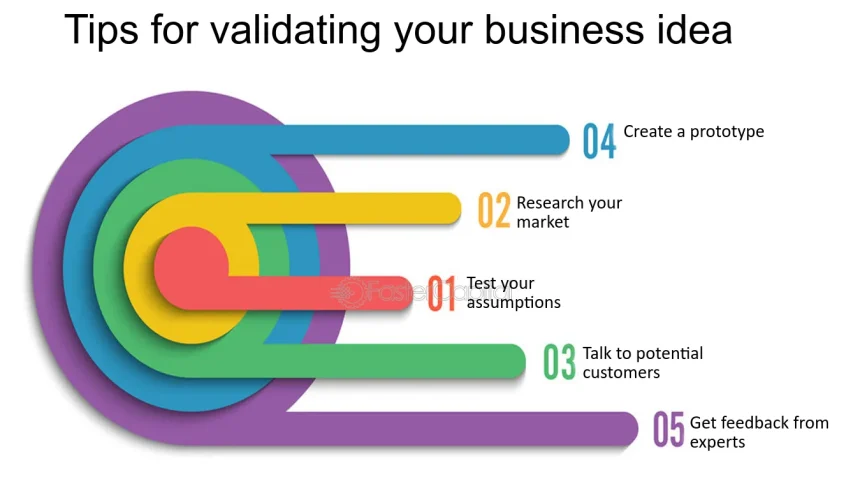
- What “validation” really means (and what it doesn’t)
- The validation mindset: evidence over opinions
- The 3-layer validation framework
- Step 1: Turn your idea into testable assumptions
- Step 2: Define your ideal customer (ICP) and target segment
- Step 3: Market + competitor research (quick, not perfect)
- Step 4: Customer discovery interviews that don’t lie to you
- Golden rules for interviews
- 15-question interview script (copy/paste)
- How many interviews do you need?
- Step 5: Smoke tests (landing page, “fake door,” waitlist)
- Option A: A 1-page landing page
- Option B: “Fake door” test
- Option C: Quick survey (only after you have traffic)
- What metrics matter (simple version)
- Step 6: Pre-sell (the fastest form of validation)
- 3 practical pre-sell models
- Use crowdfunding as validation (when it fits)
- How to pitch a pre-sell offer (simple script)
- Step 7: Build the smallest MVP that proves value
- A simple validation scorecard
- Common validation mistakes (and how to avoid them)
- 1) Asking leading questions
- 2) Validating with the wrong audience
- 3) Confusing interest with willingness to pay
- 4) Building too much too early
- 5) Ignoring the “do nothing” competitor
- 6) Not capturing learning
- FAQs
- How long should validation take?
- What’s the fastest way to validate willingness to pay?
- Should I do surveys or interviews first?
- Do I need a website to validate an idea?
- How do I validate a B2B idea?
- How do I validate a consumer idea?
- What if people say they want it, but don’t sign up?
- How many signups mean “validated”?
- Should I hide my idea to avoid copycats?
- What if competitors already exist?
- Key Takeaways
- References
You don’t need a 40-page business plan to validate an idea. You need proof: real conversations, real signals, and ideally real money. This guide shows you a fast, practical validation system you can run in days (not months) to confirm demand, pricing, and whether it’s worth building at all.
What “validation” really means (and what it doesn’t)
Business idea validation is the process of collecting enough real-world evidence to confidently answer three questions:
- Problem: Do people truly experience this problem often enough—and urgently enough—to care?
- Solution: Will they choose your approach over doing nothing or using alternatives?
- Payment: Will they pay (or commit in a measurable way) at a price that makes the business viable?
Validation is not:
- Friends saying “nice idea!”
- Likes and comments (they can help, but they aren’t proof of demand)
- One enthusiastic customer (you need patterns)
- Building a full product “to see what happens”
Your goal is to move from “I think” to “I know,” using experiments that are fast, cheap, and decisive.
The validation mindset: evidence over opinions
Most people waste time because they validate the wrong thing: they validate their excitement, not the market. A better mindset is:
- Assume you’re wrong until evidence proves otherwise.
- Start with the customer’s world, not your solution.
- Prefer actions over answers (clicks, signups, pre-orders, referrals).
- Kill bad ideas quickly to make room for great ones.
If you want a practical foundation for customer conversations and learning, explore resources like YC’s guidance on user interviews and customer conversations:
How to talk to users (YC Startup Library) and
How to Start a Startup: Talking to Users.
The 3-layer validation framework
To validate fast, stack your validation into three layers. Each layer is stronger than the last.
Layer 1: Proof of problem
- Do people experience the pain?
- How often does it occur?
- What do they do today to solve it (workarounds)?
Layer 2: Proof of demand
- Will they take a meaningful action? (join a waitlist, request a demo, book a call)
- Will they choose your positioning? (benefit-focused messaging)
Layer 3: Proof of willingness to pay
- Will they pre-pay, place a deposit, or sign a letter of intent?
- Will they pay a viable price (not “maybe later”)?
Rule of thumb: If you can get to Layer 3 quickly, do it. Money is the strongest signal.
Step 1: Turn your idea into testable assumptions
Most business ideas are too vague to validate. Your job is to translate the idea into a small set of assumptions that can be tested.
Start with a one-sentence value proposition
Use this template:
- For [specific customer],
- who [specific problem/pain],
- our product/service [does what],
- so they can [desired outcome],
- unlike [current alternatives].
Example: “For freelance designers who lose time chasing clients, our tool automates proposal follow-ups so they can close deals faster, unlike spreadsheets and manual reminders.”
Build an assumption map
Put assumptions into three buckets and rank them by risk (highest risk first).
| Assumption Type | Example Assumption | How to Test Fast |
|---|---|---|
| Problem | Customers struggle with X weekly | 10–15 interviews + pain ranking |
| Demand | They will sign up for a waitlist | Landing page + CTA conversion |
| Payment | They’ll pay ₹/ $ at price P | Pre-order, deposit, paid pilot |
Validation priority: Test the assumptions that could kill the business first (usually problem severity and willingness to pay).
Step 2: Define your ideal customer (ICP) and target segment
If you try to validate with “everyone,” you’ll get noisy feedback and weak conversions. Validation gets faster when you focus on a single segment.
Pick a narrow ICP you can reach easily
Use this quick ICP checklist:
- Who: Job role / identity (e.g., “Shopify store owners doing ₹10L+ monthly revenue”)
- Context: Where the problem happens (e.g., “during checkout,” “when hiring,” “when billing clients”)
- Trigger: Event that creates urgency (e.g., “new compliance rule,” “rapid growth,” “budget cuts”)
- Budget: Can they pay? (business budgets are easier than consumer budgets)
- Reachability: Can you reach 50–100 of them quickly?
Find where your ICP hangs out
Examples:
- LinkedIn groups and DMs
- Reddit communities
- Facebook groups
- Slack/Discord communities
- Industry newsletters and comment sections
- Local meetups and niche events
Tip: Choose a segment where you already have access. Speed beats perfection during validation.
Step 3: Market + competitor research (quick, not perfect)
You can validate faster by understanding what already exists—because competition is evidence of demand. Your job isn’t to avoid competitors; it’s to avoid being “same as everyone else.”
Do a 30-minute market research sprint
- List 10 direct competitors and 10 indirect alternatives (“do nothing,” spreadsheets, agencies, freelancers)
- Scan pricing pages and packaging
- Read reviews: look for repeated complaints (the “gap”)
- Note positioning: who do they serve, and what promise do they make?
If you need a structured starting point for research and competitive analysis, the SBA’s guide is a solid reference:
Market research and competitive analysis (SBA).
Use demand clues from search interest
Search trends won’t “prove” a business, but they help you confirm rising interest and language customers use. Useful resources:
What you’re looking for: consistent interest, clear “jobs to be done,” and language you can mirror in your landing page.
Step 4: Customer discovery interviews that don’t lie to you
Customer interviews are the fastest way to validate the problem—but only if you ask the right questions. People naturally want to be supportive, so avoid questions that invite compliments.
A classic resource on avoiding biased questions is:
The Mom Test.
Golden rules for interviews
- Talk about their past, not their opinions about your future product.
- Ask for specifics: last time it happened, what it cost, what they tried.
- Listen for emotion and urgency (frustration, time loss, fear, embarrassment, missed revenue).
- Don’t pitch in the first 80% of the conversation.
15-question interview script (copy/paste)
- Tell me about your role/day-to-day. What are your biggest priorities?
- What’s the hardest part about [area related to your idea]?
- When was the last time this problem happened? Walk me through it.
- What did you do to fix it?
- What did that cost you? (time, money, stress, lost customers)
- What tools/services have you tried?
- What do you like and dislike about those options?
- How do you decide to buy tools/services like this?
- Who else is involved in the decision?
- What would make this problem “urgent” enough to solve this month?
- If this disappeared tomorrow, what would improve in your life/business?
- How are you measuring success today?
- What’s your current workaround? Why does it still exist?
- (Optional) If I built something that solves this, what would you need to see to trust it?
- Can I follow up in 2 weeks to show you a prototype?
How many interviews do you need?
Start with 10. If the answers are scattered, do 10 more with a tighter segment. You’re looking for repeatable patterns—not a vote.
If you want more on running strong user interviews, YC’s resources are helpful:
How to talk to users.
Step 5: Smoke tests (landing page, “fake door,” waitlist)
A smoke test measures interest before you build. It’s simple: present the offer and see if people take action.
Option A: A 1-page landing page
Your landing page should answer:
- Who it’s for
- What outcome it delivers
- How it works (3 bullets)
- Proof (testimonials if you have them, or “built with X in mind”)
- One clear CTA: waitlist, demo request, or pre-order
You can build a landing page quickly using tools like Mailchimp:
Create a Landing Page (Mailchimp Help) or
Mailchimp Landing Pages.
Option B: “Fake door” test
Add a button like “Start Free Trial” or “Get Early Access” even if the feature isn’t built. If users click it, show a message: “We’re opening early access soon—join the list.” This measures intent without building the whole feature.
Option C: Quick survey (only after you have traffic)
Surveys are best for refining language and segment insights—not proving demand alone. Use them to confirm patterns you heard in interviews.
Tools you can use:
What metrics matter (simple version)
- Waitlist conversion rate: visitors → email signups
- Qualified action rate: visitors → demo requests / calls booked
- Cost per lead: if using ads, can you get leads at a reasonable cost?
Interpretation: Don’t obsess over “perfect” benchmarks. Compare versions of your messaging, offers, and ICP targeting. Validation is often about finding the right angle.
Step 6: Pre-sell (the fastest form of validation)
If you want the fastest answer to “Will people pay?”, ask for money—ethically and transparently.
3 practical pre-sell models
1) Pre-order (consumer or SMB)
You sell the product before it exists, with a clear delivery timeline and a refund policy.
2) Paid pilot (B2B)
You offer a 4–8 week pilot where you implement the result for them (often partly manual). They pay for outcomes, not code.
3) Deposit + priority access
Small deposit to lock in early access, special pricing, or onboarding help.
Use crowdfunding as validation (when it fits)
Crowdfunding can validate demand while building a community. Creator resources:
How to pitch a pre-sell offer (simple script)
Message template:
- “I’m working with [ICP] who struggle with [problem].”
- “I’m putting together a small early-access group to solve it by [approach].”
- “If I can deliver [specific outcome] in [timeframe], would you be open to a paid pilot / pre-order?”
- “If not, what would need to be true for you to say yes?”
Note: You’ll learn more from 3 paid pilots than from 300 opinions.
Step 7: Build the smallest MVP that proves value
When people say “build an MVP,” many build a mini-version of the full product. That’s still expensive. A better approach: build the smallest proof that customers can get value from.
Pick an MVP style based on speed
- Concierge MVP: You do the service manually behind the scenes (fastest learning).
- Wizard-of-Oz MVP: It looks automated to the user, but you manually fulfill parts.
- Single-feature MVP: One core action that creates the outcome.
- Template MVP: Not software—templates, spreadsheets, Notion docs, playbooks.
What your MVP must include
- One clear job: the main outcome you promise
- One target segment: specific ICP
- One measurable success metric: time saved, errors reduced, sales increased
- One feedback loop: check-ins, usage tracking, or weekly calls
Shortcut: launch to a small community
If your idea is software, a micro-launch can validate positioning and adoption quickly. For example, Product Hunt can be useful once you have something real to show:
A simple validation scorecard
Use this scorecard after your first validation sprint to decide what to do next.
| Signal | Weak | Strong |
|---|---|---|
| Problem repeats | Rare, vague, low emotion | Frequent, costly, emotional |
| Current spend | No spend, no workaround | Pays or hacks a workaround |
| Behavioral proof | “Sounds cool” | Signups, calls booked, referrals |
| Payment intent | “Maybe later” | Deposit, pre-order, paid pilot |
Decision rule:
- If you have strong signals across all rows: build the MVP and start charging early.
- If problem is strong but payment is weak: change pricing/segment or reposition outcome.
- If problem is weak: pivot the problem (or kill the idea).
Common validation mistakes (and how to avoid them)
1) Asking leading questions
“Would you use this?” invites politeness. Ask about the last time the problem happened, what they tried, and what it cost.
2) Validating with the wrong audience
People outside your ICP will give irrelevant feedback. Validate inside one segment first.
3) Confusing interest with willingness to pay
“I love it” isn’t the same as “I’ll pay.” Get to a pre-sell or paid pilot as fast as possible.
4) Building too much too early
Don’t build your dream product. Build the smallest proof that produces the promised outcome.
5) Ignoring the “do nothing” competitor
Your biggest competitor is often inertia. You must make the outcome clear and worth changing for.
6) Not capturing learning
Track every interview and experiment. Use a simple doc: ICP, pain score, current tool, budget, next step, quote.
FAQs
How long should validation take?
Validation should be fast enough that you don’t feel “invested.” A focused sprint can run in 7–14 days. The goal is to get a confident next step: proceed, pivot, or pause.
What’s the fastest way to validate willingness to pay?
Pre-sell: deposits, pre-orders, or paid pilots. It’s hard to fake. Start small and be transparent about timelines and refund options.
Should I do surveys or interviews first?
Interviews first. Surveys are better once you already know what to ask and want broader confirmation.
Do I need a website to validate an idea?
No. You can validate via direct outreach, a simple Notion page, a one-page landing page, or even a single “DM me” offer in a community.
How do I validate a B2B idea?
B2B validation is often easier because budgets exist. Focus on paid pilots, letters of intent, or contracts with clear deliverables.
How do I validate a consumer idea?
Use landing pages, content + waitlists, small paid ads, and pre-orders. Consumer validation often needs clearer positioning and stronger emotional pull.
What if people say they want it, but don’t sign up?
Your messaging, segment, or offer is likely off. Try a different ICP, rewrite your promise around outcomes, or test a stronger CTA (e.g., “Book a demo” vs “Join waitlist”).
How many signups mean “validated”?
There’s no universal number. Look for consistent conversion and increasing demand signals as you refine targeting. Compare variations and prioritize trends, not a single snapshot.
Should I hide my idea to avoid copycats?
Usually no. The risk is not being copied; it’s building something nobody wants. Execution and distribution matter more than secrecy.
What if competitors already exist?
That’s often a good sign. Your job is to differentiate—choose a niche, a new distribution channel, a simpler workflow, or a stronger outcome.
Key Takeaways
- Validation = evidence, not opinions. Seek actions: clicks, calls, deposits, pre-orders.
- Test the riskiest assumptions first (problem severity and willingness to pay).
- Narrow your ICP to speed up learning and improve clarity.
- Interviews reveal truth when they focus on past behavior, costs, and workarounds.
- Smoke tests prove interest before you build.
- Pre-selling is the strongest signal and often the quickest path to real validation.
- Build the smallest MVP that delivers the promised outcome and creates measurable results.
References
- SBA — Market research and competitive analysis
- Y Combinator — How to talk to users
- Y Combinator — Talking to users (How to Start a Startup)
- The Mom Test — Customer conversation principles
- Google Trends
- Google — Get started with Trends
- Mailchimp — Create a landing page
- Typeform — Concept testing survey templates
- Kickstarter — Creator resources
- Indiegogo — Crowdfunding guide
- Shopify — How to test a business idea
- Stripe Atlas